Three bulbs on a 12 V battery: the total resistance in series and in parallel, current that is not used up, voltage that is shared, and what happens to one bulb when its neighbour is switched off.
Step 1 of 6 · In series
Step 1 of 6
In series
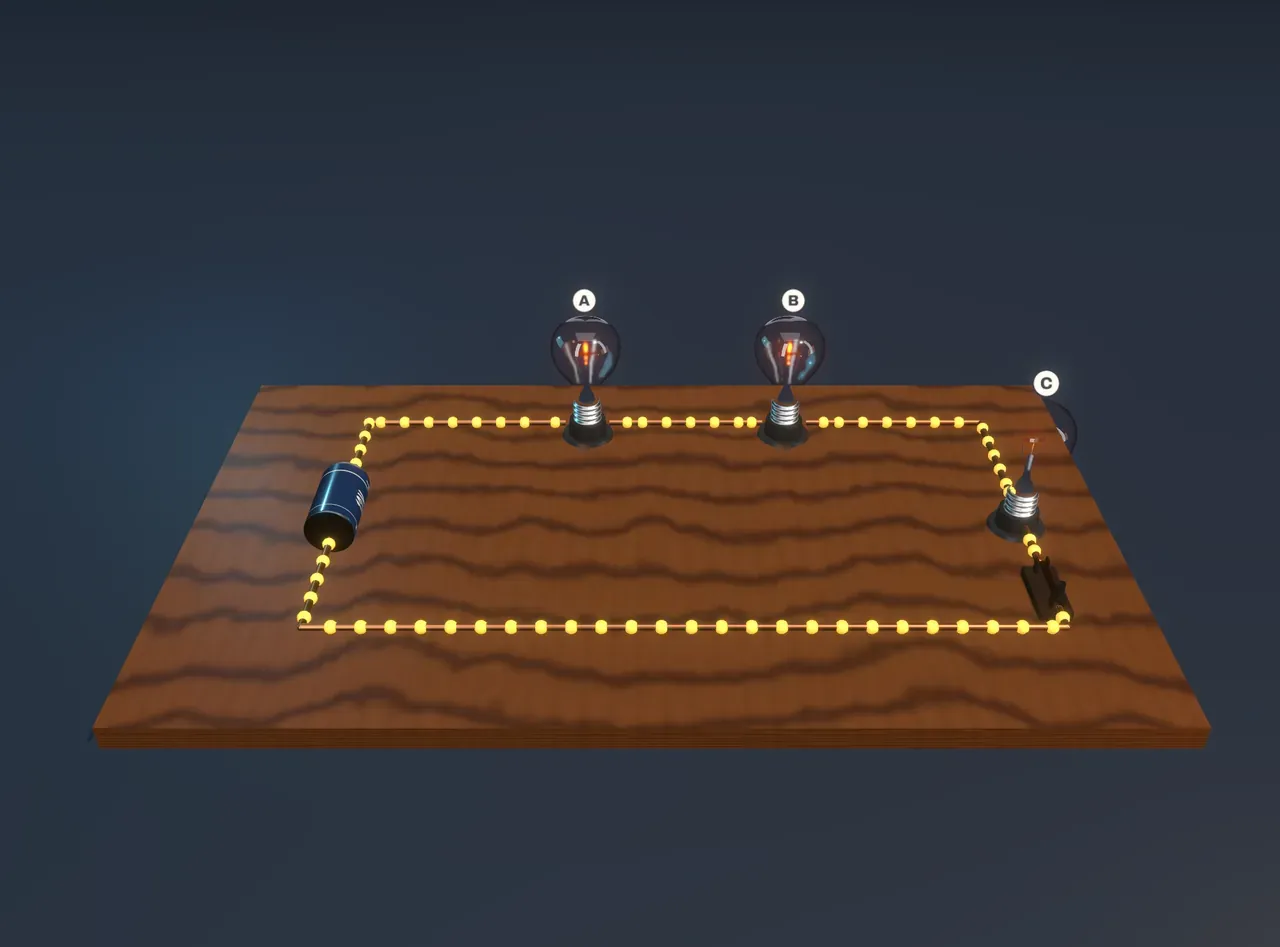
On the board are three bulbs, A, B and C, of 6 Ω each, and a 12 V battery. In a series circuit the current has only one path: it leaves the battery, passes through the bulbs one after another and comes back. Every electron has to squeeze through all three resistances, so the total resistance is their sum:
Ohm’s law, applied to the total resistance, gives the current from the battery. Measure the circuit is fixed at Circuit. Work out the current.
Step 2 of 6
The current is not used up
The current leaves the battery and passes through the bulbs one after another. Predict: does it weaken on the way? Once you answer, the Scene moves to Currents and shows a tag with the current over each branch.
Step 4 of 6
In parallel
In a parallel circuit each bulb is connected straight across the battery’s two terminals and has a path of its own. So each bulb has the full voltage, 12 V, across it, and the current in each branch is . At a junction where branches meet, the current flowing in equals the current flowing out, so the current from the battery is the sum of the branch currents.
Switch for bulb C is open now, and only A and B are lit: the battery gives 4 A. Predict what will happen to the current from the battery when you close the switch and add C.
Step 5 of 6
Resistance in parallel
Every extra branch is one more path for the current, so the total resistance of bulbs in parallel is smaller than the resistance of any one of them:
Bulb C is now 3 Ω, and A and B are 6 Ω. What total resistance does the battery see?
Step 6 of 6
Mixed
In Mixed, bulb A is in series with a pair: B and C, in parallel with each other. All the current passes through A, and after the junction it splits between B and C. So A shines brightest. The tags show the currents. Predict what will happen to bulb B when you open Switch for bulb C.
Loading the interactive version…
Loading the interactive version…
Each step sets up the Scene for you, and a control marked “fixed” stays put for that step.
Practice · Calculate
Three 6 Ω bulbs in series on a 12 V battery. What is the current from the battery? Give two decimal places.
Practice · Calculate
Three 6 Ω bulbs in series on a 12 V battery. What is the current from the battery? Give two decimal places.
Practice · Predict, then look
In series, the current passes through the bulbs one after another. What happens to it on the way?
Practice · Predict, then look
In series, the current passes through the bulbs one after another. What happens to it on the way?
Practice · Predict, then look
A and B are in parallel, and the battery gives 4 A. The switch is closed, adding C, of 6 Ω, in parallel too. What will happen to the current from the battery?
Practice · Predict, then look
A and B are in parallel, and the battery gives 4 A. The switch is closed, adding C, of 6 Ω, in parallel too. What will happen to the current from the battery?
Practice · Calculate
In parallel: A and B of 6 Ω, and C of 3 Ω. What total resistance does the battery see?
Practice · Calculate
In parallel: A and B of 6 Ω, and C of 3 Ω. What total resistance does the battery see?
Practice · Predict, then look
In the mixed circuit, A is in series with B and C, which are in parallel. The switch for C is opened. What will happen to bulb B?
Practice · Predict, then look
In the mixed circuit, A is in series with B and C, which are in parallel. The switch for C is opened. What will happen to bulb B?
Lesson complete. Every practice question here is done.