Two metal plates on a battery: equal and opposite charge on the plates, capacitance and what sets it, what an insulator between the plates changes, and the energy a capacitor stores.
Step 1 of 5 · Two plates and a battery
Step 1 of 5
Two plates and a battery
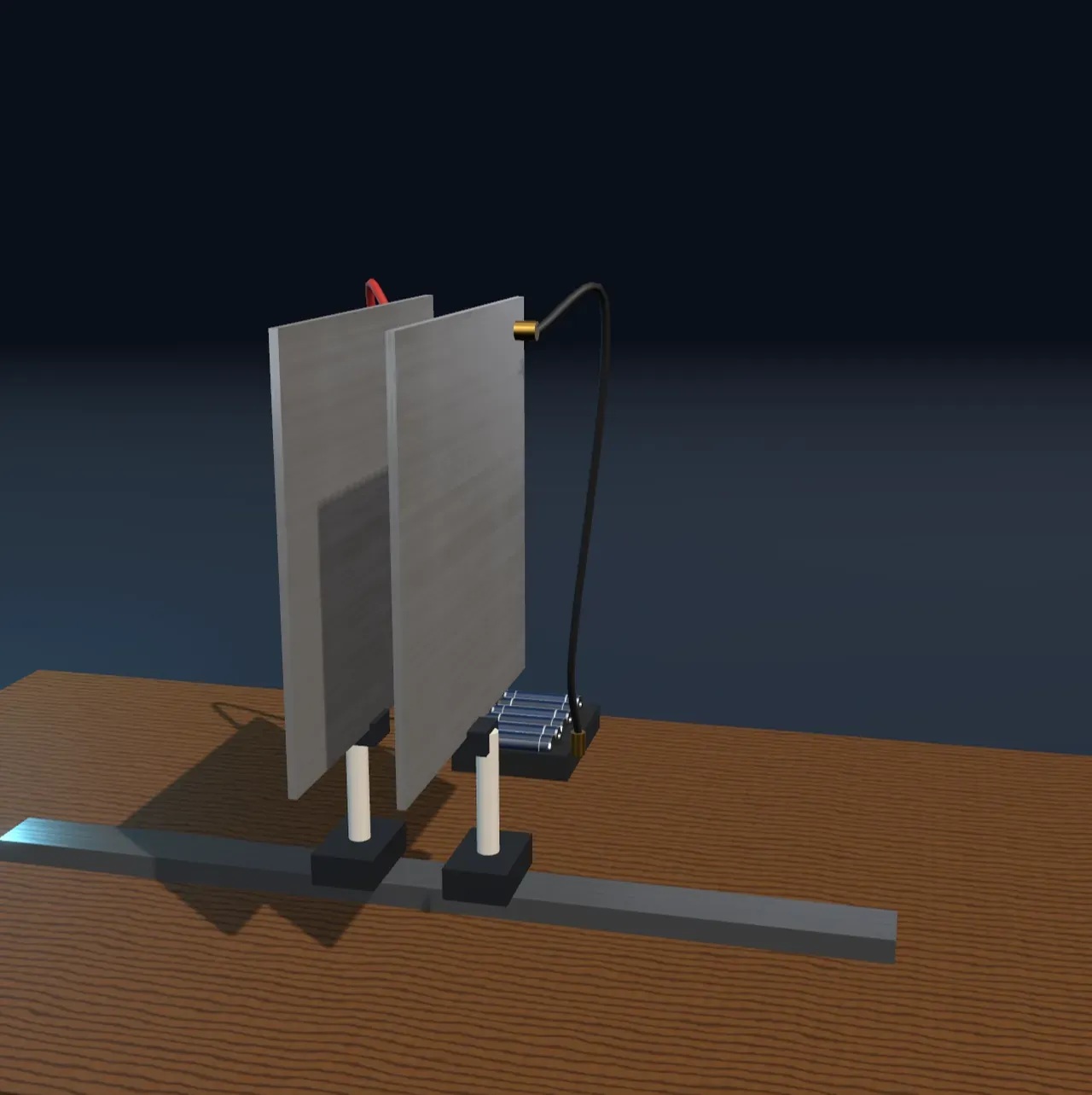
A capacitor is two conductors with an insulator between them. Here they are two square aluminium plates, with air between them, connected to a 9 V battery. No current passes across the gap itself. The moment it is connected, the battery pulls electrons off one plate and pushes as many electrons onto the other, until the voltage between the plates equals its own. Then the current stops.
Show charge and field has cut the plates open and shows the charge on the sides that face each other. Answer the question from what you see.
Step 2 of 5
Capacitance
How much charge the plates take for each volt is set by the capacitor’s capacitance:
is the charge on each plate. Capacitance is measured in farads, 1 F = 1 C/V, and a farad is a great deal, so small capacitors are measured in picofarads, . For a parallel-plate capacitor, the capacitance depends only on its shape and its material:
is the area of each plate in square metres, the gap in metres, and the dielectric constant of what lies between the plates: almost exactly for air. Bigger plates hold more charge, and plates farther apart hold less.
The readings beside the Scene are hidden now. Work out the capacitance.
Step 3 of 5
Storing a charge
The readings are back. Change Plate area and Gap between the plates until each plate carries a charge of 100 pC, and press Check. The battery is still 9 V, so .
Step 4 of 5
Between the plates
Now we put an insulating material between the plates, with the battery still connected. The material does not conduct, but the charges in its molecules shift a little in the field: it is polarised, like the scraps of paper under the balloon. Predict what will happen to the charge on the plates, then watch: the Scene will slide in Glass and bring the readings back.
Step 5 of 5
The energy in a capacitor
To move charge from plate to plate the battery does work, and that energy is stored in the field between the plates. At first the plates are empty, and the voltage between them rises in a straight line with the charge, from to . So the average voltage the charge is moved across is , and the energy stored is the area of the triangle under the graph of voltage against charge:
The capacitance of these plates, 400 cm² at 1.5 cm in air, is about 23.6 pF. How much energy do they store on a 9 V battery?
Loading the interactive version…
Loading the interactive version…
Each step sets up the Scene for you, and a control marked “fixed” stays put for that step.
Practice · Choose
The capacitor is connected to the battery, and each plate carries a charge of size . What is the total charge of the two plates together?
Practice · Choose
The capacitor is connected to the battery, and each plate carries a charge of size . What is the total charge of the two plates together?
Practice · Calculate
Two plates of 400 cm² each, 1.5 cm apart, with air between them (). What is the capacitance? Use .
Practice · Calculate
Two plates of 400 cm² each, 1.5 cm apart, with air between them (). What is the capacitance? Use .
Practice · Reach the target
The battery is 9 V. Change Plate area and Gap between the plates until each plate carries a charge of 100 pC, that is , and press Check.
Practice · Reach the target
The battery is 9 V. Change Plate area and Gap between the plates until each plate carries a charge of 100 pC, that is , and press Check.
Practice · Predict, then look
A glass slab () is slid between the plates, and the battery stays connected. What will happen to the charge on the plates?
Practice · Predict, then look
A glass slab () is slid between the plates, and the battery stays connected. What will happen to the charge on the plates?
Practice · Calculate
The capacitance is 23.6 pF and the battery 9 V. How much energy is stored in the capacitor?
Practice · Calculate
The capacitance is 23.6 pF and the battery 9 V. How much energy is stored in the capacitor?
Lesson complete. Every practice question here is done.