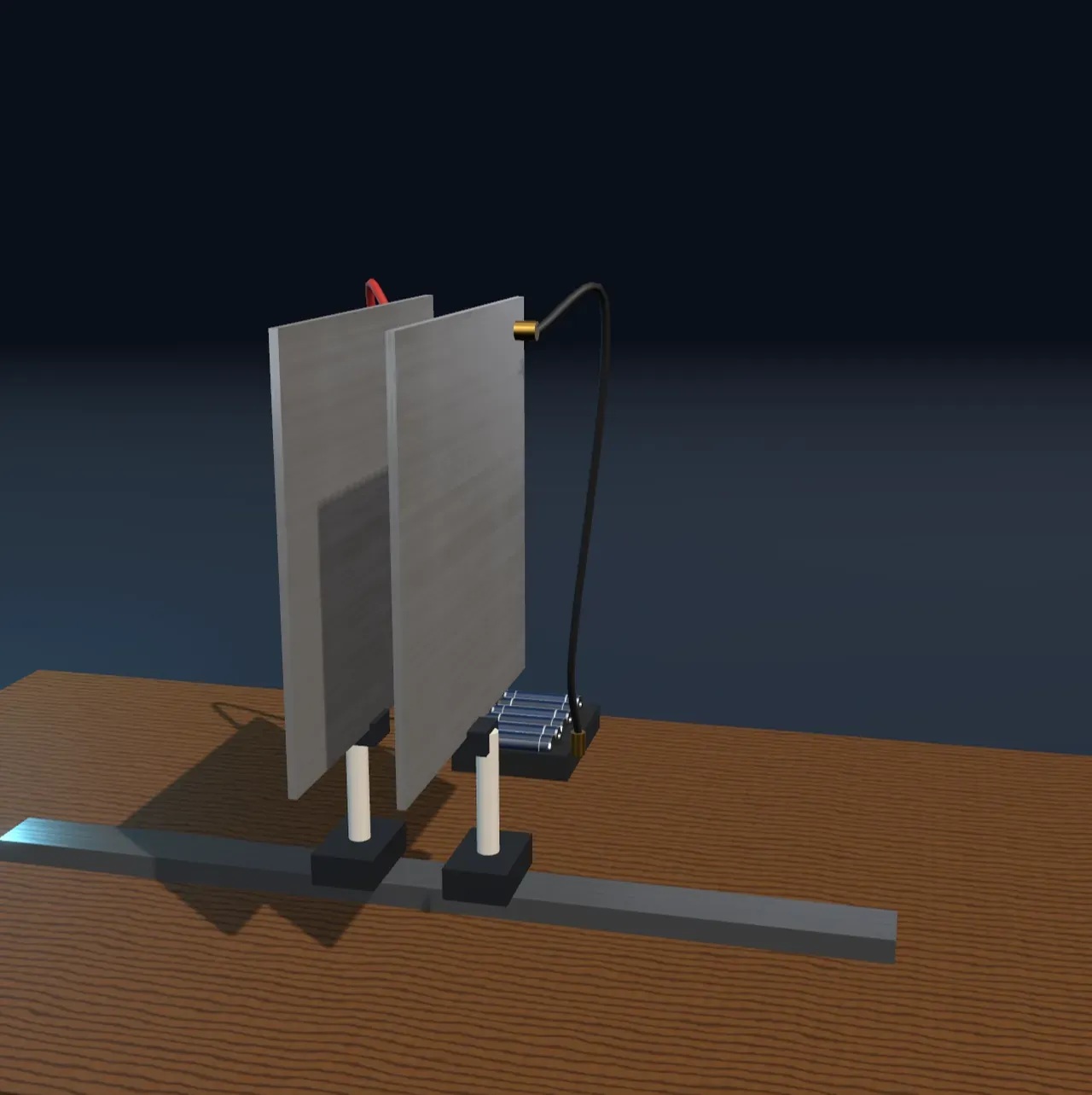
Two plates and a gap
A capacitor is about the simplest electrical part there is: two pieces of metal that face each other without touching. In the scene they are two square aluminium plates, 20 cm across and 1.5 cm apart, standing on plastic posts so that no charge can leak away through their supports.
Wire the plates to a battery and nothing seems to happen. No bulb lights and nothing moves. Yet the plates are now charged, and they hold energy that a flash gun or a defibrillator could release in a fraction of a second.
Where the charge comes from
A battery pushes electrons round a circuit. Here the circuit has a gap in it, so no steady current can flow. What happens instead is brief: the battery pulls electrons off one plate and pushes the same number onto the other. The first plate is left positive, the second becomes negative, and the two carry exactly equal and opposite charges.
The flow stops by itself. Every electron added to the negative plate is pushed back by the ones already there, and once the plates are charged to the battery’s own voltage, the battery can push no more. In the scene this takes a moment so you can watch electrons drift along the leads; plates like these really finish in billionths of a second.
Capacitance
How much charge the plates take from a given battery is their capacitance:
where is the charge on each plate and is the voltage between them. It is measured in farads: one farad holds one coulomb for every volt. That is enormous. The plates in the scene have a capacitance of about 24 picofarads (millionths of a millionth of a farad), so the 9 V battery puts about 210 picocoulombs on each, which is still more than a billion electrons.
Area and gap
Two things set a pair of plates’ capacitance. Bigger plates give the charge more room, so twice the area holds twice the charge. A narrower gap does the same: halve the distance and the charge doubles. For plates in air,
where is the area of each plate, the gap and a constant of nature, about 8.85 × 10⁻¹² farads per metre.
Why should the gap matter? The charges on each plate attract the opposite charges across the gap. The closer the plates, the harder each one pulls its partner’s charge towards it, so the battery can pile on more before the plates’ own push back matches its voltage.
Try it: open Show charge and field fully and move Gap between the plates from 2 cm to 1 cm. The marks on the facing sides crowd closer, and the charge in the readings beside the Scene doubles.
Something between the plates
Slide a sheet of plastic or glass into the gap and the capacitance rises again, without touching the plates. Such a material is called a dielectric. Its electrons cannot flow, but the charges in each molecule can shift a little: in the field between the plates, every molecule is stretched with its positive end towards the negative plate. Inside the slab these shifts cancel out. At its two faces they do not, and a thin layer of bound charge appears, negative against the positive plate and positive against the negative one.
That bound charge cancels part of the plates’ pull on each other, so the battery can push on more before it is matched. How much more is the material’s relative permittivity, (kappa), and the formula becomes . Air barely changes anything ( = 1.0006). Polythene has of about 2.3; clear laboratory glass about 4.7.
Try it: with Show charge and field open, choose Glass under Between the plates. The plates’ marks multiply by almost five, and the paler marks just inside the glass show its bound charge cancelling most of them.
The field between the plates
Between two charged plates the electric field points from the positive plate to the negative one, and it has the same strength everywhere in the gap except near the edges, where it bulges outwards. That is why the field lines in the scene run straight across and are evenly spaced. Its strength is the voltage divided by the gap:
so 9 V across 1.5 cm is a field of 600 volts per metre. Close the gap to 1 cm and the field rises to 900 V/m, which the scene shows as field lines drawn closer together.
With the battery still connected, a dielectric leaves the field unchanged. The plates’ extra charge exactly makes up for what the bound charge cancels, so the field between them stays at . If you disconnected the battery first and then slid in the glass, the charge would have nowhere to come from, and the field would drop instead.
Energy stored in the field
Charging a capacitor takes work, because each new electron has to be pushed onto a plate that already repels it. That work is stored, and it comes back out when the plates discharge. The energy stored is
The battery itself does twice that much work, , moving the charge. The other half is lost as heat in the leads while the charge flows, however thin or thick they are.
Where is the stored energy? Not in the metal, but in the field between the plates. Every cubic centimetre of the gap holds some, more where the field is stronger and more in a dielectric than in air.
Try it: slide Show charge and field all the way to Charge, field and energy, then choose Glass and slide Gap between the plates to 1 cm. The energy column fills almost to the top: about seven times the energy of the plates in air at the start.
Capacitors in circuits
The plates in the scene store only a few billionths of a joule. Real capacitors fit far more capacitance into a small space with the same three tricks: plates with a huge area, rolled up or stacked in hundreds of thin layers; a gap that may be a few millionths of a metre; and a dielectric whose runs into the thousands. A thumbnail-sized part can hold millions of times the charge of these plates.
Because they fill and empty so fast, capacitors are everywhere. A camera flash charges one slowly from a battery and dumps it into the lamp in a thousandth of a second. Power supplies use them to smooth out ripples in the voltage, and with a resistor they set the timing of a circuit, since a capacitor charging through a resistor fills in a predictable time, quickly at first and then more slowly. The touch screen on a phone senses your finger as a tiny change in capacitance, and every bit in a computer’s main memory is held as charge on a microscopic capacitor.
What this model leaves out
The scene works out the charge, the field and the energy from the formulas above, which assume the plates are so large next to the gap that the field round their edges does not matter. Real plates also hold charge in the field that bulges out round their edges and on their outer faces: for 20 cm plates 1.5 cm apart, about a fifth more than the formula gives, and with 10 cm plates 4 cm apart, over half as much again. The formula still shows the right trends, and the scene draws the bulge only roughly.
The battery is treated as perfect, holding exactly 9 V however fast the charge flows. The flow itself is slowed down so it can be seen: with these plates and leads, real charging is over in billionths of a second. The gap is drawn three times wider than it really is, so that the marks and field lines inside it have room; the meter and the physics use the real gap. The dielectric always fills the whole gap, and its bound charge is drawn as marks just inside its faces, though it is really a shift spread through every molecule of the slab.