Sunlight comes in, heat goes out, and a few gases in the air decide how much of it escapes. Work out how cold the Earth would be with no greenhouse gas, how much heat the extra carbon dioxide holds back, why each doubling adds the same, and how much warmer that makes us.
Step 1 of 6 · The balance
Step 1 of 6
The balance
The Earth is warmed by one thing, sunlight, and cooled by one thing, its own glow. Everything warm gives off invisible infrared light, and the ground and oceans shine it out to space day and night. When the energy going out matches the energy coming in, the temperature holds steady. A warm body radiates a power of from each square metre, by the Stefan–Boltzmann law: twice the temperature, sixteen times the radiation.
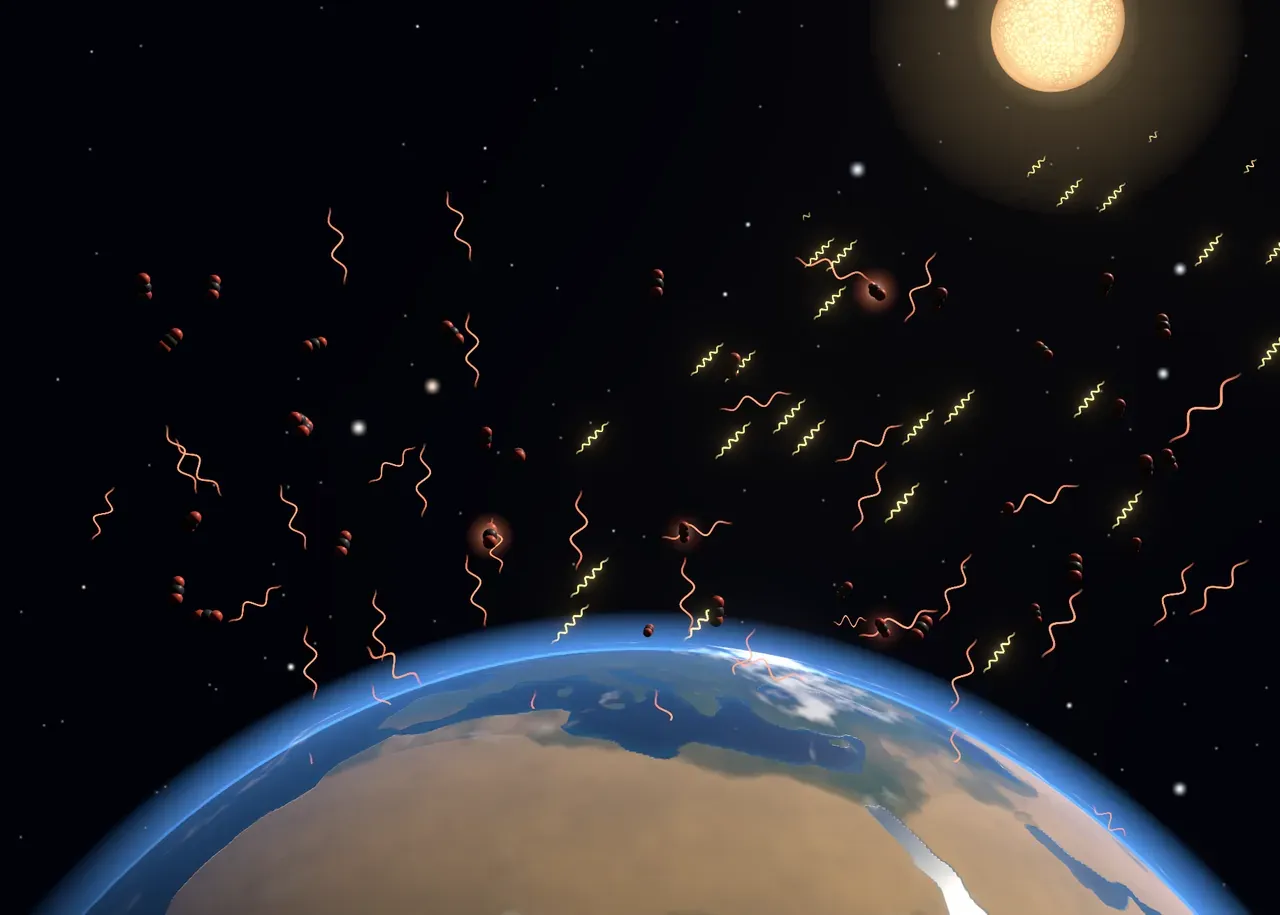
In the Scene, short yellow waves are sunlight, and long red waves are infrared. Greenhouse gas is at None, and Sunlight is locked at 100%.
Step 2 of 6
The trap
Most of the air, nitrogen and oxygen, is transparent to both sunlight and infrared. But a few gases, water vapour, carbon dioxide and methane, are transparent to sunlight and not to infrared. Greenhouse gas is now at Pre-industrial. Watch the red packets rising from the ground and the molecules flashing.
Step 3 of 6
Radiative forcing
Two centuries of burning coal, oil and gas have raised the carbon dioxide in the air from about 280 to about 420 parts per million, ppm: less than a twentieth of a per cent of the air, yet a rise of half. The extra gas holds back a little more of the escaping heat. That difference is measured in watts per square metre.
Step 4 of 6
Each doubling
The forcing depends on the amount of gas through a logarithm: . And since , each doubling of adds the same to the forcing. Greenhouse gas is at Doubled, 560 ppm.
Step 5 of 6
How much warmer
A forcing is an imbalance: more comes in than goes out. The Earth warms until it glows strongly enough to restore the balance. That takes decades, because the oceans store heat.
Step 6 of 6
Feedbacks
Warming sets off changes that in turn change it, feedbacks. Some amplify it, and some steady it. Greenhouse gas is at 840 ppm.
Loading the interactive version…
Loading the interactive version…
Each step sets up the Scene for you, and a control marked “fixed” stays put for that step.
Practice · Calculate
Greenhouse gas is at None, and Sunlight is locked at 100%. The Earth absorbs on average about 238 W/m² of sunlight. With no greenhouse gas, the ground has to radiate all of it straight to space: , with . What will its temperature be?
Practice · Calculate
Greenhouse gas is at None, and Sunlight is locked at 100%. The Earth absorbs on average about 238 W/m² of sunlight. With no greenhouse gas, the ground has to radiate all of it straight to space: , with . What will its temperature be?
Practice · Choose
Show the energy is On, and Greenhouse gas at Pre-industrial. Short yellow waves are sunlight, and long red waves are infrared given off by the warm ground. What do the carbon dioxide molecules do?
Practice · Choose
Show the energy is On, and Greenhouse gas at Pre-industrial. Short yellow waves are sunlight, and long red waves are infrared given off by the warm ground. What do the carbon dioxide molecules do?
Practice · Calculate
Greenhouse gas is locked at Today, 420 ppm, against 280 ppm before the industrial revolution. Radiative forcing is how many watts per square metre fewer escape to space because of the extra gas. For carbon dioxide . What is the forcing today?
Practice · Calculate
Greenhouse gas is locked at Today, 420 ppm, against 280 ppm before the industrial revolution. Radiative forcing is how many watts per square metre fewer escape to space because of the extra gas. For carbon dioxide . What is the forcing today?
Practice · Predict, then look
Greenhouse gas is at 560 ppm, double the amount before the industrial revolution: the forcing is about 3.7 W/m². Raise it to 1120 ppm, another doubling. What will the forcing be?
Practice · Predict, then look
Greenhouse gas is at 560 ppm, double the amount before the industrial revolution: the forcing is about 3.7 W/m². Raise it to 1120 ppm, another doubling. What will the forcing be?
Practice · Calculate
Greenhouse gas is locked at 560 ppm. Once the climate settles, each 1 W/m² of forcing warms the Earth by about 0.8 °C, feedbacks included. By how many degrees will the Earth warm in the end, for a doubling of carbon dioxide?
Practice · Calculate
Greenhouse gas is locked at 560 ppm. Once the climate settles, each 1 W/m² of forcing warms the Earth by about 0.8 °C, feedbacks included. By how many degrees will the Earth warm in the end, for a doubling of carbon dioxide?
Practice · Choose
Warming sets off changes that in turn change it. Which of them amplify the warming? Choose all that are right.
Practice · Choose
Warming sets off changes that in turn change it. Which of them amplify the warming? Choose all that are right.
Lesson complete. Every practice question here is done.