What a magnet does to the space round it: field lines and what they say, two poles that always come as a pair, magnets that attract and repel, what a magnet pulls, and the Earth as a magnet.
Step 1 of 5 · Field lines
Step 1 of 5
Field lines
In the last Unit you saw that an electric charge makes an electric field round it, and that the field pushes on another charge without touching it. A magnet has a field of its own, a magnetic field, and it acts on other magnets and on iron.
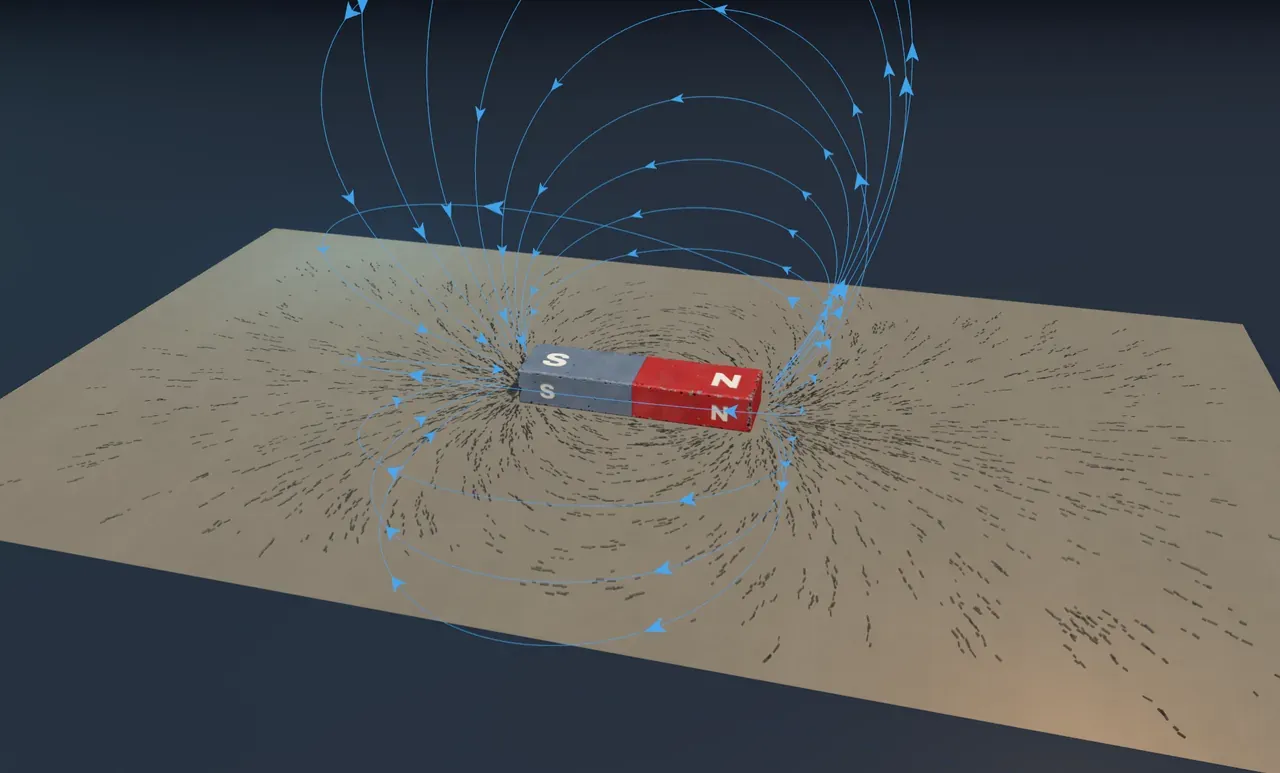
A bar magnet lies on the paper, with iron filings round it. Each grain of filing behaves like a tiny compass needle: it turns until it lies along the field where it is. The blue lines join those directions into field lines. Outside the magnet they leave the north pole (the red one) and enter the south pole, and the arrows show that direction. Where the lines crowd together, near the poles, the field is strong; where they spread out, it is weak.
Try it: drag Show the field back and forth, and watch the filings line up with the lines.
Step 2 of 5
Two poles
Every magnet has two poles, north and south. The field is strongest near the poles and weakest round the middle. But the poles are not two things stuck on the ends: the magnetism comes from all of the material.
Step 3 of 5
North facing north
The rule for two magnets: opposite poles attract, and like poles repel. Now there are two magnets on the paper, north facing south, and their lines join into one pattern running straight from one to the other.
Predict what will happen when the second magnet is turned round, then look at the gap between the poles.
Try it: after predicting, slide Distance apart from 7 up to 16 and back, and switch between N facing S and N facing N.
Step 4 of 5
What a magnet pulls
A magnet pulls a paper clip before they even touch, but it does not pull everything. In a few materials, such as iron, the atoms themselves are tiny magnets. The magnet’s field lines them up, and the whole piece becomes a magnet while the magnet is near, so it is pulled. In the next Lesson you will see that the very same lining up turns an iron bolt into the core of an electromagnet.
Step 5 of 5
The Earth as a magnet
A compass needle is a small magnet free to turn, and it lines up with the Earth’s magnetic field. The end that turns north is called the needle’s north pole. The Earth’s field looks roughly like the field of a giant bar magnet running through it.
Try it: choose One under Magnets, and imagine the magnet on the paper is the Earth. Which of its poles would a needle beside it turn towards?
Loading the interactive version…
Loading the interactive version…
Each step sets up the Scene for you, and a control marked “fixed” stays put for that step.
Practice · Choose
The paper shows the magnet’s field lines. What does a field line tell you at a point on it?
Practice · Choose
The paper shows the magnet’s field lines. What does a field line tell you at a point on it?
Practice · Choose
A bar magnet is cut in two, exactly in the middle. What do you get?
Practice · Choose
A bar magnet is cut in two, exactly in the middle. What do you get?
Practice · Predict, then look
Now the north pole of one magnet faces the south pole of the other, and the lines run straight from one to the other. The second magnet is turned round so that north faces north. What will the lines do in the gap between the poles?
Practice · Predict, then look
Now the north pole of one magnet faces the south pole of the other, and the lines run straight from one to the other. The second magnet is turned round so that north faces north. What will the lines do in the gap between the poles?
Practice · Choose
Which of these does a magnet pull? Choose every right answer.
Practice · Choose
Which of these does a magnet pull? Choose every right answer.
Practice · Choose
A compass needle’s north pole points roughly to the Earth’s geographic North Pole. What kind of magnetic pole is there?
Practice · Choose
A compass needle’s north pole points roughly to the Earth’s geographic North Pole. What kind of magnetic pole is there?
Lesson complete. Every practice question here is done.