What happens to kinetic energy in a collision: elastic, inelastic and perfectly inelastic collisions, how much energy is lost, finding the bounciness from the velocities, and where the energy goes.
Step 1 of 6 · Kinetic energy before the hit
Step 1 of 6
Kinetic energy before the hit
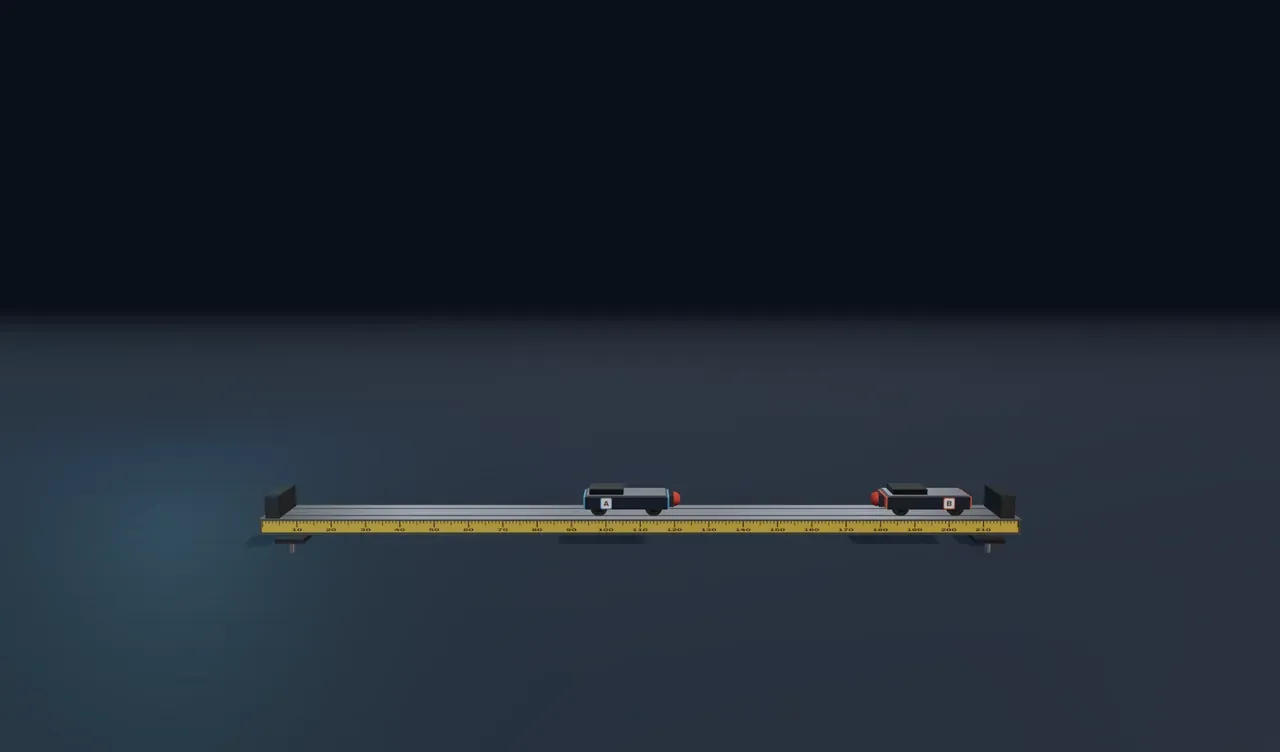
A moving cart also has kinetic energy, , measured in joules. Unlike momentum, it has no direction, and the speed in it is squared. Before the hit only cart A is moving, so all the system’s kinetic energy is A’s.
Step 2 of 6
When the carts stick
Momentum is conserved in every collision. Kinetic energy is not always: when the bumpers squash and do not fully spring back, part of it becomes heat and sound. A collision in which the kinetic energy is kept is called elastic, and any other is called inelastic. When the objects stick and move on together the collision is perfectly inelastic, and it loses the most kinetic energy possible without breaking the conservation of momentum.
Here the carts are equal and stick. Work out how much kinetic energy is left.
Step 3 of 6
Momentum always, energy not always
Show momentum and energy is On. Move Bounciness between , and , and compare the two halves of the board: the total momentum bar against its dashed line, and the kinetic energy bar against the Heat and sound bar.
Step 4 of 6
A heavy target
When equal carts stick, half the kinetic energy is lost. Now B is four times as heavy. Predict, then watch the board.
Step 5 of 6
How bouncy
Bounciness is hidden now. You can find it from the velocities before and after the collision, as you would in a laboratory: it is the speed of moving apart divided by the speed of closing in,
Mind the signs: right is positive.
Step 6 of 6
Where the energy goes
Energy is neither made nor destroyed. It only passes from one form to another. In every collision that is not elastic, the board shows where the missing kinetic energy went.
Loading the interactive version…
Loading the interactive version…
Each step sets up the Scene for you, and a control marked “fixed” stays put for that step.
Practice · Calculate
Cart A, 1 kg, rolls at 0.6 m/s. What is its kinetic energy before the collision?
Practice · Calculate
Cart A, 1 kg, rolls at 0.6 m/s. What is its kinetic energy before the collision?
Practice · Calculate
Equal carts, 1 kg each, stick and roll on together at 0.3 m/s. What is the kinetic energy of the two together after the hit?
Practice · Calculate
Equal carts, 1 kg each, stick and roll on together at 0.3 m/s. What is the kinetic energy of the two together after the hit?
Practice · Choose
In which collisions is the two carts’ total momentum conserved: when they stick, when half bouncy, or when perfectly bouncy?
Practice · Choose
In which collisions is the two carts’ total momentum conserved: when they stick, when half bouncy, or when perfectly bouncy?
Practice · Predict, then look
Now B is four times as heavy, and the carts stick. When the carts were equal, half the kinetic energy was lost. How much will be lost now?
Practice · Predict, then look
Now B is four times as heavy, and the carts stick. When the carts were equal, half the kinetic energy was lost. How much will be lost now?
Practice · Calculate
Cart A arrives at 0.6 m/s at B, which stands still. After the hit A comes back at 0.1 m/s, and B moves right at 0.35 m/s. What is the bounciness of the collision?
Practice · Calculate
Cart A arrives at 0.6 m/s at B, which stands still. After the hit A comes back at 0.1 m/s, and B moves right at 0.35 m/s. What is the bounciness of the collision?
Practice · Choose
When the equal carts stick, half the kinetic energy is missing after the hit. Where did it go?
Practice · Choose
When the equal carts stick, half the kinetic energy is missing after the hit. Where did it go?
Lesson complete. Every practice question here is done.