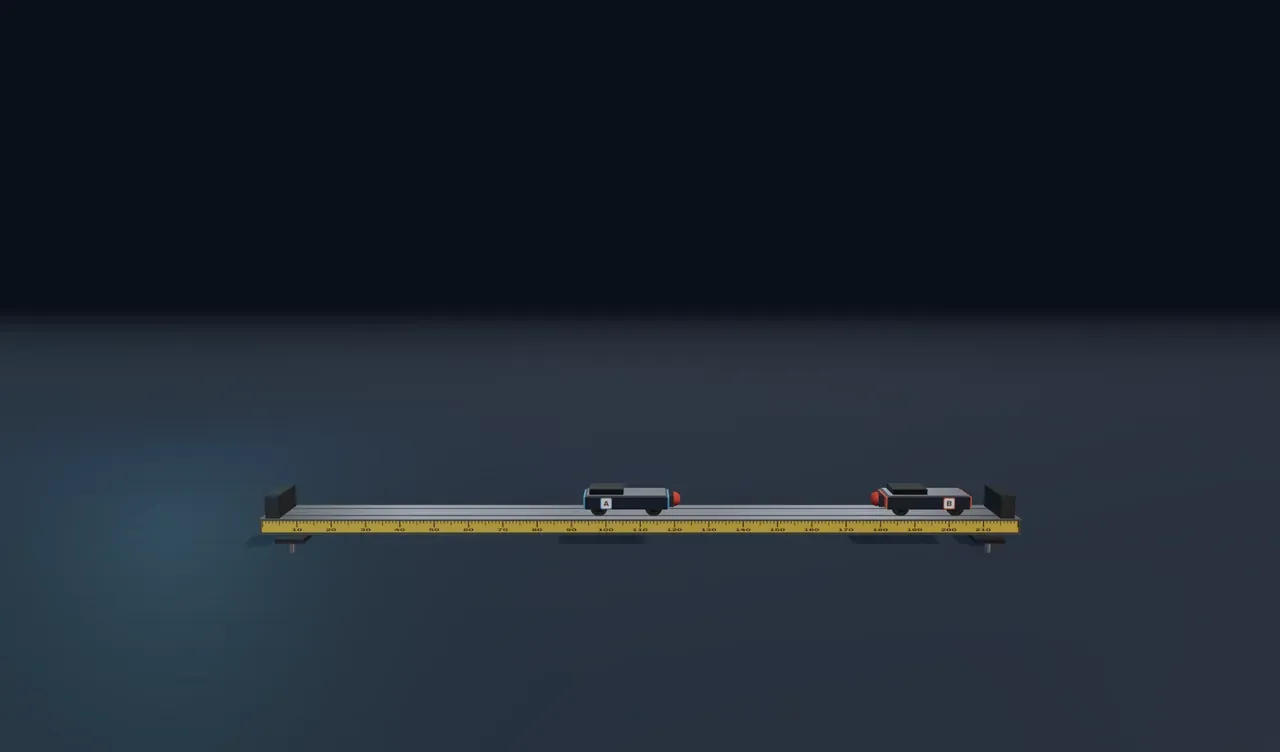
Two carts, one crash
Roll one cart into another that is standing still and three things can happen. The first cart can stop dead while the second rolls away. The two can lock together and roll on as one, more slowly. Or the first cart can bounce back the way it came while the second creeps forward.
Which one you get depends on only two things: how heavy the carts are compared with each other, and how bouncy the ends that meet are. Yet underneath all three outcomes one quantity comes out of the crash exactly as it went in.
Momentum is mass times velocity
That quantity is momentum: a moving object’s mass multiplied by its velocity, written p = mv and measured in kilogram metres per second (kg·m/s). Cart A, 1 kg at 0.6 metres per second, carries 0.6 kg·m/s. A 4 kg cart would need only 0.15 metres per second to carry the same.
Momentum has a direction. Moving right counts as positive and moving left as negative, so a cart bouncing backwards carries negative momentum. That sign is what lets the books balance when a cart rebounds.
Why the total cannot change
While the bumpers touch, cart A pushes on cart B and cart B pushes back on cart A. By Newton’s third law those two pushes are equal in size and opposite in direction, and they last for exactly the same moment, because they are the same contact. Whatever momentum B gains, A loses. Nothing else pushes along the track, so the total of the two is fixed.
This is the conservation of momentum: when nothing outside a group of objects pushes on it, their total momentum stays the same, however violently they interact. It holds for carts, for billiard balls, for a rifle and its bullet, and for a rocket and its exhaust.
Shared, handed over or bounced back
Slide Mass ratio B : A to see how the momentum is divided.
With equal carts, Mass ratio B : A at 1, and perfectly bouncy ends, Bounciness at 1, cart A stops dead and cart B leaves at 0.6 metres per second: all the momentum is handed over, as in a game of pool or a Newton’s cradle. Keep the ends perfectly bouncy and make B lighter: A cannot give all its momentum away, so it keeps rolling forward while B shoots off faster than A arrived. Slide Mass ratio B : A up to 4, four times A’s mass, and B moves off slowly, at 0.24 metres per second. That is 0.96 kg·m/s, more than A started with, so for the total to stay at 0.6 kg·m/s cart A must bounce back carrying −0.36 kg·m/s.
A bounce therefore pushes harder than a stick. A cart that bounces back has to have its forward momentum removed and then reversed, so it receives a bigger push from the other cart, and gives a bigger one in return.
Where the kinetic energy goes
Moving things also carry kinetic energy, ½mv². Cart A starts with 0.18 joules. Unlike momentum, kinetic energy is not kept in every crash.
Bounciness, which physicists call the coefficient of restitution, is the speed at which the carts move apart divided by the speed at which they came together. At 1 they separate as fast as they met, and all the kinetic energy comes back as motion. At 0 they do not separate at all. In between, the bumpers dent and spring back imperfectly, and some of the energy ends up as warmth in the bumpers and as the sound of the knock.
Two equal carts that stick together share the momentum, each rolling at 0.3 metres per second. That is still 0.6 kg·m/s in total, but only 0.09 joules of kinetic energy: half of it has gone. The energy has not vanished. It has spread out into the jostling of the bumpers’ molecules and into a sound wave, where it can no longer push the carts.
Try it: choose On under Show momentum and energy, then slide Bounciness from 0, where the carts stick together, through 0.5 to 1, perfectly bouncy. The total momentum bar stays on its dashed line every time, while the kinetic energy bar gives way to heat and sound in every crash except the perfectly bouncy one.
What this model leaves out
Real carts lose a little speed to friction in their wheels and to the air, so their total momentum drifts slowly down between collisions, and a long track can make that drift visible. The model also treats the collision as instantaneous. A real one lasts a few thousandths of a second while the bumpers squash, and how long it lasts decides how hard the push is: the same change of momentum spread over a longer time needs a smaller force. That is why cars have crumple zones and why catching a ball means letting your hands give, a story the momentum bars alone cannot show.
No real bumper is perfectly bouncy, although spring and magnet bumpers come close. The flash of heat and sound in the Scene is sized to the energy lost, but it is a symbol: the warming is far too small to feel and the sound is a brief click.