How a force changes momentum: impulse, force times time, the equal and opposite pushes of two colliding carts, why a bounce pushes harder than a stick, and why an airbag protects.
Step 1 of 7 · Force times time
Step 1 of 7
Force times time
To change an object’s momentum takes a force. By Newton’s second law, , and the acceleration is the change in velocity each second, . Substitute and multiply by :
The force times the time it acts for is called the impulse, , and it equals the change of momentum. Its unit is the newton second, N·s, exactly the same unit as kg·m/s. A small force acting for a long time can change the momentum as much as a large force acting for a moment.
Step 2 of 7
What B received
In a collision, all the change in a cart’s momentum happens in the short time the bumpers touch. Cart B starts at rest, so all the momentum it leaves with is the impulse A gave it.
Step 3 of 7
Equal and opposite pushes
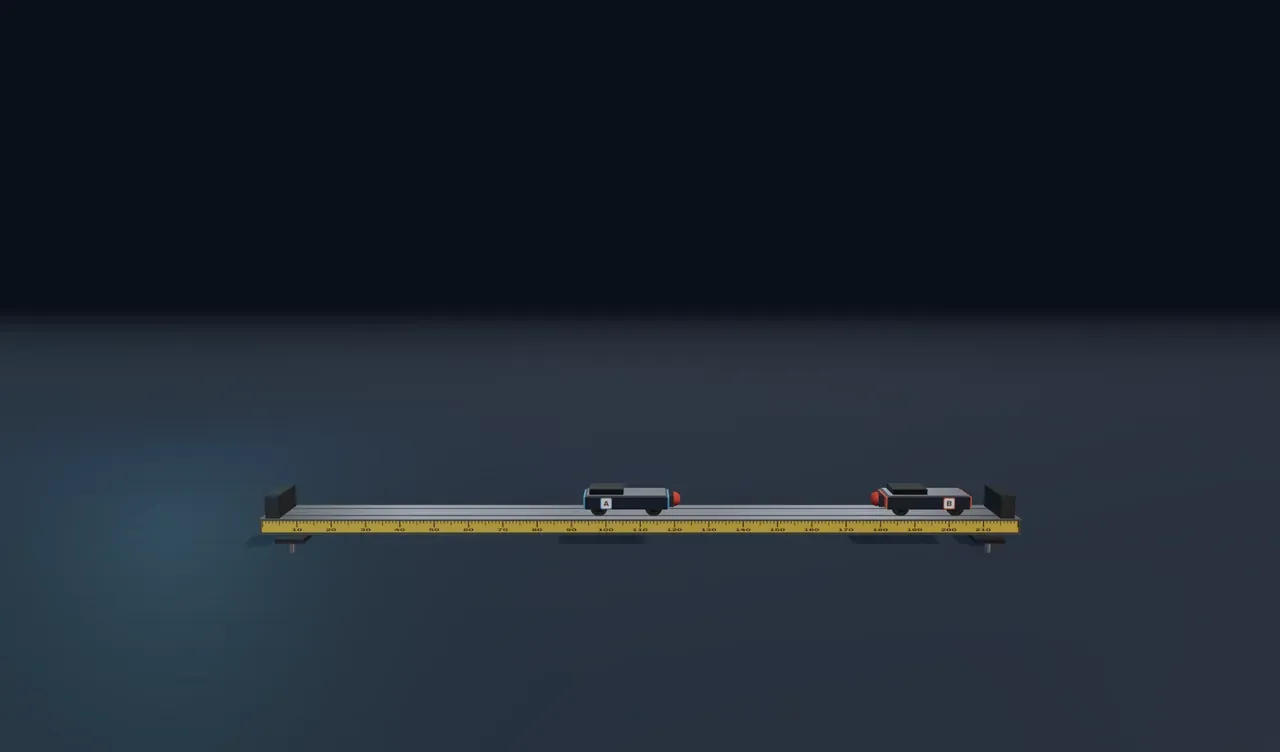
While the bumpers touch, A pushes on B and B pushes on A. Change Mass ratio B : A and watch on the board how A’s bar shrinks by exactly as much as B’s grows, at the moment of the hit.
Step 4 of 7
The impulse on A
Now B is twice as heavy, and the collision is perfectly bouncy, so A comes back. To work out the impulse on A, subtract its starting momentum from its final momentum, with the signs: right is positive.
Step 5 of 7
Bounce or stick
Equal carts stick together. In a stick the bumpers only stop the carts closing in, and the two roll on together. Predict what happens to the impulse on B when the ends are perfectly bouncy, then watch.
Step 6 of 7
How hard
The model in the Scene treats the collision as instantaneous, but real bumpers squash for a few thousandths of a second. If you know how long the contact lasts, you can work out the average force from the impulse: .
Step 7 of 7
A soft landing
The same change of momentum, spread over a longer time, takes a smaller force. That is the whole idea behind crumple zones in cars, a mat under a high jump and knees that bend on landing.
Loading the interactive version…
Loading the interactive version…
Each step sets up the Scene for you, and a control marked “fixed” stays put for that step.
Practice · Calculate
A steady force of 3 N pushes a cart for 0.2 s. By how much does its momentum change?
Practice · Calculate
A steady force of 3 N pushes a cart for 0.2 s. By how much does its momentum change?
Practice · Calculate
Cart B is twice as heavy as cart A: 2 kg. The carts stick, and after the hit they roll on together at 0.2 m/s. What impulse did cart A give cart B?
Practice · Calculate
Cart B is twice as heavy as cart A: 2 kg. The carts stick, and after the hit they roll on together at 0.2 m/s. What impulse did cart A give cart B?
Practice · Choose
Cart B is four times as heavy as cart A. While the bumpers touch, which cart pushes harder on the other?
Practice · Choose
Cart B is four times as heavy as cart A. While the bumpers touch, which cart pushes harder on the other?
Practice · Calculate
Cart B is twice as heavy, and the collision is perfectly bouncy. Cart A, 1 kg, arrives at 0.6 m/s and comes back at 0.2 m/s. Right is positive. What impulse did cart B give cart A?
Practice · Calculate
Cart B is twice as heavy, and the collision is perfectly bouncy. Cart A, 1 kg, arrives at 0.6 m/s and comes back at 0.2 m/s. Right is positive. What impulse did cart B give cart A?
Practice · Predict, then look
Equal carts. When they stick, A gives B an impulse of 0.3 N·s. What happens to the impulse when the collision is perfectly bouncy?
Practice · Predict, then look
Equal carts. When they stick, A gives B an impulse of 0.3 N·s. What happens to the impulse when the collision is perfectly bouncy?
Practice · Calculate
In the sticky collision of the equal carts, A gives B an impulse of 0.3 N·s. Suppose the bumpers touch for 0.05 s. What average force does A exert on B?
Practice · Calculate
In the sticky collision of the equal carts, A gives B an impulse of 0.3 N·s. Suppose the bumpers touch for 0.05 s. What average force does A exert on B?
Practice · Choose
In a crash, an airbag stops the passenger. Why does it protect them?
Practice · Choose
In a crash, an airbag stops the passenger. Why does it protect them?
Lesson complete. Every practice question here is done.