Until now every shot flew without air. Add air resistance and the parabola breaks, the ball lands closer, and the best angle drops.
Step 1 of 3 · Adding air
Step 1 of 3
Adding air
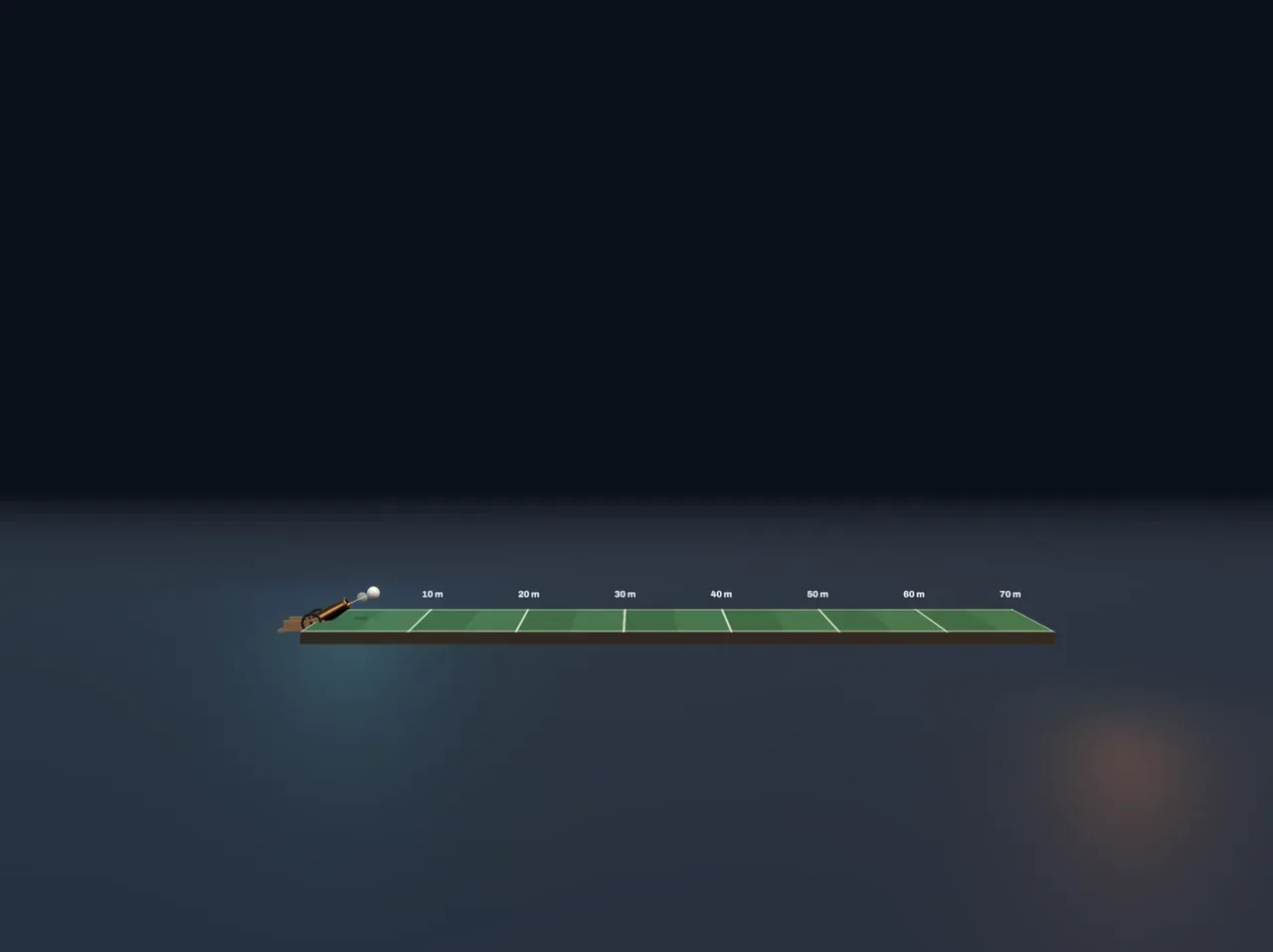
The ball is launched at 25 m/s at , with no air. In a moment it will be swapped for a tennis ball flying through real air, and the Scene will keep the vacuum path as a dashed curve to compare against.
Predict where the tennis ball will land.
Step 2 of 3
Why it lands closer
Now there is air, and Split the velocity is On. The air pushes on the ball with a drag force that points against its velocity and grows with the square of its speed.
Try it: change Air resistance between No air and Tennis ball and follow the blue arrow.
Step 3 of 3
The best angle with air
Air resistance is now set to Shuttlecock. Change the Launch angle and find which angle goes farthest.
Loading the interactive version…
Loading the interactive version…
Each step sets up the Scene for you, and a control marked “fixed” stays put for that step.
Practice · Predict, then look
Now you launch a tennis ball, through real air. Compared with the dashed curve of the no-air flight, where will it land?
Practice · Predict, then look
Now you launch a tennis ball, through real air. Compared with the dashed curve of the no-air flight, where will it land?
Practice · Choose
Why does the ball land closer when there is air?
Practice · Choose
Why does the ball land closer when there is air?
Practice · Choose
With a lot of air resistance (a shuttlecock), which angle goes farthest?
Practice · Choose
With a lot of air resistance (a shuttlecock), which angle goes farthest?
Lesson complete. Every practice question here is done.