Every throw draws the same kind of curve
Throw a ball, kick a football or watch water arc from a hose, and the path has a familiar shape: rising steeply, rounding over at the top, falling steeply again. Without air in the way, that shape is a parabola, as Galileo showed in 1638. Anything moving freely under gravity alone, a projectile, follows one.
Two motions at once
The secret is that a projectile is really doing two simple things at the same time, and neither affects the other.
Across the ground, nothing pushes or pulls on the ball once it has left the cannon, so its sideways speed stays exactly the same from launch to landing. Up and down, gravity pulls constantly, taking 9.81 metres per second of upward speed away every second. The ball rises more and more slowly, stops rising at the top, then falls faster and faster.
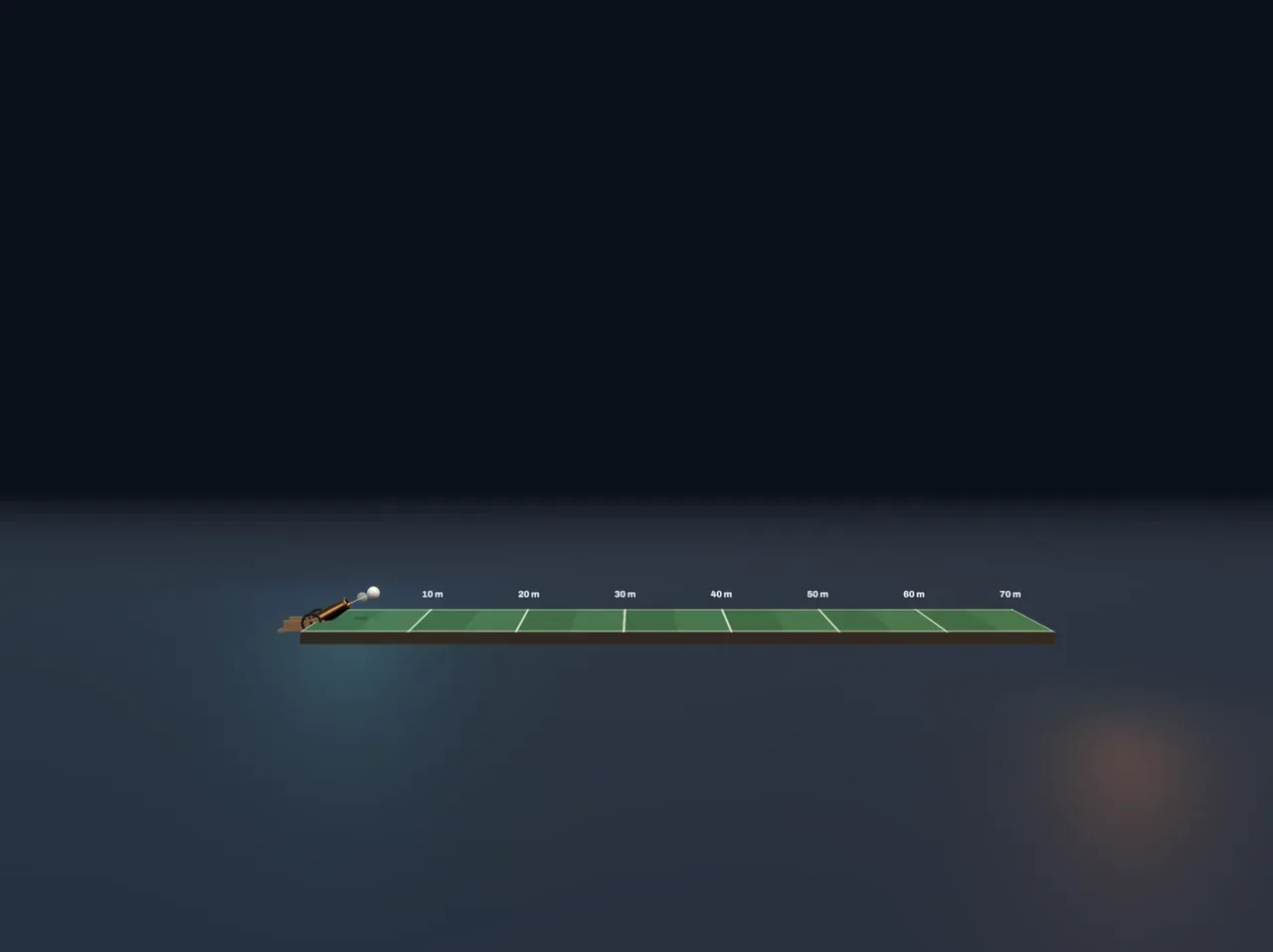
The ghosts show both. They sit at equal times, a quarter of a second apart, and they are evenly spaced across the field but bunched together near the top of the arc, where the ball is barely rising or falling.
Try it: choose On under Split the velocity. The blue arrows, the sideways speed, are all the same length. The orange arrows, the up-and-down speed, shrink to nothing at the top, flip, and grow on the way down.
A famous consequence: a ball dropped from a table and a ball flicked off it sideways hit the floor at the same moment. Sideways speed does nothing to how fast either falls.
Why 45° goes farthest
How far the ball goes depends on two things: how long it stays up, and how fast it travels across while it is up. Aiming high gives a long flight but leaves little speed for going across. Aiming low gives plenty of speed across but a short flight. Without air, the best trade is exactly halfway, at 45°, and the range is the launch speed squared, times the sine of twice the angle, divided by gravity.
That formula has a neat consequence: angles that add up to 90° land in the same place. Set Launch angle to 30° and then to 60° and the ball lands about 35 m away both times, the steep shot just takes longer. Speed matters even more than angle: double the launch speed and the range grows four times.
Air changes the answer
Real balls push through air, and air pushes back, harder the faster the ball goes. Choose Tennis ball and the path stops being a parabola: it climbs less, slows across the field, and comes down steeply, well short of the dashed no-air curve. The best angle drops too, to about 40° for a tennis ball thrown at 25 m/s, and to nearer 30° for a feathery Shuttlecock, because a long, high flight gives the air more time to take speed away.
Air resistance is one reason sports throws are often launched below 45°. Throwers also release the ball above the ground, and arms and legs can usually throw faster at flatter angles, both of which favour a lower launch.
What this model leaves out
The model assumes level ground, a launch from field height, still air and a ball that does not spin. A spinning ball curves and can rise or dip, which is how a footballer bends a free kick, and a drag coefficient that changes with speed is simplified to a single number. Over very long distances the curvature and rotation of the Earth would matter too. The ball and cannon are shown far larger than their true size on this field, so that you can see them.