A ball launched at an angle moves across and up at the same time. What happens to each part of its velocity, and what is its velocity at the top?
Step 1 of 4 · Watching the flight
Step 1 of 4
Watching the flight
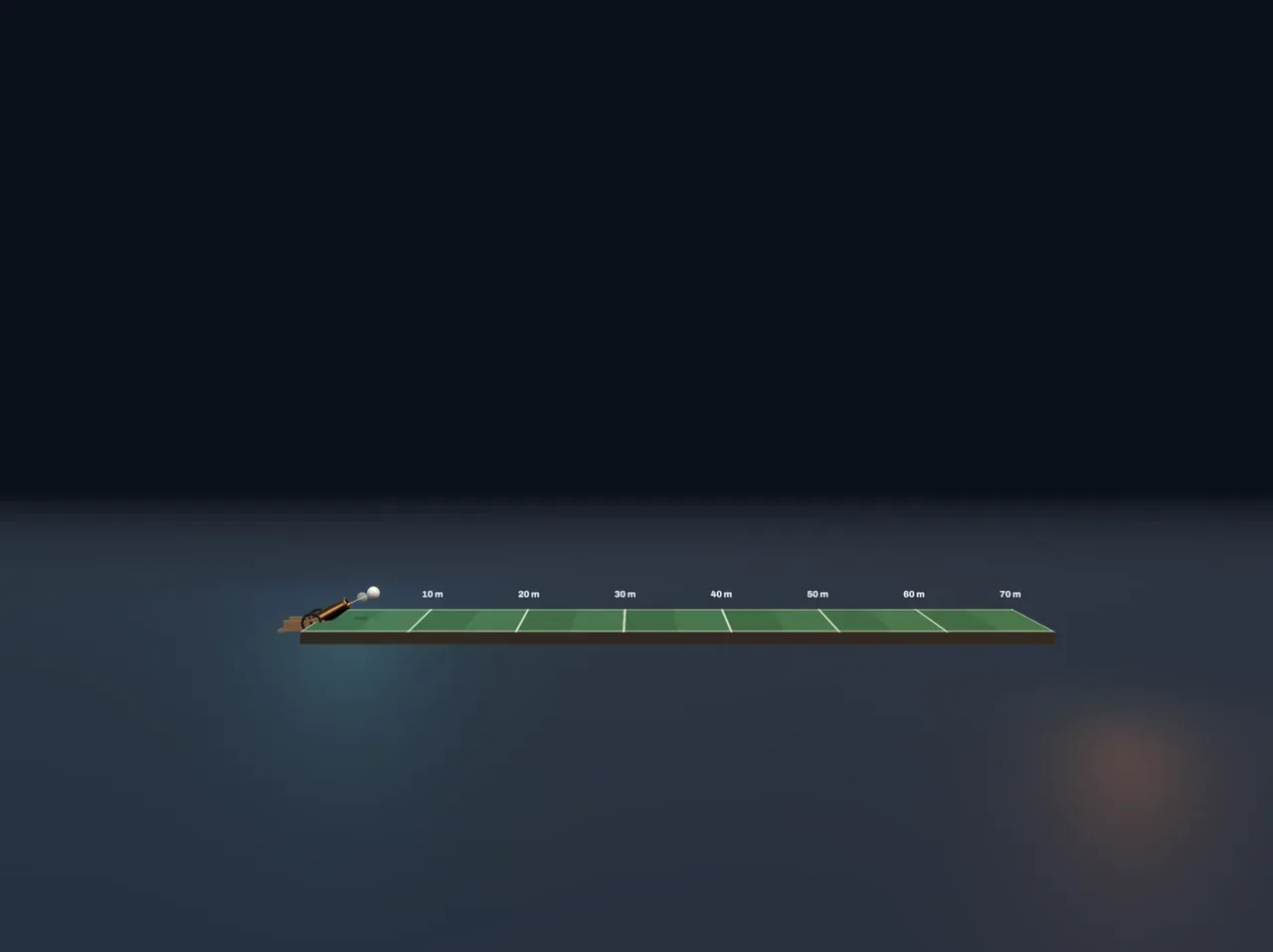
The cannon fires a ball at , with no air. The ball leaves a ghost every quarter of a second, so you can compare what happened over equal stretches of time.
Look at the sideways gaps between the ghosts, along the field. Then answer the question.
Step 2 of 4
Splitting the velocity in two
Split the velocity is now On: each ghost has two arrows.
- The blue arrow is the horizontal part, . There is no horizontal force, so it keeps the same length for the whole flight.
- The orange arrow is the vertical part, . It shortens on the way up, vanishes for a moment, flips on the way down, and changes by 9.81 m/s every second.
The two motions do not get in each other’s way: across, it is motion at a constant speed; up and down, it is motion with constant acceleration, just like the cart in the last lesson.
Try it: change the Launch angle. A low angle gives a long blue arrow and a short orange one; a high angle does the opposite.
Step 3 of 4
What happens at the top
The angle is now , and Split the velocity is hidden until you have made your prediction. Think about the two parts separately: what is left of each one at the highest point?
Step 4 of 4
And what about mass?
The Scene has no mass control. Nothing is missing: without air, the ball’s path does not depend on its mass at all.
Loading the interactive version…
Loading the interactive version…
Each step sets up the Scene for you, and a control marked “fixed” stays put for that step.
Practice · Choose
The ball flies with no air resistance. What happens to the horizontal part of its velocity during the flight?
Practice · Choose
The ball flies with no air resistance. What happens to the horizontal part of its velocity during the flight?
Practice · Predict, then look
What are the ball’s velocity and acceleration at the highest point of its path?
Practice · Predict, then look
What are the ball’s velocity and acceleration at the highest point of its path?
Practice · Choose
You launch a ball twice as heavy at the same speed and angle, with no air. Where will it land?
Practice · Choose
You launch a ball twice as heavy at the same speed and angle, with no air. Where will it land?
Lesson complete. Every practice question here is done.