Hit the flag, find the angle that goes farthest, and work out the range from the speed and the angle.
Step 1 of 4 · Hit the flag
Step 1 of 4
Hit the flag
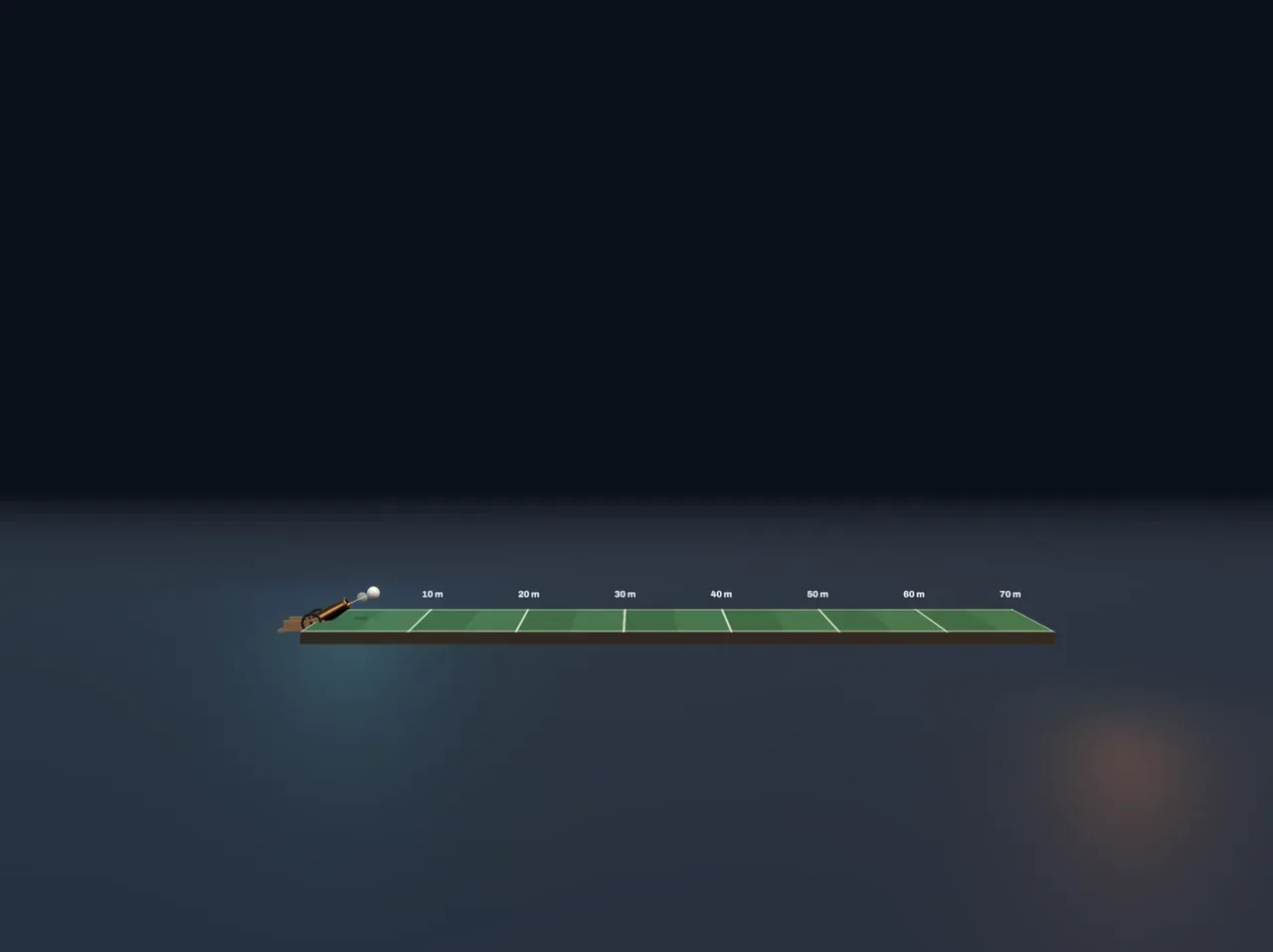
There is a flag planted in the field. Your goal: launch the ball so that it lands on it. You have two controls, Launch angle and Launch speed, and the Scene marks where the ball landed.
Step 2 of 4
Which angle goes farthest
At a fixed speed, every angle shares that speed out differently between moving across and moving up. A low angle travels across quickly but lands soon; a high angle stays in the air a long time but makes slow progress.
Predict which angle wins, then watch.
Step 3 of 4
The range formula
The flight time is set by the vertical part: the ball goes up and comes back down in . During that time it moves across at a constant speed , so:
is largest at . Angles that add up to , such as and , give the same range.
The angle and the speed are now fixed. Work out the range yourself.
Step 4 of 4
Double the speed
In the formula, the range depends on . Before you try it in the Scene, answer: what happens to the range when you double the speed?
Loading the interactive version…
Loading the interactive version…
Each step sets up the Scene for you, and a control marked “fixed” stays put for that step.
Practice · Reach the target
The flag stands 40 m from the launch line. Change the Launch angle and the Launch speed until the ball lands on the flag, then press Check.
Practice · Reach the target
The flag stands 40 m from the launch line. Change the Launch angle and the Launch speed until the ball lands on the flag, then press Check.
Practice · Predict, then look
At the same launch speed and with no air, which angle sends the ball farthest?
Practice · Predict, then look
At the same launch speed and with no air, which angle sends the ball farthest?
Practice · Calculate
The ball is launched at 20 m/s at above the horizontal, with no air, and lands at the height it was launched from. What is its range? Use .
Practice · Calculate
The ball is launched at 20 m/s at above the horizontal, with no air, and lands at the height it was launched from. What is its range? Use .
Practice · Choose
You double the launch speed and keep the angle. How many times farther does the ball go (with no air)?
Practice · Choose
You double the launch speed and keep the angle. How many times farther does the ball go (with no air)?
Lesson complete. Every practice question here is done.