The cannon moves up onto a tower. How long is the ball in the air now, and is 45 degrees still the best angle?
Step 1 of 2 · How long in the air
Step 1 of 2
How long in the air
The cannon now stands on a tower 20 m high. The ball still goes up and comes down as before, but at the end it keeps falling all the way to the field, another 20 m below.
The formula no longer fits: it only holds when the ball lands at the height it was launched from. Write the vertical position as a function of time and find when it reaches the field:
Step 2 of 2
Is 45 degrees still the best
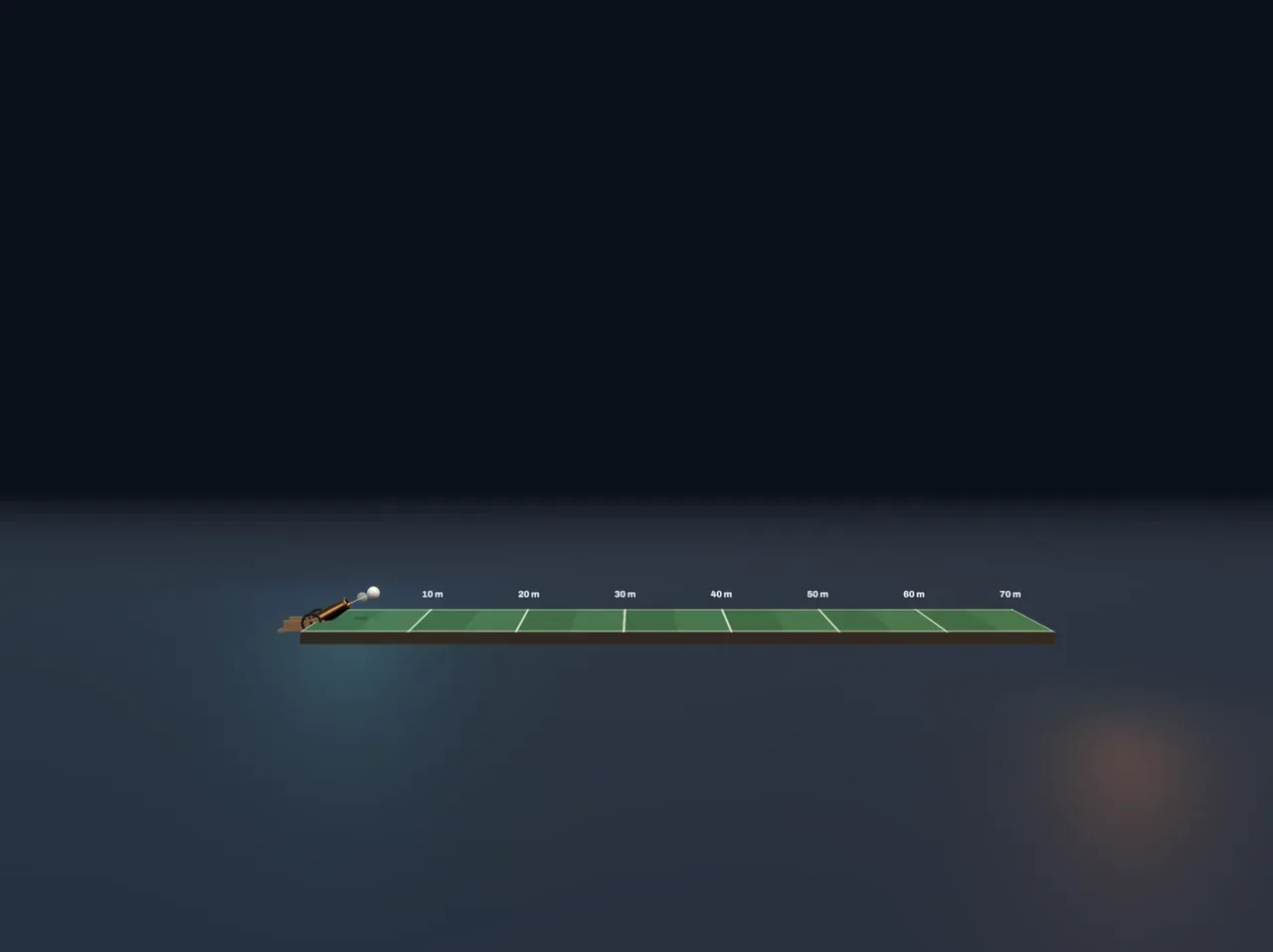
The speed is now 15 m/s and the cannon is still on the tower. Launch angle and Launch speed are free to change: try a few angles and compare the distances the Scene marks.
Loading the interactive version…
Loading the interactive version…
Each step sets up the Scene for you, and a control marked “fixed” stays put for that step.
Practice · Calculate
The cannon stands on a 20 m tower and fires at 10 m/s at above the horizontal, with no air. How long is the ball in the air before it hits the field? Use .
Practice · Calculate
The cannon stands on a 20 m tower and fires at 10 m/s at above the horizontal, with no air. How long is the ball in the air before it hits the field? Use .
Practice · Choose
The cannon is on the 20 m tower and fires at 15 m/s. Is still the angle that goes farthest?
Practice · Choose
The cannon is on the 20 m tower and fires at 15 m/s. Is still the angle that goes farthest?
Lesson complete. Every practice question here is done.