A push that fills the space
Rub a balloon on your hair and it can lift the hair from a few centimetres away, with nothing in between. A charged object pushes or pulls on every other charge around it, and the push depends only on where that other charge is. So you can describe it before anything is put there. At every point, imagine a tiny positive test charge, too small to disturb anything, and ask which way it would be pushed and how hard. That push for each coulomb of charge is the electric field, , measured in newtons per coulomb, which is the same as volts per metre.
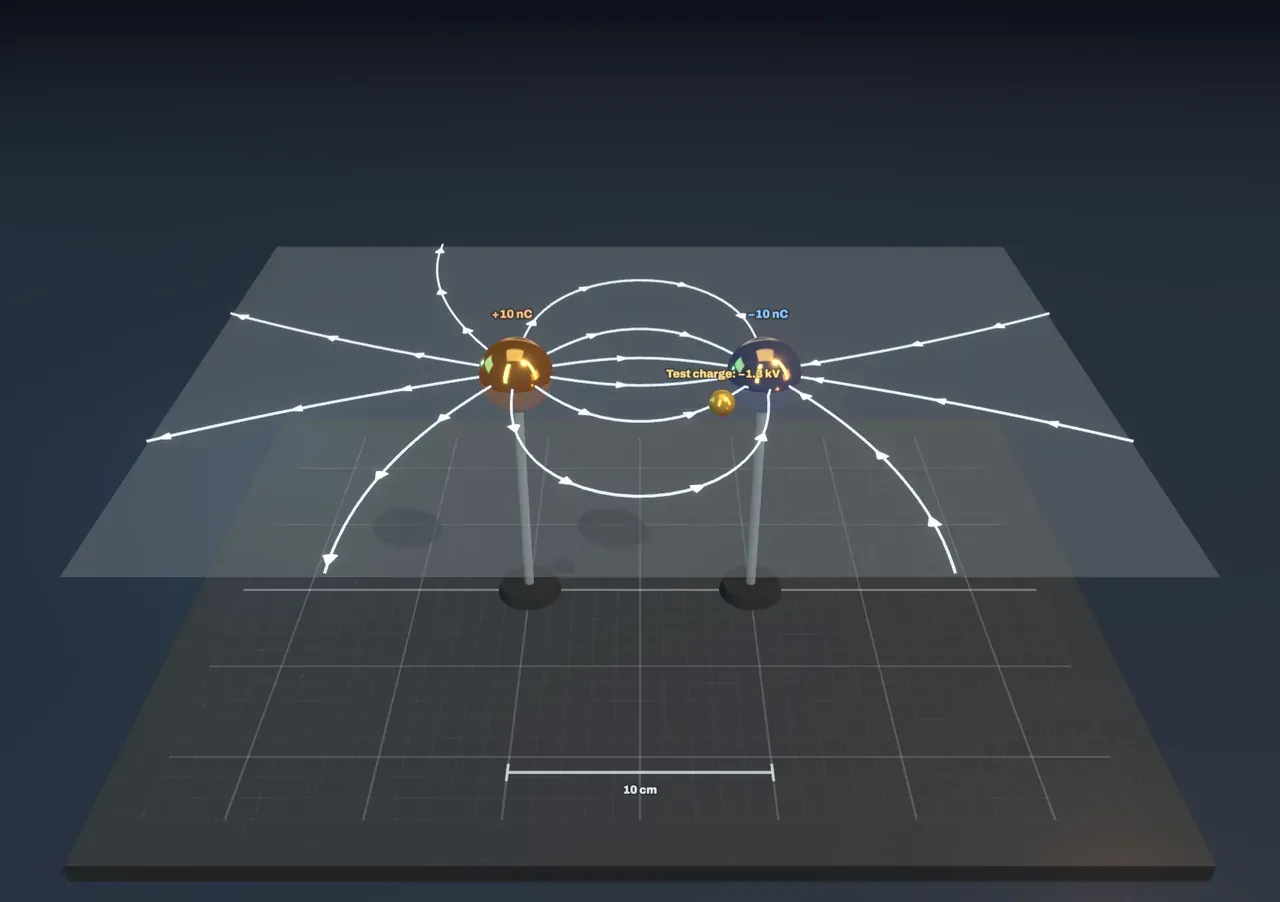
The scene shows two small brass spheres. The left one holds 10 nanocoulombs of positive charge (a nanocoulomb is a billionth of a coulomb, the charge of about six billion electrons). The right one holds the same amount of negative charge. The white lines are field lines. At every point a line runs along the push a positive charge would feel there, and its arrowheads point the way of that push. Where the lines crowd together, the field is strong; where they spread out, it is weak. Nobody can see field lines: they are a drawing of a field that fills all the space round the spheres. The scene draws only the lines that lie in one flat slice through both centres.
The gold bead is a positive test charge. It is let go just beside the positive sphere, and it drifts along the line it starts on, away from the positive sphere and towards the negative one.
Try it: slide Right charge to 0 nC. With only one charged sphere, the lines run straight out from it in every direction, like spokes. Slide it back to −10 nC and they bend round to end on the right sphere.
Opposite and like charges
Every field line starts on a positive charge and ends on a negative one, or runs off into the distance. Between opposite charges, most lines leave the positive sphere and arc across to the negative one, crowded together in the gap. That is where the push is strongest: halfway between the spheres at the start, the field is about 72,000 volts per metre.
Make the charges the same sign and the picture changes completely. Lines from the two spheres never meet; they swerve away from each other and head off to the edges. Halfway between two equal charges the two pushes are equal and opposite, so the field there is exactly zero. A test charge put down at that point would stay put, though the slightest nudge sideways would send it off.
The field from each sphere weakens with the square of the distance, , where is about 9 billion newton square metres per coulomb squared. Double the distance and the field falls to a quarter. The field of two spheres is simply the two fields added together, point by point, as arrows.
Try it: slide Right charge up to +10 nC. The lines between the spheres vanish, and a gap opens in the middle where the field is zero. Then slide it to −4 nC: the few lines the right sphere can take end on it, and the rest of the left sphere’s lines escape.
Closer means stronger
Bring the spheres closer and the field between them grows fast, because each sphere’s own field grows with one over the square of the distance. At 10 cm apart the field halfway between them is about 72,000 volts per metre. At 5 cm it is about 288,000, four times as much.
That is still far below what dry air can stand. At around 3 million volts per metre, air stops insulating: the field tears electrons off its molecules and a spark jumps. A spark from a door handle on a dry day is that breakdown happening across a millimetre or so.
Try it: slide Spacing down to 5 cm, then up to 16 cm. The lines between the spheres pack in tight, then loosen and spread.
Potential: a landscape for charges
The field says which way a charge is pushed. A second idea, electric potential, says how much energy that push can hand over. The potential at a point, , is the energy each coulomb of charge would have there, compared with being very far away. It is measured in volts: one volt is one joule for each coulomb.
Near a positive charge the potential is high, because a positive charge put there is pushed away and can gain energy as it goes. Near a negative charge it is low, below zero. At the start, the surface of the left sphere sits at about +5,000 volts, the right sphere at about −5,000 volts, and the point exactly halfway between them at 0 volts.
Draw the potential as height and the slice becomes a landscape: a hill at a positive charge and a pit at a negative one. A positive charge on that landscape behaves like a ball. It rolls downhill, from high potential to low, and the energy it loses on the way down is the energy the field hands over to it. The field is the slope of the hill. It points straight downhill, and it is strongest where the ground is steepest:
The contour lines on the landscape join points at the same height. They are equipotentials: moving along one takes no energy at all, so the field lines always cross them at right angles.
Try it: choose Potential landscape under Show the potential. The sheet rises into a hill at the positive sphere and sinks into a pit at the negative one, with the field lines draped down the slopes. The test charge rolls down the hill and into the pit, and its reading falls as it goes.
With like charges the landscape is two hills with a low saddle between them. The point where the field is zero is the top of that saddle: flat, so nothing pushes, but downhill both ways to the sides.
Volts you already know
A battery is a hill of potential you can carry. A 1.5 volt cell lifts each coulomb of charge 1.5 joules up its hill inside, and the charge rolls down through the wires and the bulb on the way back, handing that energy over. A mains socket swings through a few hundred volts.
The spheres in the scene are at a few thousand volts, but they hold so little charge that the energy is tiny. You can get a few thousand volts on your body by shuffling across a carpet, and it is harmless. Danger comes from voltage combined with a supply that can keep a large current flowing, as mains electricity can. A thundercloud builds up hundreds of millions of volts over kilometres, until the field breaks the air down and lightning carries the charge across.
What this model leaves out
The scene treats each sphere as if all its charge sat at its centre. Real metal spheres are conductors, and their charge can slide around their surfaces. Each one pulls the other’s charge towards it (or pushes it away), so the near sides of two opposite spheres hold a little more charge than the far sides. That makes the field in the gap somewhat stronger than shown when the spheres are close.
The test charge is shown creeping along a field line, as if it were moving through thick oil. A real charged bead let go in air would speed up, and like a ball rolling across a curved hillside it would swing wide of a curving line instead of following it exactly. The landscape’s heights are squashed by a logarithm so that the steep spikes at the spheres fit on screen. The downhill direction everywhere is still exactly the direction of the field, but the heights are not to scale.
The number of lines drawn on each sphere, one for every nanocoulomb, is a convention. Field lines are a picture of the field, and there is nothing special about where they are drawn. The scene shows one flat slice through both spheres. The real field fills the space all around them, and the lines that leave the slice at its edges carry on into the room. Potential is measured from a point very far away, where it is taken as zero.