Lesson 2 of 6
Coulomb's law, field and potential.
The force between two charges and how it falls with the square of the distance, the electric field as force per coulomb, fields that add as vectors, and potential: energy per coulomb.
Step 1 of 6 · Coulomb's law
Step 1 of 6
Coulomb’s law
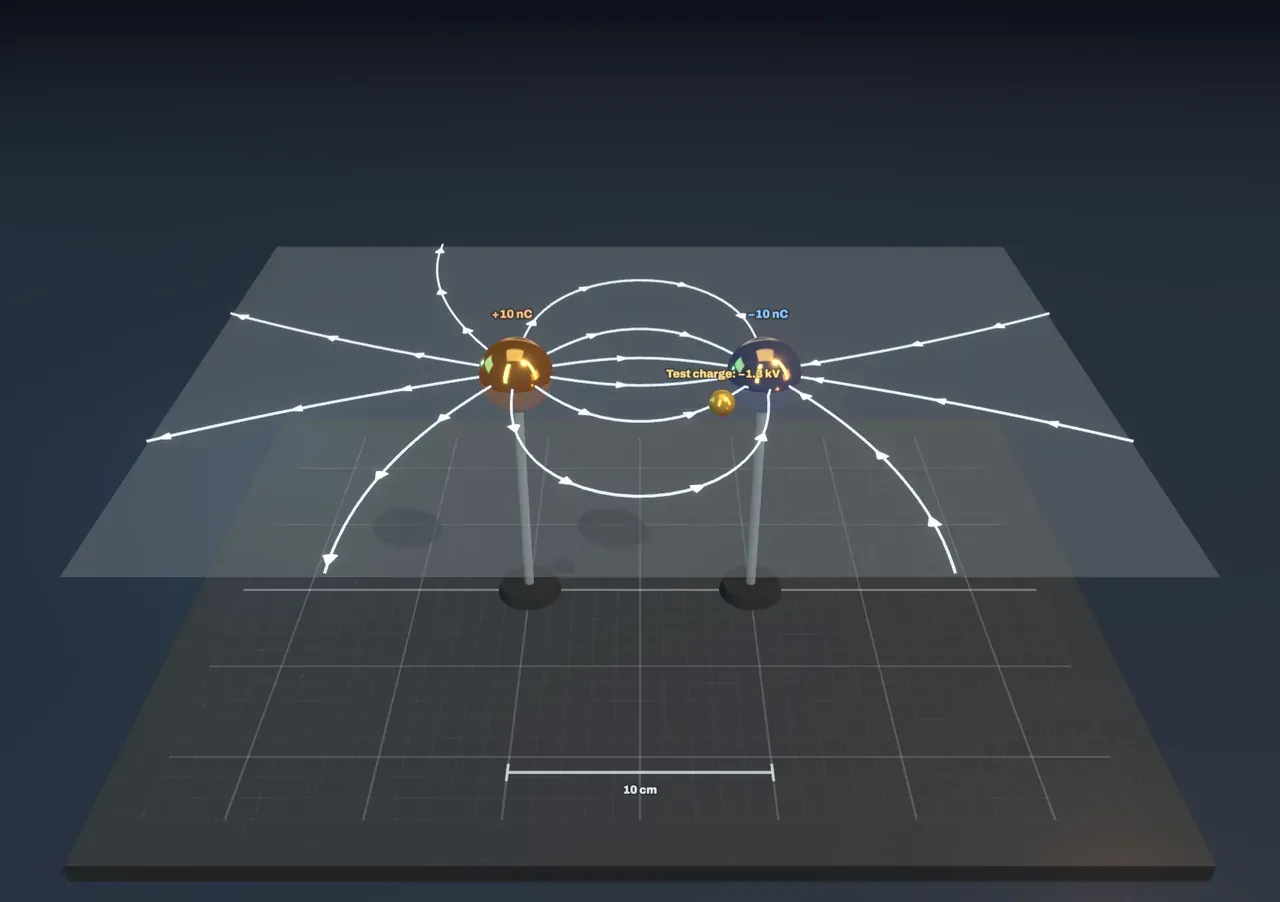
On the board stand two small brass spheres. The left one carries +10 nC, the right one −10 nC, and their centres are 10 cm apart. Opposite charges pull towards each other and like charges push apart, along the line between the charges.
The size of the force is given by Coulomb’s law:
and are the charges in coulombs, and is the distance between the centres in metres. It has the same form as Newton’s law of gravitation: the force grows with each of the two and falls with the square of the distance. The difference is that mass has only one sign and gravity always attracts, while charge has two signs, so the electric force can also repel. By Newton’s third law, each sphere feels a force of the same size.
Left charge, Right charge and Spacing are now fixed. Work out the force.
Step 2 of 6
The square of the distance
The spheres are now close, 5 cm apart, with the same charges. Before you move Spacing, predict: what happens to the force if the distance is doubled?
Step 3 of 6
The electric field
A charge changes the space around it: any other charge placed there would feel a force. The electric field at a point is the force that would act there on each coulomb of a small positive test charge:
Its unit is the newton per coulomb, N/C, which is the same unit as the volt per metre, V/m. From Coulomb’s law, the field of a point charge at a distance from it is , and it points away from a positive charge and towards a negative one.
The field lines in the Scene show the direction: they leave the positive sphere and enter the negative one, and where they crowd together the field is strong. The gold test charge drifts along them. At the point halfway between the spheres, each sphere is 5 cm away. What is the field there?
Step 4 of 6
Fields add as vectors
A field is a vector: it has a size and a direction. Between a positive sphere and a negative one, both fields point the same way, from the positive towards the negative, so they add up. What happens when the right sphere is positive too? Predict, then look at the field lines in the middle.
Step 5 of 6
Potential
With gravity, a body loses potential energy as it goes down, and the height tells you how much energy each kilogram has. In electricity, the potential at a point is the potential energy of each coulomb placed there: . Its unit is the volt, 1 V = 1 J/C.
The potential of a point charge at a distance from it is
Note: , not , and with its sign. Potential is a scalar, so the potentials of several charges simply add as numbers, each with its own sign.
Show the potential is at Potential landscape: the height of the sheet is the potential. Only the left sphere is charged now, with +10 nC, and the right one is uncharged. A positive charge rolls downhill, from high potential to low, exactly along the field lines. What is the potential halfway, 5 cm from the centre of the left sphere?
Step 6 of 6
Zero potential
We are back to +10 nC and −10 nC. Halfway, both spheres are the same distance away, and their potentials are equal in size and opposite in sign, so they cancel: there . Look at the landscape: that point is at height zero, but is the ground there flat?
Loading the interactive version…
Loading the interactive version…
Each step sets up the Scene for you, and a control marked “fixed” stays put for that step.
Practice · Calculate
The left sphere carries +10 nC, the right one −10 nC, and their centres are 10 cm apart. What is the size of the force each sphere exerts on the other? Use .
Practice · Calculate
The left sphere carries +10 nC, the right one −10 nC, and their centres are 10 cm apart. What is the size of the force each sphere exerts on the other? Use .
Practice · Predict, then look
The spheres are 5 cm apart. The distance is increased to 10 cm, and the charges stay the same. What will happen to the force between them?
Practice · Predict, then look
The spheres are 5 cm apart. The distance is increased to 10 cm, and the charges stay the same. What will happen to the force between them?
Practice · Calculate
The spheres carry +10 nC and −10 nC, 10 cm apart. What is the strength of the electric field at the point halfway between them? Use .
Practice · Calculate
The spheres carry +10 nC and −10 nC, 10 cm apart. What is the strength of the electric field at the point halfway between them? Use .
Practice · Predict, then look
Now the right sphere will be positive too, +10 nC, at the same distance. What will the field be at the point halfway?
Practice · Predict, then look
Now the right sphere will be positive too, +10 nC, at the same distance. What will the field be at the point halfway?
Practice · Calculate
Only the left sphere is charged, with +10 nC, and the right one is uncharged. What is the potential at the point halfway, 5 cm from the centre of the left sphere? Use .
Practice · Calculate
Only the left sphere is charged, with +10 nC, and the right one is uncharged. What is the potential at the point halfway, 5 cm from the centre of the left sphere? Use .
Practice · Choose
Between +10 nC and −10 nC, the potential halfway is 0 V. Is the electric field there zero too?
Practice · Choose
Between +10 nC and −10 nC, the potential halfway is 0 V. Is the electric field there zero too?
Lesson complete. Every practice question here is done.