Heat that turns a wheel
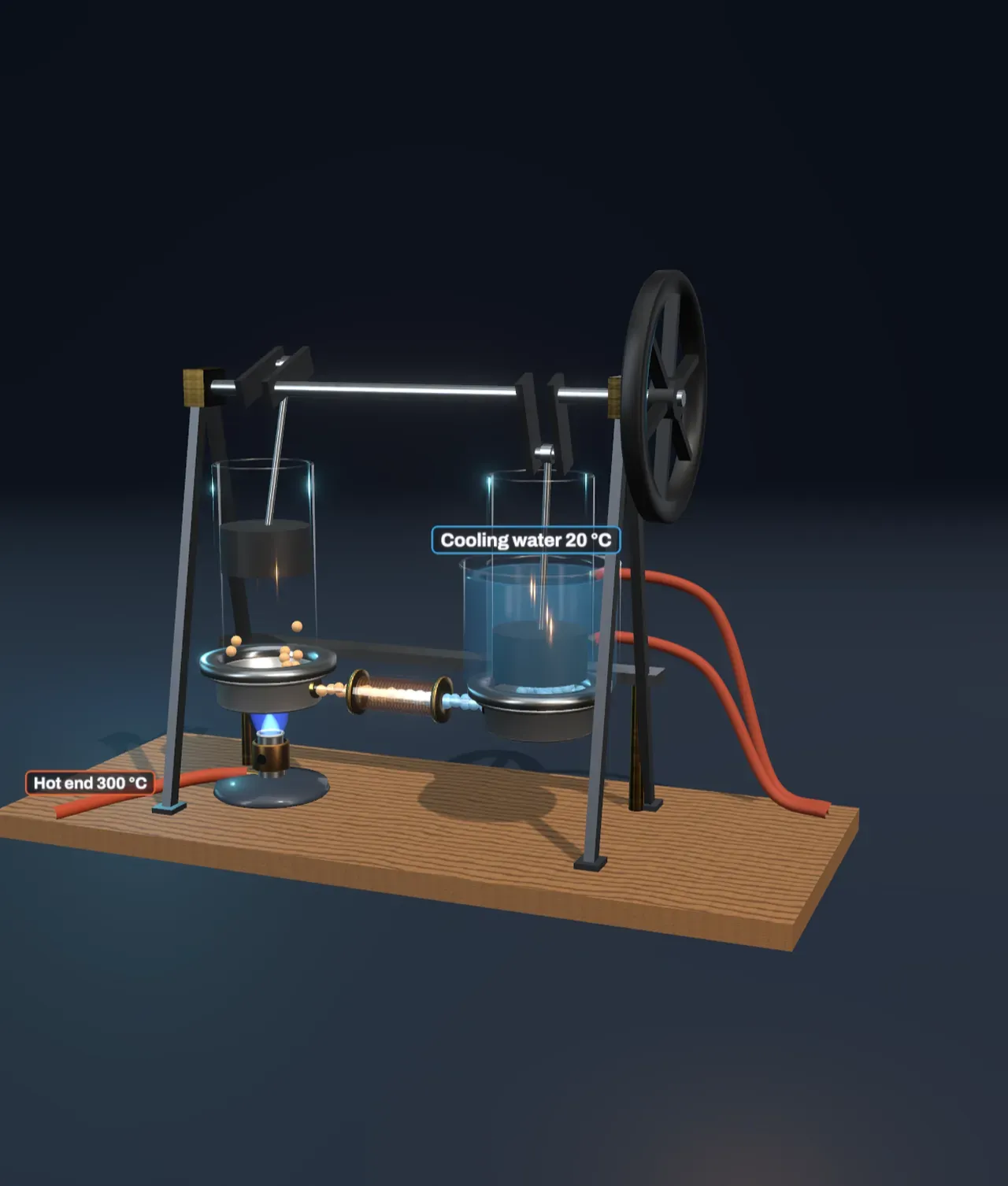
Burn fuel and you get heat. Engines turn some of that heat into work: a turning wheel, a moving car, electricity from a power station’s generator. Steam engines did it first, by boiling water. Car engines burn petrol inside their cylinders. The engine in the scene is a third kind, patented by the Scottish minister Robert Stirling in 1816: a sealed engine that runs on any outside source of heat, from a gas flame to sunlight.
Every one of them has a hot side and a cold side. A car engine’s cold side is the air its exhaust goes out into and its radiator; a power station’s is the river or cooling tower that condenses its steam. And every one of them throws a large share of its heat away there. This is not careless design. It is a law of nature, and the reason is entropy.
Two cylinders, one pressure
The engine has two cylinders joined by a pipe. The left one ends in a steel cap over a flame, so its air stays hot. The right one stands in cooling water, so its air stays cold. The two pistons drive one crankshaft a quarter of a turn apart, so the same air keeps sloshing from one cylinder to the other and back.
At every moment the pressure is the same on both sides, because they are joined. Most of the air is in the hot cylinder while the pressure is high, and it pushes that piston up hard. Most of it is in the cold cylinder while the pressure is low, and the cold piston pushes it back down with little effort. More work comes out on the hot strokes than goes in on the cold ones, and the difference turns the flywheel.
On its way across, the air passes through the regenerator, a plug of copper mesh in the pipe. Hot air leaving the hot side warms the mesh and arrives cold; cold air coming back picks that heat up again and arrives hot. The regenerator lends heat back and forth without wasting it.
Try it: watch the particles crossing the pipe. They change colour inside the copper mesh, and the hot ones fly faster than the cold ones, because a gas’s molecules move faster the hotter it is.
Heat in, work out, heat out
Energy is never made or lost, so everything that goes into the engine in one turn must come out of it. Heat comes in from the flame. Some leaves as work on the crankshaft. The rest leaves as heat into the cooling water. In the default setting, a hot end at 300 °C and water at 20 °C, every 100 joules of heat from the flame gives 49 joules of work and 51 joules of heat to the water.
Try it: slide Show the Carnot limit to halfway. Choose Hot water for the hot end and the work arrow shrinks to 19 joules. Choose Red hot and it grows to 73.
Why must any heat go to the water at all? Energy alone does not forbid an engine that turns all 100 joules into work. Something else does.
Entropy: where heat can go by itself
Heat flows by itself from hotter things to colder ones, never the other way. The quantity that keeps track of this is entropy, named by Rudolf Clausius in 1865. When an amount of heat enters something at temperature , measured in kelvin, that thing’s entropy rises by
A joule of heat therefore carries less entropy when it is hot than when it is cold. Take 100 joules from a flame side at 573 K: the hot side loses 100 ÷ 573 = 0.17 joules per kelvin of entropy. Give the same 100 joules to water at 293 K and the water gains 0.34. Entropy has grown. The second law of thermodynamics says that this is the only way things go: in any process, the total entropy never falls. That is why heat runs downhill.
At the scale of molecules, entropy counts the number of ways the energy can be shared out among them; this is Ludwig Boltzmann’s idea, written today as . Heat given to slow, cold molecules opens up many more new arrangements than the same heat given to fast, hot ones, which already have plenty.
The Carnot limit
Now look at the engine’s books. Each turn it ends exactly where it started, so its own entropy does not change. The heat it takes in brings entropy . Work carries no entropy at all: a turning wheel is perfectly ordered. So the only way out for that entropy is with the heat given to the cold side, and by the second law it must take at least as much as came in:
The heat that must be thrown away is at least , and the most that can be left over for work is
This is the Carnot limit, after the engineer Sadi Carnot, who found it in 1824, before anyone knew what heat was. No engine of any design, burning any fuel, can beat it. An ideal engine like the one in the scene reaches it exactly.
Try it: slide Show the Carnot limit to Carnot limit. The chart beside the experiment works through the entropy in, the heat out needed to carry it away, and the work left over, for the temperatures you set.
The limit depends only on the two temperatures. A hotter hot side or a colder cold side both help. With a red-hot end at 800 °C and ice water at 0 °C the limit is 75 %. With the hot end turned down to 40 °C and Warm water at 40 °C, it is zero: with no difference, nothing turns.
Real engines
Real engines fall short of the limit, because heat needs a temperature difference to flow into and out of the gas, because parts rub, and because real regenerators and valves leak. A large power station raises steam to about 600 °C and condenses it at about 30 °C. Its Carnot limit is 65 %; the best stations turn about 45 % of their fuel’s heat into electricity. A car engine burns its fuel far hotter but reaches 30 to 40 % at best.
Small differences still work, slowly. Model Stirling engines sold as desk toys run on the warmth of a cup of coffee or a hand. Between a palm at 37 °C and a room at 20 °C the limit is about 5 %, enough to spin a light flywheel.
The same bookkeeping runs the other way in a fridge or a heat pump, which uses work to push heat from cold to hot. There the second law sets the least work that job can take, and again only the two temperatures decide it.
What this model leaves out
The engine is Gustav Schmidt’s 1871 ideal Stirling engine. The air in each cylinder is taken to stay at exactly its side’s temperature, the regenerator to pass on all the heat it takes up, and the pressure to be the same everywhere. Under those rules this little engine, at the default temperatures, takes about 0.68 joules of heat from the flame each turn and does 0.33 joules of work, exactly the Carnot share. A real engine of this size loses much of that to friction and to the time heat takes to cross its walls.
The particles are a picture of the air, not a count: each stands for a few billion billion molecules, and they bounce off the walls but not off each other. How many are in each cylinder follows the real share of the air there. The flywheel’s speed is drawn in proportion to the temperature difference; a real engine’s speed depends on its load and friction as well. The flame and the glow of the hot end show the hot side’s temperature only roughly; at 800 °C a real glass cylinder would need to be quartz.