A Stirling engine between a flame and cooling water: why it needs two sides at different temperatures, the books of heat in, work and heat out, entropy and the second law, and the Carnot limit no engine can pass.
Step 1 of 6 · Two sides
Step 1 of 6
Two sides
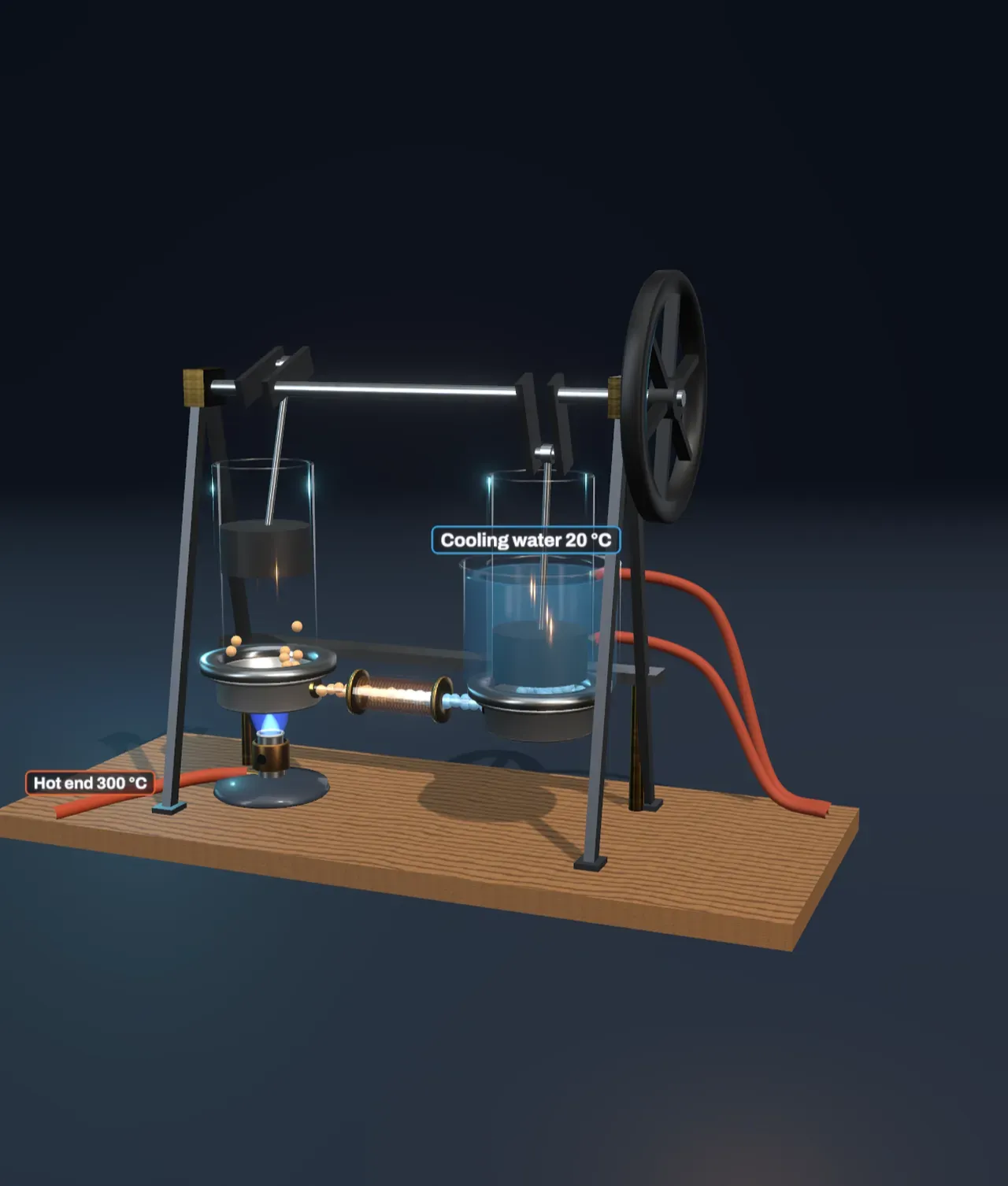
The Scene has a Stirling engine: two cylinders joined by a pipe, with the same air in both. The left cylinder ends in a steel cap over a flame, so its air stays hot. The right one stands in cooling water, so its air stays cold. The two pistons drive one crankshaft a quarter of a turn apart, so the air keeps passing from one cylinder to the other and back.
The pressure is the same on both sides at every moment. While most of the air is on the hot side the pressure is high, and it pushes that piston hard. While most of it is on the cold side the pressure is low, and the piston pushes it back with little effort. The difference turns the flywheel. Predict what will happen if both sides are at the same temperature.
Step 2 of 6
The Carnot limit
Energy is never made or lost, so everything that goes into the engine in one turn must come out of it: heat in from the flame, work on the shaft, and heat out into the cooling water. The engine’s efficiency is the share of the heat in that becomes work.
The hot end is at 300 °C and the cooling water at 20 °C, as written in the Scene beside each cylinder. Sadi Carnot showed in 1824 that an engine between two temperatures has a largest efficiency that depends only on them, in kelvin:
The engine in the Scene is an ideal engine, and reaches that limit exactly. The temperatures and Show the Carnot limit are fixed now.
Step 3 of 6
The books of heat and work
The Cooling water temperature is fixed at Tap water, and the Hot end temperature can be changed. After you predict, Show the Carnot limit will move to Carnot limit, and arrows will show where every 100 J of heat goes: how much to work and how much to the water.
Step 4 of 6
Entropy
Why must any heat go to the water at all? Conservation of energy does not forbid an engine that turns all 100 J into work. Something else does: entropy. When heat enters something at temperature , in kelvin, its entropy rises by
The second law of thermodynamics says the total entropy never falls. The engine ends every turn exactly where it started, so the entropy the heat in brought must leave it. Work carries no entropy; only the heat out into the water can take it away. The temperatures are fixed at 300 °C and 20 °C again.
Step 5 of 6
Seventy per cent
Show the Carnot limit is at Carnot limit now, and the chart beside the Scene shows the whole calculation: the entropy coming in, the heat out needed to carry it away, and the work left over. The limit grows when the hot side is hotter or the cold side colder.
Step 6 of 6
Real engines
Here the end is Red hot, 800 °C, against Ice water: a limit of about 75%. Real engines fall short of the limit: heat needs a temperature difference to flow into and out of the gas, parts rub, and heat exchangers and valves leak. A car engine reaches 30–40% at best.
The same books run the other way too: a fridge or a heat pump uses work to move heat from cold to hot, and the second law sets the least work that takes.
Loading the interactive version…
Loading the interactive version…
Each step sets up the Scene for you, and a control marked “fixed” stays put for that step.
Practice · Predict, then look
The Hot end temperature is turned down to 313 K, and Warm water is chosen for the Cooling water temperature, also 313 K. What will the engine do?
Practice · Predict, then look
The Hot end temperature is turned down to 313 K, and Warm water is chosen for the Cooling water temperature, also 313 K. What will the engine do?
Practice · Calculate
The hot end is at 300 °C and the cooling water at 20 °C. What is the Carnot limit: the largest share of the heat that can become work? Write it as a decimal, such as 0.25.
Practice · Calculate
The hot end is at 300 °C and the cooling water at 20 °C. What is the Carnot limit: the largest share of the heat that can become work? Write it as a decimal, such as 0.25.
Practice · Predict, then look
Hot water is chosen for the Hot end temperature, 363 K, and the cooling water stays Tap water, 293 K. Predict: at most how many joules of work will the engine give for every 100 J of heat?
Practice · Predict, then look
Hot water is chosen for the Hot end temperature, 363 K, and the cooling water stays Tap water, 293 K. Predict: at most how many joules of work will the engine give for every 100 J of heat?
Practice · Calculate
100 J of heat come in from the hot end, at 300 °C, and bring entropy with them. The heat that goes into the water, at 20 °C, must carry all of it away. At least how much heat must go into the water?
Practice · Calculate
100 J of heat come in from the hot end, at 300 °C, and bring entropy with them. The heat that goes into the water, at 20 °C, must carry all of it away. At least how much heat must go into the water?
Practice · Reach the target
Change the two temperatures until the Carnot limit is 70%.
Practice · Reach the target
Change the two temperatures until the Carnot limit is 70%.
Practice · Choose
A power station heats steam to 600 °C and condenses it at 30 °C. Its Carnot limit is 65%, and the best stations reach about 45%. Which is true?
Practice · Choose
A power station heats steam to 600 °C and condenses it at 30 °C. Its Carnot limit is 65%, and the best stations reach about 45%. Which is true?
Lesson complete. Every practice question here is done.