Lesson 3 of 3
Brownian motion and random walks.
A speck that never rests in still water: what pushes it, why a big speck wanders less, why in a random walk getting twice as far takes four times as long, and Einstein's formula that proved molecules exist.
Step 1 of 5 · A speck that never rests
Step 1 of 5
A speck that never rests
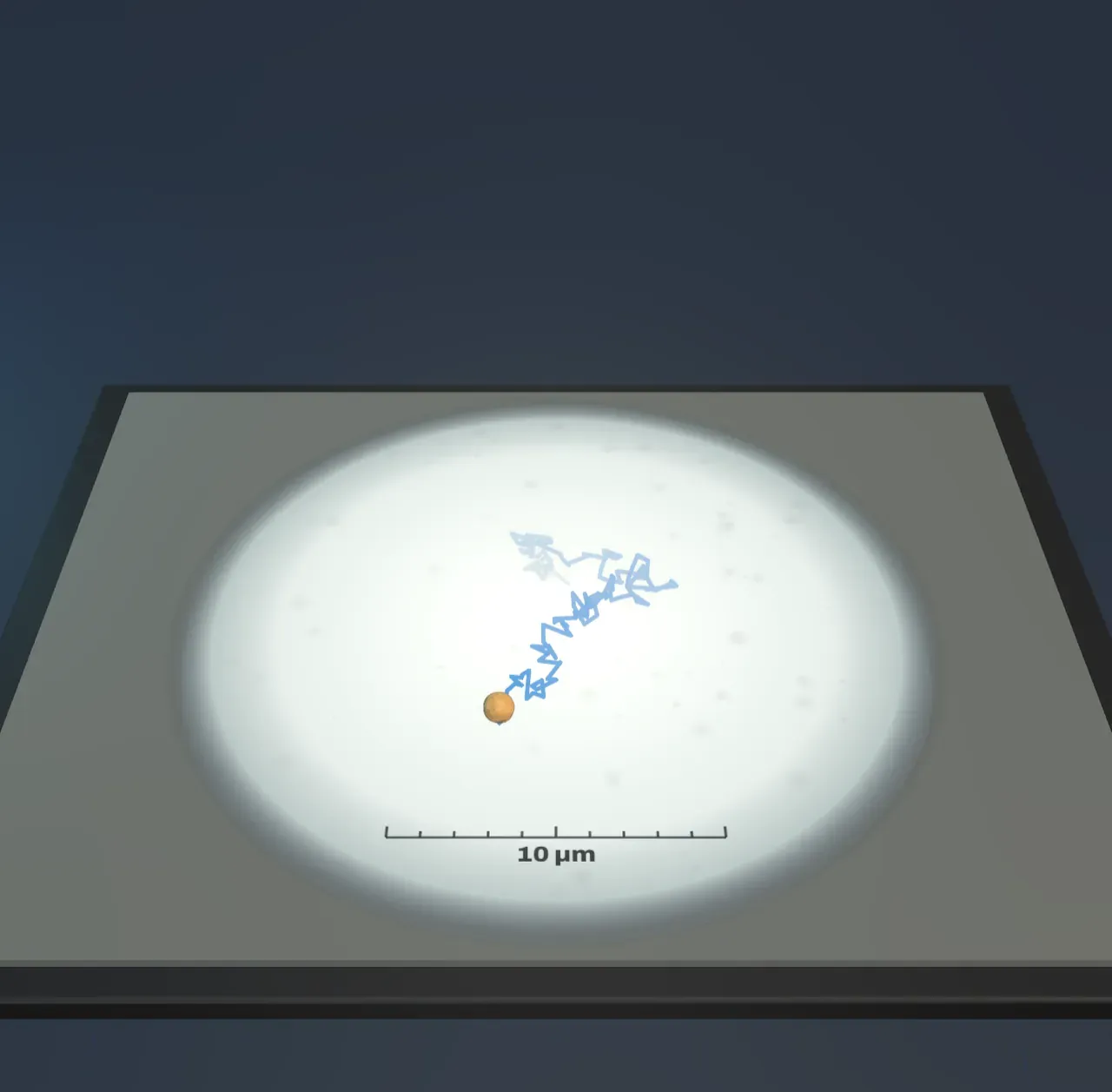
The Scene has a drop of water under a microscope, with a speck in it a micrometre across, a thousandth of a millimetre. It moves exactly as fast as such a speck really does in water. The blue line marks where it has been over the last half minute.
In 1827 the botanist Robert Brown saw motion like this in the particles that came out of pollen grains, and could not explain it. It has been called Brownian motion ever since. Watch the speck for a few moments.
Try it: after answering, step Zoom to the molecules to Molecules. The gold arrow is the net push over the last moment.
Step 2 of 5
The speck’s size
Each molecule that hits the speck gives it a tiny push, and a vast number of them hit it every second. If the pushes from all sides balanced exactly, the speck would stand still. They never quite do. The Water temperature is fixed now. Predict what a bigger speck will change.
Step 3 of 5
Four times as long
A path made of steps in random directions, each forgetting the last, is called a random walk. A hundred steps in a straight line take you a hundred steps from the start. A hundred random steps undo each other a lot, and take you on average only about ten steps: after steps the typical distance is one step’s length times .
Zoom to the molecules is at Many specks now: sixty specks set off together from the centre, and the red ring marks their typical distance from the start. The chart beside the Scene plots it against time. In symbols, the average of the squared distance grows in step with time:
is the diffusion coefficient, which says how quickly something spreads.
Step 4 of 5
Einstein’s formula
In 1905 Albert Einstein worked out what sets for a ball in a liquid:
The temperature , in kelvin, is on top: warmer molecules move faster and hit harder. Underneath are the speck’s radius and the viscosity , how thick the liquid is. is Boltzmann’s constant. In 1908 Jean Perrin measured how specks like these spread, found exactly what Einstein had predicted, and convinced the last doubters that atoms and molecules really exist. The water is boiling now, at 373 K, and both Parameters are fixed.
Step 5 of 5
Faster
Water also gets much runnier as it warms: its viscosity falls from about 1.8 × 10⁻³ Pa·s at 0 °C to about 0.28 × 10⁻³ Pa·s near boiling. So heating the water raises more than the temperature alone would.
Loading the interactive version…
Loading the interactive version…
Each step sets up the Scene for you, and a control marked “fixed” stays put for that step.
Practice · Choose
The speck in the water never stops for a moment, even when the water is perfectly still. What moves it?
Practice · Choose
The speck in the water never stops for a moment, even when the water is perfectly still. What moves it?
Practice · Predict, then look
Speck size is raised from 1 µm to 5 µm. Predict: what will happen to its wandering?
Practice · Predict, then look
Speck size is raised from 1 µm to 5 µm. Predict: what will happen to its wandering?
Practice · Calculate
In water at room temperature, a 1 µm speck gets on average about 4.1 µm from its start in ten seconds. How far will it get, on average, after 40 s?
Practice · Calculate
In water at room temperature, a 1 µm speck gets on average about 4.1 µm from its start in ten seconds. How far will it get, on average, after 40 s?
Practice · Calculate
The water is boiling, 373 K, and its viscosity is 0.28 × 10⁻³ Pa·s. The speck is 1 µm across, and Boltzmann’s constant is k = 1.38 × 10⁻²³ J/K. Work out , and then: how far will the speck get on average in ten seconds?
Practice · Calculate
The water is boiling, 373 K, and its viscosity is 0.28 × 10⁻³ Pa·s. The speck is 1 µm across, and Boltzmann’s constant is k = 1.38 × 10⁻²³ J/K. Work out , and then: how far will the speck get on average in ten seconds?
Practice · Reach the target
Change the Water temperature and the Speck size until the speck gets on average 10 µm in ten seconds.
Practice · Reach the target
Change the Water temperature and the Speck size until the speck gets on average 10 µm in ten seconds.
Lesson complete. Every practice question here is done.