A speck that will not sit still
In 1827 the Scottish botanist Robert Brown put pollen grains in water under his microscope and watched the tiny particles that came out of them. They never kept still. Each one trembled and wandered in a zigzag, hour after hour, with no current in the water to carry it. Brown first wondered whether the particles were alive. Then he saw the same restless motion in specks of soot, of powdered glass and of rock, which have never been alive. The jiggling became known as Brownian motion, and for almost eighty years nobody could say what drove it.
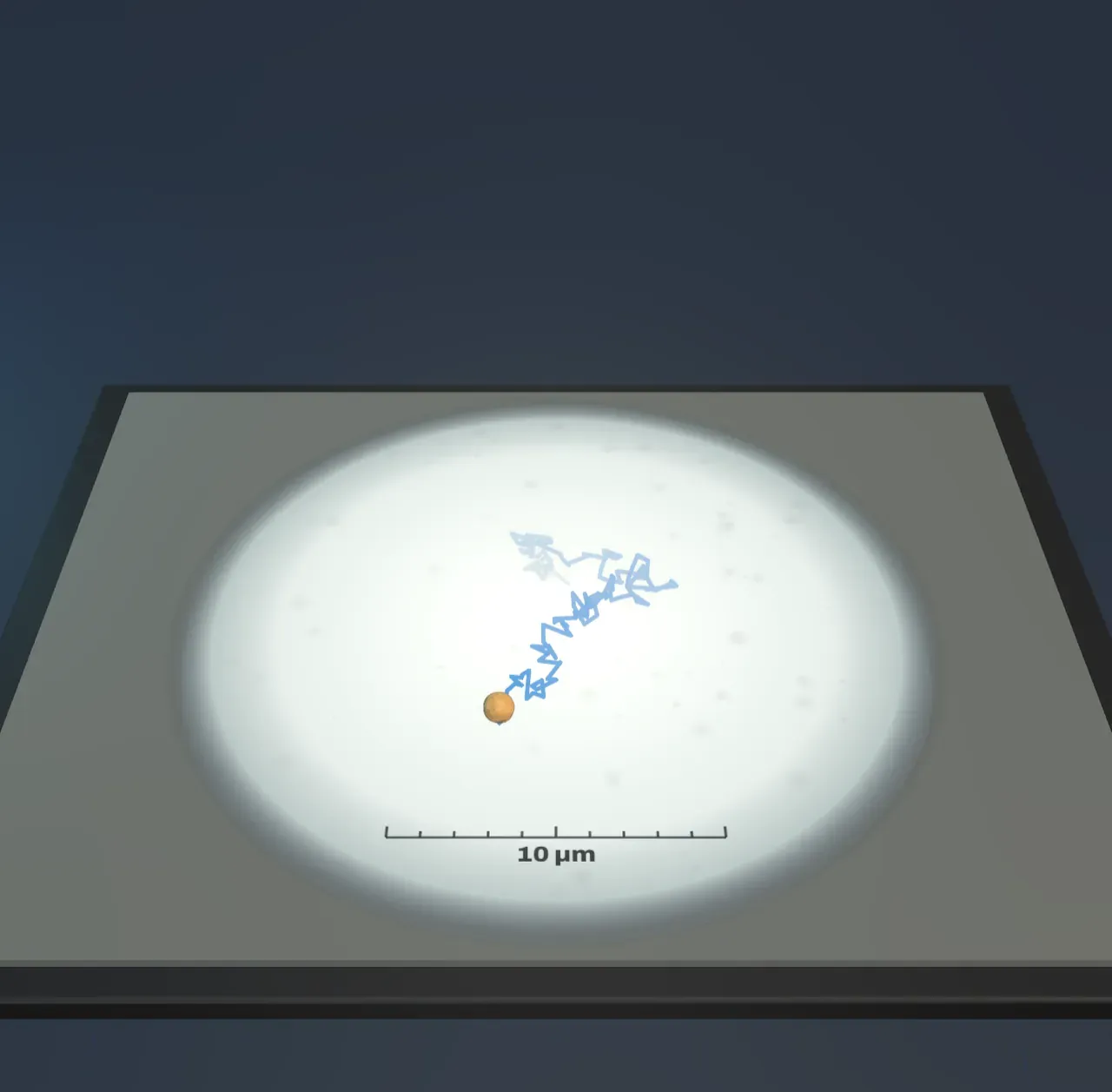
The speck in the Scene is one micrometre across, a thousandth of a millimetre, about the size of the particles Brown watched. It moves exactly as fast as such a speck in water really does: in a second it typically wanders a little over a micrometre, about its own width. The blue line traces where it has been over the last half minute.
Kicked from every side
The answer is that water is not smooth. It is made of molecules about three tenths of a nanometre across, thousands of times smaller than the speck, packed close together and always jostling. Each molecule that bumps into the speck gives it a tiny push. Something like ten billion billion of them hit it every second, from every direction.
If the pushes from all sides balanced exactly, the speck would sit still. They never quite do. At any moment a few more molecules happen to strike one side than the other, or strike it a little harder, and the speck is nudged that way. A moment later the imbalance points somewhere else. The speck itself is far too small to be pushed in one direction for long, and far too big to be thrown far by any one molecule, so it shuffles: a little this way, a little that way, never settling.
Try it: step Zoom to the molecules to Molecules. The view zooms in on the speck until the water molecules appear round it. Flashes mark some of the hits. The gold arrow shows the net push over the last moment: it keeps swinging round, and the speck shivers along it.
The molecules themselves are invisible under any light microscope. Brownian motion is the one place you can watch their effect directly: a visible thing pushed about by countless invisible ones.
A random walk
A path made of steps in random directions, each one forgetting the last, is called a random walk. The same mathematics describes a speck in water, a scent spreading through a still room, sugar spreading through tea, and a dropped dye slowly clouding a glass.
The surprising thing about a random walk is how slowly it gets anywhere. Take a hundred steps in a straight line and you are a hundred steps away. Take a hundred steps in random directions and many of them undo each other: on average you end up only about ten steps from the start. After N steps the typical distance is about the length of one step times √N. To get twice as far you need four times as many steps, so four times as long.
Four times as long, twice as far
Step Zoom to the molecules to Many specks. Sixty more specks are released together from the centre and spread out, each on its own random walk. They are drawn as small dots, so that big specks do not hide each other. The red dashed ring sits at their typical distance from the start, measured from the specks themselves, and the chart beside the experiment plots that distance second by second.
The red dots follow the blue curve, the square root of time. After 5 seconds the crowd has spread about 2.9 micrometres; after 20 seconds, four times as long, about 5.9, only twice as far. In symbols, the average of the squared distance grows in step with time:
Here is the time and is the diffusion coefficient, which says how quickly something spreads. The 4 is there because the specks are seen spreading across a flat view; counted in all three directions it becomes 6. The square root is why diffusion is fast over short distances and hopeless over long ones. A sugar molecule crosses a cell, a few micrometres, in a fraction of a second, but would take weeks to diffuse across a cup of tea without any stirring. Stirring and currents, not diffusion, mix most things we see. Diffusion and osmosis follows the same random motion into living cells.
Hotter water, smaller specks
In 1905 Albert Einstein worked out what sets for a ball in a liquid:
The temperature in kelvin is on top: warmer molecules move faster and hit harder. The ball’s radius is underneath: a bigger ball is hit by more molecules at once, so their pushes average out better, and the liquid drags on it more. The viscosity , how thick or runny the liquid is, is underneath too. is Boltzmann’s constant, 1.38 × 10⁻²³ joules per kelvin.
Water gets much runnier as it warms: its viscosity falls from about 1.8 thousandths of a pascal-second at 0 °C to 1.0 at 20 °C and 0.28 near boiling. So heating the water from freezing to boiling makes a speck spread almost nine times faster, more than the temperature alone would suggest.
Try it: slide Water temperature up to 100 °C, then Speck size down to 0.5 µm. The trail scribbles across the field. Now slide them to 0 °C and 5 µm: the speck barely shivers in place. Between the two, changes about ninety times.
How it proved atoms are real
At the start of the twentieth century, many respected scientists still doubted that atoms and molecules really existed. Chemistry worked as if they did, but nobody could see one. Einstein’s 1905 paper turned Brownian motion into a test. If water really is made of molecules of a certain size, a speck of known size must spread at a rate he could predict, and measuring that spread would reveal how many molecules there are in a given amount of water.
Between 1908 and 1909 the French physicist Jean Perrin did the measurements. He made specks of a yellow resin called gamboge, all of the same size, and tracked them through a microscope, marking each one’s position every 30 seconds and joining the marks with straight lines. The spread grew with time exactly as Einstein predicted, and from it Perrin worked out the number of molecules in a mole of a substance, in good agreement with other, entirely different methods. Doubters gave up. Perrin received the Nobel Prize in Physics in 1926.
Perrin also noticed something strange about the paths. Mark the positions ten times as often and every straight segment breaks into a zigzag of its own. A Brownian path has no smooth stretches at any magnification, so it has no definite speed: the closer you look, the longer it gets. Mathematicians later made this exact, and the random walk became one of the most used ideas in science, from the spread of heat to the prices of shares.
What this model leaves out
- The third direction. A real speck also wanders up and down through the water and drifts in and out of focus. The model shows only its movement across the view, which is what a microscope shows sharply, and keeps it inside the field of view, where a real one would sooner or later drift out of it.
- Gravity. A speck a little denser than water slowly sinks while it jiggles. For specks this small the jiggling wins over short times; Perrin used that balance in another of his experiments.
- The trail. The line joins positions every 0.2 seconds. A camera taking pictures more often would show more zigzags within each segment.
- The molecules. In the zoom the molecules are drawn hundreds of times too big compared with the speck, there are far fewer of them, and they move far too slowly to see. Real water molecules also cling to each other with hydrogen bonds, so they do not fly freely between hits. The gold arrow shows the idea, not a measured force.
- The crowd. The sixty specks pass through each other, as if each were a separate run of the same experiment; real specks that close together would bump and nudge each other.
- Shapes and walls. The speck is a perfect sphere in an endless pool of still water. Real particles have odd shapes, also tumble as they move, and move more slowly near the glass.