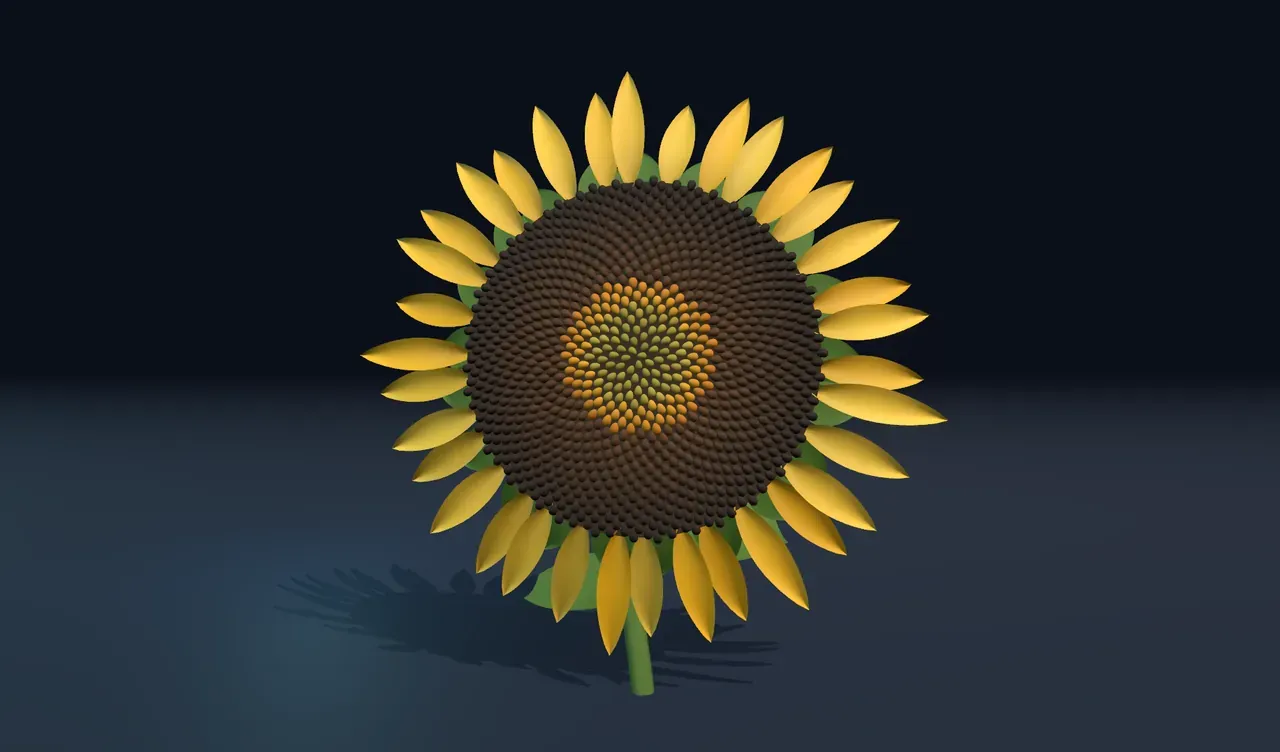
Spirals in a flower
Look closely at the middle of a sunflower and the seeds seem to curve away from the centre in spirals: some sweeping clockwise, others anticlockwise. Count them and you will usually find 34 one way and 55 the other, or 55 and 89 on a bigger head. The scales of a pine cone usually run in 8 and 13. These pairs are neighbours in the Fibonacci sequence, 1, 1, 2, 3, 5, 8, 13, 21, 34, 55, 89…, where each number is the sum of the two before it. Leonardo of Pisa, later called Fibonacci, used it in his book Liber Abaci of 1202.
One rule, one angle
A sunflower head grows from a ring of tissue that makes new florets one after another. Each forms where there is most room, away from the ones made just before it, and on the way round consecutive florets end up separated by a fixed angle: about 137.5°, the golden angle. It is the smaller part of a full turn divided in the golden ratio, about 1.618 to 1.
In 1979 Helmut Vogel showed that one simple rule recreates a sunflower head. Put seed number n at n times the golden angle round the centre, at a distance that grows with the square root of n so every seed gets the same space. That is exactly the rule this model follows.
Why that angle?
Try a simple fraction of a turn instead. With a third of a turn, every third seed lands on the same line, and the head becomes three straight spokes with empty wedges between. A three-eighths turn makes eight spokes. Any fraction of a turn eventually repeats itself, wasting space.
Try it: slide Turn between seeds to 120°, 135° and 144°, then back to 137.5°, the golden angle. Drag it slowly near the golden angle and watch the gaps close.
The golden ratio is, in a precise sense, the number that fractions approximate worst, so seeds placed by the golden angle never fall into line. They fill the head evenly, packing the most seeds into the least space.
Where the Fibonacci numbers come from
The fractions that come closest to the golden ratio are ratios of neighbouring Fibonacci numbers: 3/2, 5/3, 8/5, 13/8 and so on. A seed’s nearest neighbours are therefore the seeds a Fibonacci number of places before or after it. Joining each seed to those neighbours traces the spirals, and the number of arms in each family is that same Fibonacci number. Choose On under Show the spirals to see the families coloured and counted, then switch Plant to Pine cone.
What this model leaves out
Real plants are messier. Their growing tips set the angle through chemical signals, not geometry, so it wobbles from one floret to the next, and a large 2016 citizen-science count of sunflowers found most heads showed Fibonacci numbers but a sizeable minority did not. Real florets swell and squeeze each other into shape. This model places identical seeds by one exact rule. Its pine cone adds scales up an egg-shaped core by the same turn, with plain woody lips rather than the real scales’ shapes.