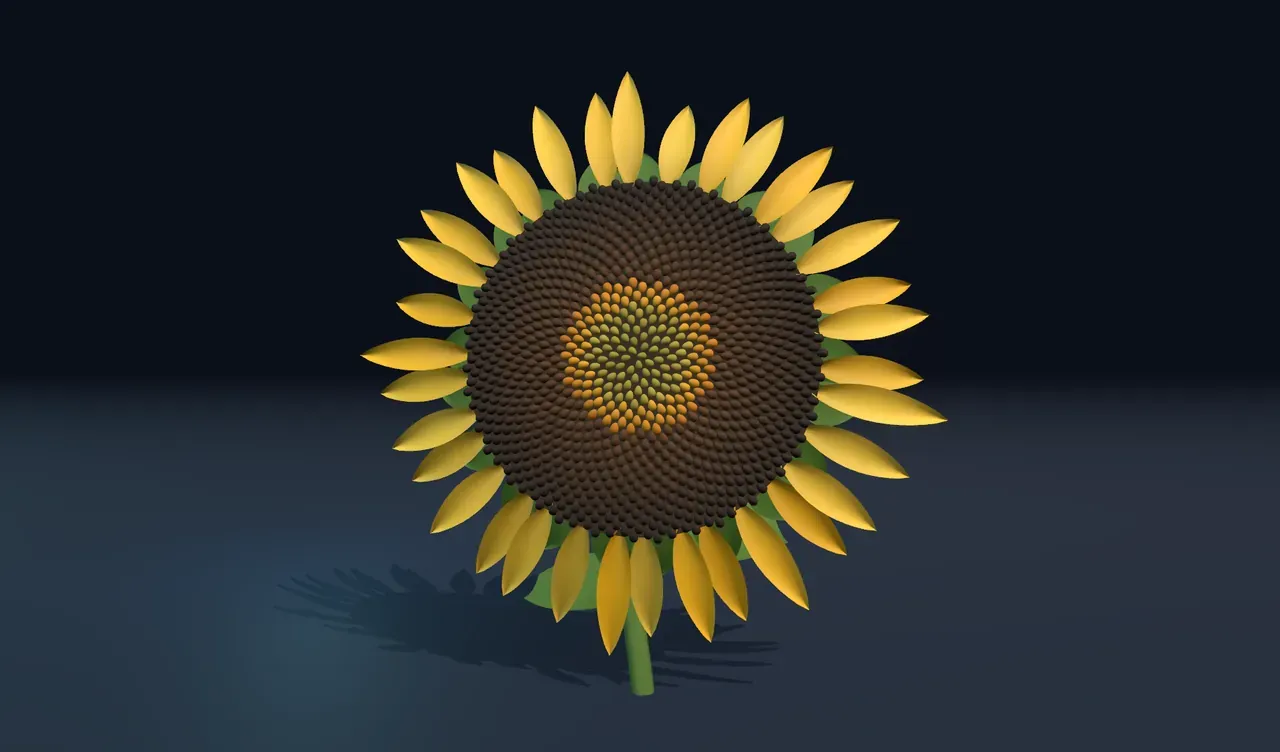
Why you count 8 and 13 or 34 and 55 spirals on a sunflower or a pine cone: a fixed turn between seeds, fractions of a turn that make spokes, the golden angle that lies near no simple fraction, and the Fibonacci numbers that close in on it.
Step 1 of 5 · Spokes
Step 1 of 5
Spokes
In the Fibonacci sequence each term is the sum of the two before: These numbers turn up in a sunflower’s spirals, and one simple rule links them. In a sunflower head each new seed grows at the centre, turns a fixed angle from the seed before it, and is pushed outwards as newer seeds follow.
Turn between seeds is locked at of a turn, : every third seed points the same way again, and the seeds fall into straight spokes with empty gaps between them. Predict what happens at of a turn.
Step 2 of 5
Fibonacci’s fractions
When the turn is of a turn, the seeds fall into spokes, with empty space between them: such a plant wastes room. To use all the space the turn must be far from every simple fraction. The fractions , whose numerators and denominators are Fibonacci numbers, close in on exactly such a number. Find the turn for the next fraction in the row, .
Step 3 of 5
The golden angle
These fractions close in on , where is the golden ratio, which the ratio of consecutive Fibonacci numbers also closes in on: . That turn, 137.5°, is the golden angle. It is the number hardest to approximate by a simple fraction, so no seed ever lands exactly behind another, and the seeds fill the head evenly. Work out what fraction of a turn the golden angle is.
Step 4 of 5
Counting spirals
At the golden angle there are no spokes, but the eye finds spirals: each seed sits close to the seeds a Fibonacci number of steps before it, because after or turns of the golden angle a seed points almost the same way again. Choose On under Show the spirals and count.
Step 5 of 5
A pine cone
The same rule works on a pine cone: the scales grow along an axis, each one turned by the golden angle from the last. A pine cone has far fewer scales than a sunflower has seeds. Predict how many spirals you will see, then switch Plant.
Loading the interactive version…
Loading the interactive version…
Each step sets up the Scene for you, and a control marked “fixed” stays put for that step.
Practice · Predict, then look
Now each seed turns of a turn from the last, and the seeds fall into spokes. How many spokes will they fall into at of a turn, ?
Practice · Predict, then look
Now each seed turns of a turn from the last, and the seeds fall into spokes. How many spokes will they fall into at of a turn, ?
Practice · Reach the target
, , : the numerators and denominators are Fibonacci numbers. The next fraction in the row is . Change Turn between seeds so that the seeds fall into spokes, then press Check.
Practice · Reach the target
, , : the numerators and denominators are Fibonacci numbers. The next fraction in the row is . Change Turn between seeds so that the seeds fall into spokes, then press Check.
Practice · Calculate
The turn is the golden angle, , and the golden ratio is . What fraction of a full turn is the golden angle? (Give a decimal.)
Practice · Calculate
The turn is the golden angle, , and the golden ratio is . What fraction of a full turn is the golden angle? (Give a decimal.)
Practice · Choose
Choose On under Show the spirals. Each colour is one family of spirals, and the number beside it counts its arms. What do the numbers have in common?
Practice · Choose
Choose On under Show the spirals. Each colour is one family of spirals, and the number beside it counts its arms. What do the numbers have in common?
Practice · Predict, then look
Switch Plant to the pine cone, at the same golden angle. A pine cone has only scales. How many spirals will the two families have?
Practice · Predict, then look
Switch Plant to the pine cone, at the same golden angle. A pine cone has only scales. How many spirals will the two families have?
Lesson complete. Every practice question here is done.