The same picture at every size
Start with a triangle. Swap the middle third of every edge for two edges of the same length that stick out as a point. Each straight edge has become four edges, each a third as long. Do it again to every new edge, and again. After a few steps the outline looks like a snowflake, and every bump on it carries smaller bumps, which carry smaller bumps still. This is the Koch snowflake, described by the Swedish mathematician Helge von Koch in 1904.
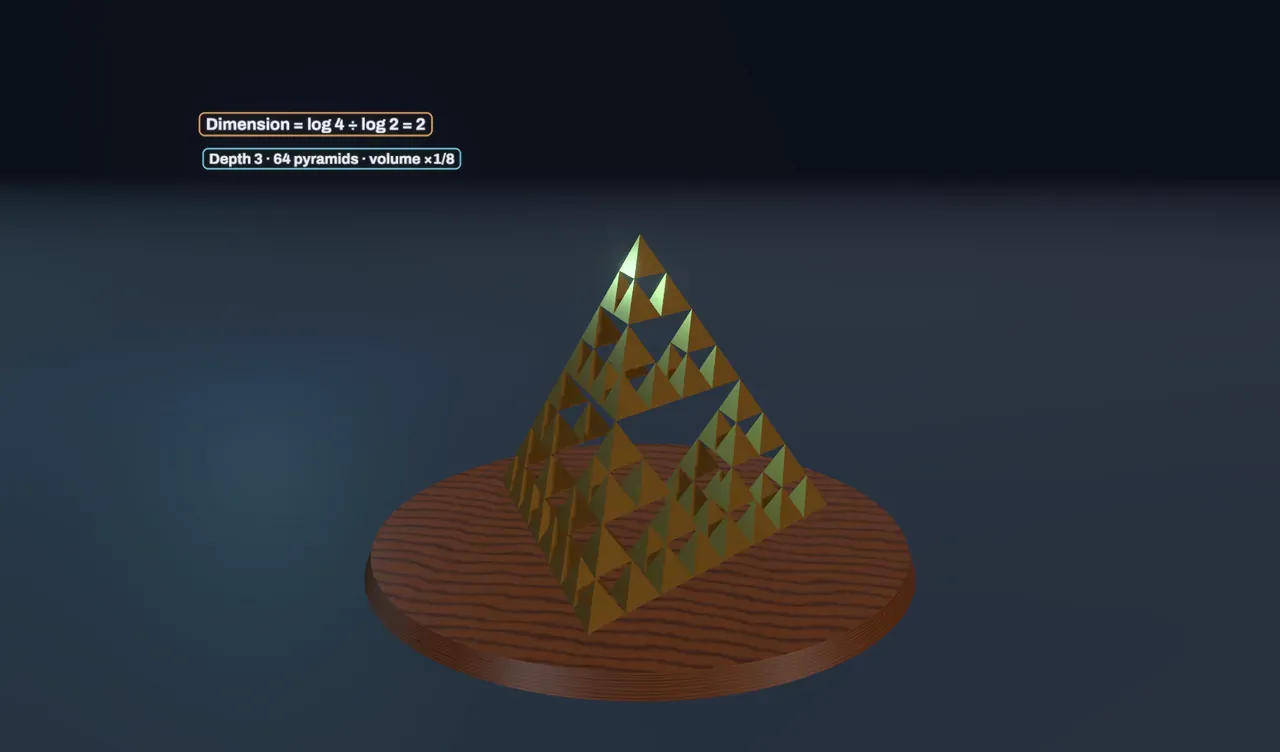
A shape whose small parts look like the whole is self-similar. The Sierpiński pyramid works the same way in three dimensions: replace a pyramid by four pyramids of half the size sitting in its corners, leaving a hole in the middle, then do the same to each of those. Wacław Sierpiński described the flat triangle version in 1915.
Try it: slide Depth from 0 to 1, then up to 5, and watch each piece split into copies of the whole. Then choose Zoom in under Zoom in.
Zooming in that never ends
In the Scene the camera stays still and the shape is enlarged about one of its corners. The corner of a Sierpiński pyramid is a half-size copy of the whole pyramid, so after the shape has doubled in size you are looking at exactly the picture you started with. The snowflake does the same every time it grows three times larger. A real fractal can be zoomed like this forever and never runs out of detail. Built shapes, like the brass pyramid, run out of detail after a few steps, so the Scene keeps adding new steps as the old pieces grow.
A dimension between the whole numbers
Halve a line and you get 2 copies. Halve a square’s sides and you get 4 copies. Halve a cube’s edges and you get 8. Those numbers are 2¹, 2² and 2³, and the power is the dimension: 1, 2 and 3. In general, if a shape is made of N copies of itself, each 1/s of its size, its fractal dimension is
D = log N ÷ log s.
The Sierpiński pyramid is 4 copies at half size: log 4 ÷ log 2 = 2. It is a three-dimensional object with the dimension of a surface. The Koch snowflake’s edge is 4 copies at a third of the size: log 4 ÷ log 3 ≈ 1.26. It is more than a line but less than an area.
Infinite edge, finite area
Each step multiplies the snowflake’s perimeter by 4/3, so after enough steps the edge is longer than any length you name. Yet the added bumps get smaller so fast that the area only creeps up towards 8/5 of the starting triangle. The pyramid does the opposite trick: each step halves the volume of brass, so the limit has no volume at all, while the total surface area of all the pieces stays exactly the same at every step. The Scene’s readout shows these numbers as Depth changes.
Fractals in the world
The word fractal was coined by Benoît Mandelbrot in 1975. Years earlier he had asked how long the coast of Britain is: the answer depends on the length of your ruler, because a shorter ruler follows smaller bays and headlands and measures a longer coast. A coastline behaves like a Koch curve with a dimension a little above 1. Ferns, branching trees, river networks, lungs and the florets of Romanesco broccoli repeat their shape over a few levels in a similar way. The Menger sponge, a cube with its middles punched out over and over, described by Karl Menger in 1926, has dimension log 20 ÷ log 3 ≈ 2.73.
What this model leaves out
A true fractal has infinitely many steps; the Scene builds at most five, and while zooming it adds steps only where they are on screen, growing the newest step in smoothly. The pyramid’s pieces touch only at their corners, so a real brass model would fall apart; they are shown floating exactly in place. Fractals found in nature are only roughly self-similar, and only over a limited range of sizes.