Shapes whose every part is a small copy of the whole: how many parts each step makes, a perimeter that grows without end round a finite area, and a dimension that is not a whole number.
Step 1 of 8 · Copies of copies
Step 1 of 8
Copies of copies
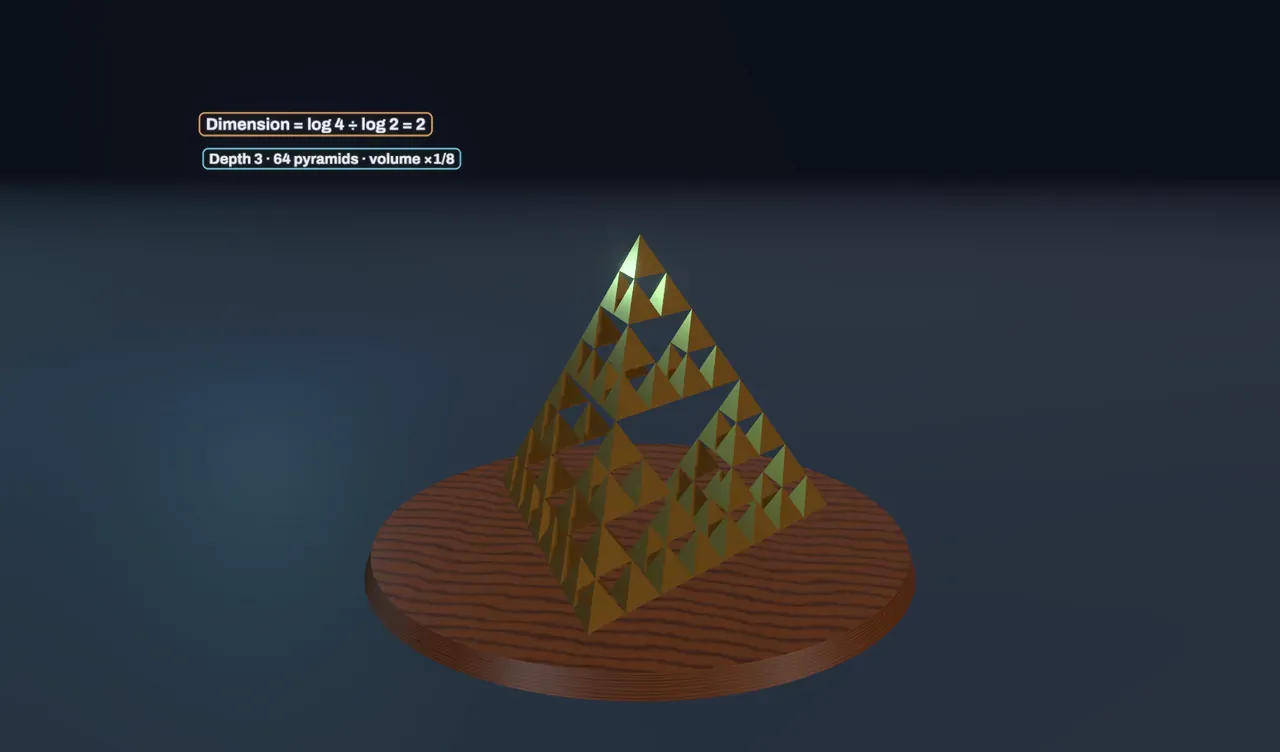
A fractal is a self-similar shape: each small part of it looks like the whole. The Sierpiński pyramid is built in steps: swap a pyramid for four pyramids at half size, sitting in its corners, then do the same to each of them. The Depth is the number of steps. At depth there are pyramids.
Step 2 of 8
A growing perimeter
The Koch snowflake starts from an equilateral triangle. At each step every side is split into thirds, and a small triangle is added on the middle third, pointing out. Each side so becomes four sides, each a third as long. The Shape and Depth are fixed now.
Step 3 of 8
Without end
At depth the steps are already hard to see. Zoom in goes into a corner, and the same picture comes back again and again. Suppose the building goes on for ever.
Step 4 of 8
A broken dimension
Halve a line: copies. Halve the sides of a square: copies. Of a cube: . These are , and , and the exponent is the dimension. In general, if a shape is made of copies of itself, each its size, then , and the fractal dimension is
For the Sierpiński pyramid and , so , though it is a solid in three dimensions.
Step 5 of 8
How many copies
Back to the pyramid, one step only.
Step 6 of 8
How much smaller
Each copy is like the whole, only smaller.
Step 7 of 8
The volume
At each step part of the pyramid is taken out. How much is left?
Step 8 of 8
The snowflake’s area
The snowflake’s perimeter grows without end. What happens to its area?
Loading the interactive version…
Loading the interactive version…
Each step sets up the Scene for you, and a control marked “fixed” stays put for that step.
Practice · Predict, then look
At depth the Sierpiński pyramid is made of small pyramids. How many is it made of at depth ?
Practice · Predict, then look
At depth the Sierpiński pyramid is made of small pyramids. How many is it made of at depth ?
Practice · Calculate
At each step of the Koch snowflake every side becomes four sides, each a third as long. How many times longer is the perimeter at depth than the starting triangle’s?
Practice · Calculate
At each step of the Koch snowflake every side becomes four sides, each a third as long. How many times longer is the perimeter at depth than the starting triangle’s?
Practice · Choose
The snowflake’s construction goes on for ever. What happens to its perimeter and its area?
Practice · Choose
The snowflake’s construction goes on for ever. What happens to its perimeter and its area?
Practice · Calculate
Each side of the Koch snowflake is made of copies of itself, each its size. What is the snowflake’s fractal dimension?
Practice · Calculate
Each side of the Koch snowflake is made of copies of itself, each its size. What is the snowflake’s fractal dimension?
Practice · Calculate
Shape: Sierpiński pyramid, Depth . Into how many small pyramids, the same shape as the big one, does the pyramid break in one step?
Practice · Calculate
Shape: Sierpiński pyramid, Depth . Into how many small pyramids, the same shape as the big one, does the pyramid break in one step?
Practice · Calculate
At each step of the Sierpiński pyramid every pyramid is replaced by smaller ones, each sitting in a corner. How many times shorter is each edge of a small pyramid than an edge of the big one?
Practice · Calculate
At each step of the Sierpiński pyramid every pyramid is replaced by smaller ones, each sitting in a corner. How many times shorter is each edge of a small pyramid than an edge of the big one?
Practice · Calculate
At Depth of the Sierpiński pyramid, what share of the starting pyramid’s volume is left? At each step every pyramid is replaced by copies, each half the size.
Practice · Calculate
At Depth of the Sierpiński pyramid, what share of the starting pyramid’s volume is left? At each step every pyramid is replaced by copies, each half the size.
Practice · Calculate
Shape: Koch snowflake, Depth . On each of the triangle’s three sides a small triangle has grown, its side a third of the big triangle’s. How many times the starting triangle’s area is the snowflake’s?
Practice · Calculate
Shape: Koch snowflake, Depth . On each of the triangle’s three sides a small triangle has grown, its side a third of the big triangle’s. How many times the starting triangle’s area is the snowflake’s?
Lesson complete. Every practice question here is done.