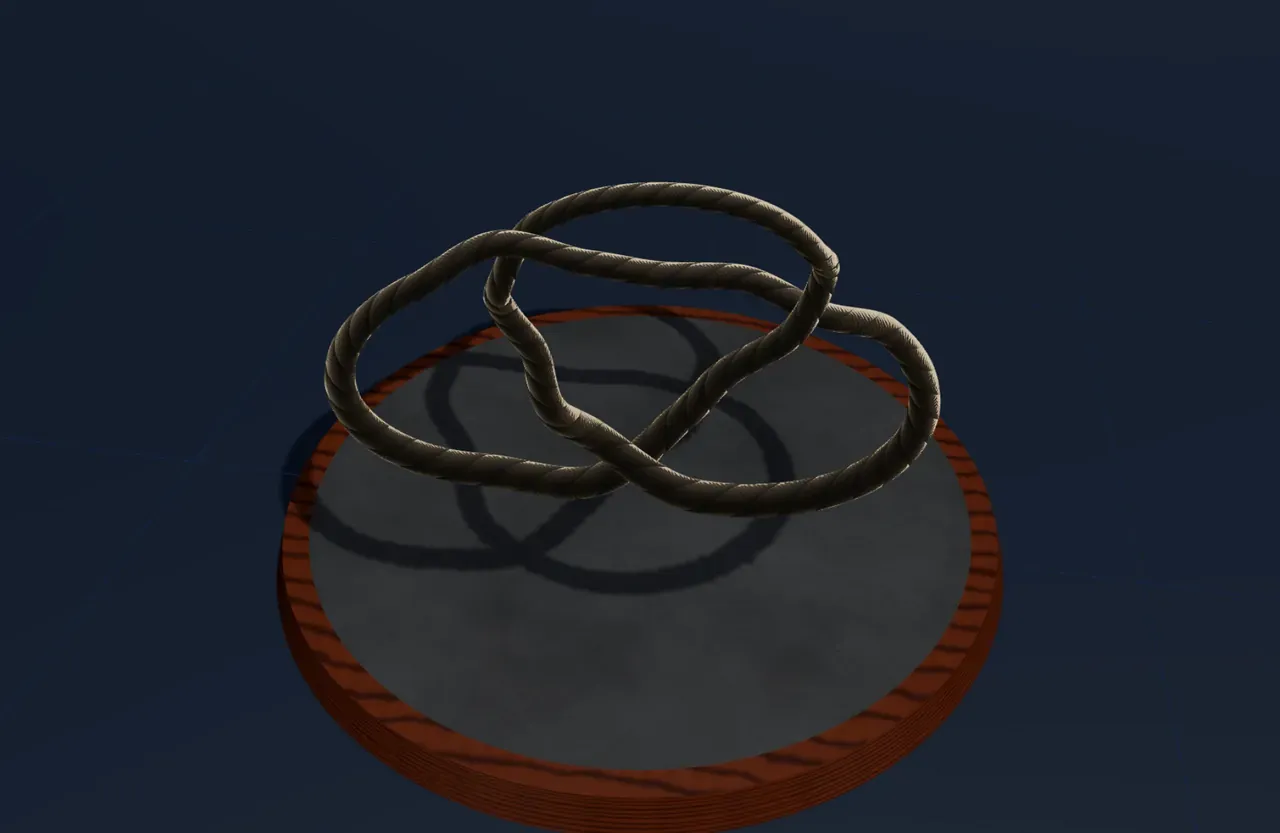
A knot you cannot untie
Any knot in a shoelace can be undone: you pull an end back through the loops it went through. Mathematicians remove that way out. Tie the knot, then join the two ends so the rope has no ends at all. What is left is a knot in the mathematical sense: a closed loop in space.
Two loops count as the same knot if you can move one into the shape of the other by bending, stretching and sliding the rope, as long as it never passes through itself and is never cut. A plain ring is the simplest knot of all, the unknot. A loop is knotted if no amount of moving it about will turn it into a plain ring.
That sounds easy to test. Pick up the loop and try. But a tangle that refuses to come apart might only be waiting for a cleverer move, so failing to untangle it proves nothing. The question this article answers is how you can be sure.
Drawing a knot
A knot lives in three dimensions, but it is easiest to study on paper. Look at the loop from straight above and draw what you see. Wherever the rope crosses over itself, break the lower strand for a moment, so the drawing still says which strand is on top. This is a knot diagram, and the places where it crosses itself are its crossings.
Try it: step to Drawing, then drag the scene round until you look straight down on the rope. It covers its own drawing, and each gap in the chalk sits under a place where the rope dips under itself.
The same knot has many diagrams. Add a loop here or a twist there and the number of crossings goes up, though the knot is unchanged. What belongs to the knot itself is the smallest number of crossings any of its diagrams can have, its crossing number. The unknot’s is zero. No knot has a crossing number of one or two: a loop drawn with one or two crossings can always be undone, which is why the scene’s first three loops all end up as plain rings.
Three moves are enough
In 1927 Kurt Reidemeister proved that every change you can make to a knot shows up in its diagram as a sequence of just three kinds of local move, mixed with smooth wiggles that do not touch any crossing.
- Move I, the twist, puts a small curl in one strand, or takes one out. It adds or removes one crossing.
- Move II, the poke, slides one strand over another, or pulls it back. It adds or removes two crossings.
- Move III, the slide, moves a strand across the crossing of two others, from one side to the other. The number of crossings stays the same.
So two diagrams show the same knot exactly when some sequence of these moves turns one into the other. In the scene, the loop with one crossing comes undone by a single twist move, and the loop with two crossings by a single poke.
Try it: choose Fake knot and step to Try to untangle. The upper side slides back off the lower one, both crossings vanish, and the loop that looked knotted is a plain ring.
There is a catch. Sometimes the only way to untangle a diagram is to add crossings first and remove more of them later, so a knot that refuses to simplify might still be the unknot in disguise. To prove a knot is really knotted you need something different: a property of the diagram that none of the three moves can change. Such a property is called a knot invariant.
Proving a knot is knotted
One of the simplest invariants is a colouring. Break the diagram into its arcs, the stretches of rope from one under-pass to the next. Now try to give each arc one of three colours, using at least two of them, so that at every crossing the three arcs that meet are either all the same colour or all different. Such a colouring is a tricolouring.
Check each move in turn and you find that it never matters: if the diagram before a move can be tricoloured, so can the diagram after it, and the other way round. A plain ring is a single arc, so it has only one colour and cannot be tricoloured. The trefoil can. So no sequence of moves can ever turn the trefoil into a plain ring. It is knotted, and this is the proof.
Try it: choose Trefoil and step to Try to untangle. Its three arcs take three colours, and all three meet at every crossing.
The figure-eight knot cannot be tricoloured, but that does not make it the unknot. Number the colours instead, 0 to 4, and ask that at every crossing twice the number of the arc on top equals the sum of the two arcs below, counting round a clock face with five hours. With three colours, the same rule is exactly the all-same-or-all-different rule. These Fox colourings also survive every move, the figure-eight has one with five colours, and so it is knotted too. The scene finds the smallest number of colours that works for each of its knots: three for the trefoil and the stevedore knot, five for the figure-eight and the cinquefoil, seven for the septafoil.
How many knots are there?
Tables of knots list them by crossing number, counting a knot and its mirror image once and leaving out knots that are two smaller knots tied in a row. There is one knot with three crossings, the trefoil, and one with four, the figure-eight. There are two with five crossings, three with six, seven with seven, twenty-one with eight, and the numbers keep climbing: there are 1,701,936 knots with sixteen crossings or fewer. For five, six and seven crossings the scene shows one knot of each, the one written 5₁, 6₁ and 7₁ in the tables.
The first tables were drawn by hand in the 1870s and 1880s by Peter Guthrie Tait, Thomas Kirkman and Charles Little, prompted by Lord Kelvin’s idea that atoms might be knotted loops in the ether. The idea was wrong, but the tables were remarkably good. Tait also guessed that a diagram whose crossings go over, under, over, under all the way round, with no crossing that a twist could remove, already has the fewest crossings possible. That was proved only in 1987. Every knot the scene shows is drawn this way.
A knot can differ from its own mirror image. The trefoil comes in a left-handed and a right-handed version, and Max Dehn proved in 1914 that neither can be moved into the other. The figure-eight knot, by contrast, can be moved into its mirror image.
Knots in the world
Long molecules tangle like any long rope. The DNA in a cell would knot itself hopelessly without enzymes called topoisomerases, which cut through the double helix, pass another stretch of DNA through the gap and seal the cut again: exactly the move a mathematician forbids, used to undo knots that moves alone cannot. A small number of proteins fold into knotted shapes, and physicists have tied knotted vortex loops in water and knotted dark lines in beams of light.
What this model leaves out
Each loop is shown in one fixed shape, and each real knot in a drawing with the fewest crossings it can have. Untangling shows one way of undoing the loops that come undone; for the knots, the scene does not try moves at all but shows a colouring, which is a proof that no moves will ever work.
Colourings are not the whole story. Some knots, such as the eleven-crossing Conway knot, have no colouring with more than one colour, yet are knotted. Telling them apart needs subtler invariants, such as the polynomials that knot theorists calculate from a diagram.
The rope here is ideal: perfectly flexible, the same thickness everywhere, and able to slide against itself without friction. Real rope is stiff and grips itself, which is what makes a sailor’s knot hold, but whether a closed loop is knotted, and which knot it is, depends only on how it passes over and under itself.