What makes a loop of rope a knot: crossings in a drawing that moves can remove, and a colouring of the arcs that proves a true knot can never be undone.
Step 1 of 6 · A fake knot
Step 1 of 6
A fake knot
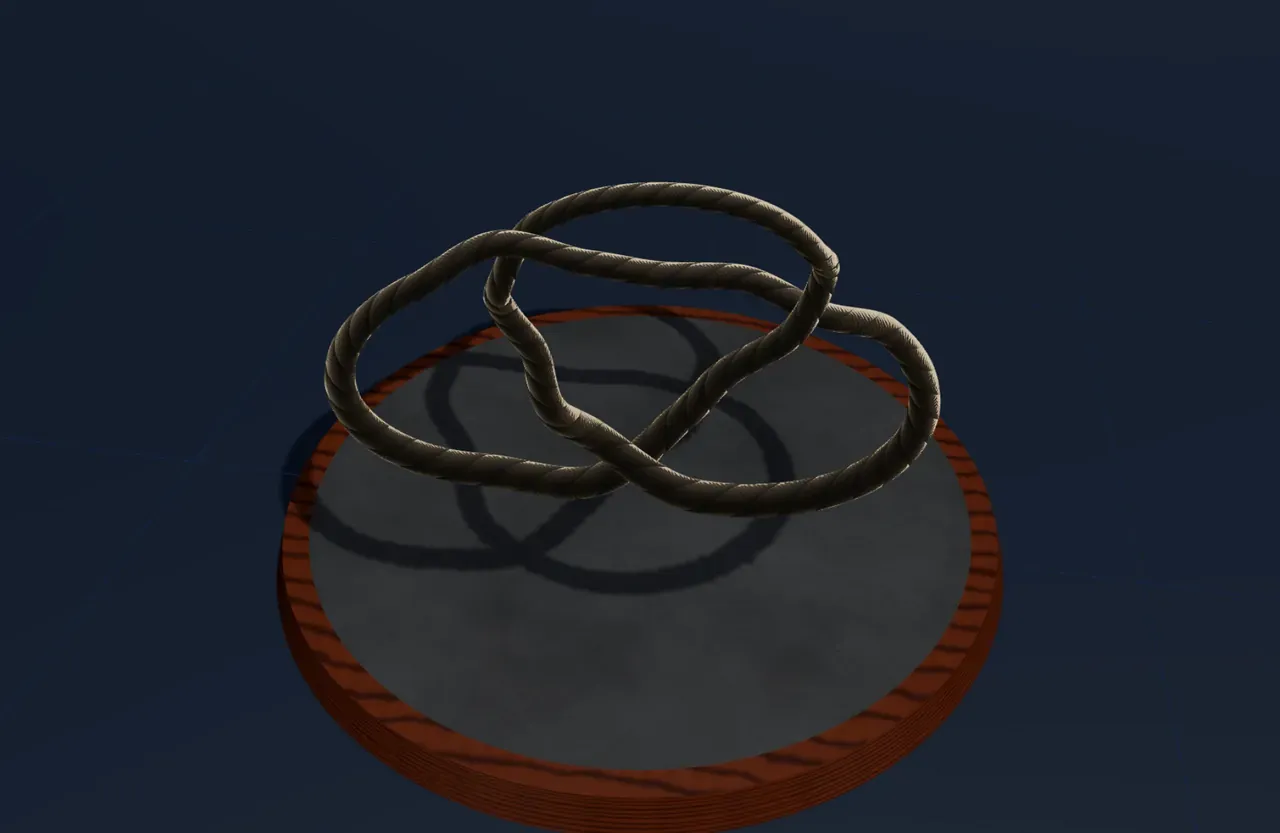
In mathematics a knot is a closed loop of rope: its two ends are joined, so they cannot be pulled through. The loop is drawn from above, in a drawing where the rope passing under is broken. A point where the rope passes over itself is a crossing.
Three moves shift the rope without cutting it: move I, the twist, adds or removes one crossing; move II, the push, adds or removes two; move III, the slide, moves a strand across a crossing. The Crossings are fixed now.
Step 2 of 6
Proof that it is a knot
In the trefoil every crossing goes over, under, over in turn, and no move removes a crossing. But perhaps we just have not found the right order? To prove a knot is real you need an invariant: a property that no move changes.
The rule of 3-colouring: colour each arc of the drawing so that at every crossing the three arcs that meet there are all one colour, or all different colours.
Step 3 of 6
Arcs
An arc is a stretch of rope in the drawing, from one place where it is broken to the next. At the Drawing stage you can see the breaks. The Crossings and the untangling are fixed now.
Step 4 of 6
What crossings do not tell you
A knot’s crossing number is the smallest number of crossings among all its drawings: for the trefoil, for the figure-eight. One drawing can hold more crossings than that. Think about what six crossings in one drawing tell you, and what they do not.
Step 5 of 6
The crossing number of a fake
One drawing can hold crossings it does not need. The crossing number ignores them.
Step 6 of 6
Five colours
One invariant is not enough for every knot. Draw and untangle at Drawing shows the arcs.
Loading the interactive version…
Loading the interactive version…
Each step sets up the Scene for you, and a control marked “fixed” stays put for that step.
Practice · Predict, then look
The Fake knot has two crossings in its drawing. What will happen when you try to untangle it?
Practice · Predict, then look
The Fake knot has two crossings in its drawing. What will happen when you try to untangle it?
Practice · Choose
The Trefoil cannot be untangled by moves. What proves it really is a knot?
Practice · Choose
The Trefoil cannot be untangled by moves. What proves it really is a knot?
Practice · Calculate
In the Figure-eight’s drawing, how many arcs are there? An arc is a stretch of rope from one pass under the rope to the next.
Practice · Calculate
In the Figure-eight’s drawing, how many arcs are there? An arc is a stretch of rope from one pass under the rope to the next.
Practice · Choose
A closed rope lies on the table, and its drawing has six crossings. What can you say for sure?
Practice · Choose
A closed rope lies on the table, and its drawing has six crossings. What can you say for sure?
Practice · Calculate
The Fake knot’s drawing has crossings, but it can be untangled. The crossing number of a loop is the fewest crossings any of its drawings has. What is the fake knot’s crossing number?
Practice · Calculate
The Fake knot’s drawing has crossings, but it can be untangled. The crossing number of a loop is the fewest crossings any of its drawings has. What is the fake knot’s crossing number?
Practice · Reach the target
The 3-colouring rule proves that the Trefoil is a knot. But some true knots cannot be coloured with three colours, and need a rule with colours. Change the Crossings until you find such a knot, and press Check.
Practice · Reach the target
The 3-colouring rule proves that the Trefoil is a knot. But some true knots cannot be coloured with three colours, and need a rule with colours. Change the Crossings until you find such a knot, and press Check.
Lesson complete. Every practice question here is done.