Keeping pace with Earth
Earth takes a year to go round the Sun. Anything orbiting closer to the Sun goes round faster, and anything farther out goes slower: Mercury’s year lasts 88 days, Mars’s almost two Earth years. So a spacecraft sent into its own orbit round the Sun drifts away from Earth, ahead or behind, and its radio signal grows weaker every month.
There are five places where that does not happen. A probe placed at one of them, moving at the right speed, goes round the Sun in exactly a year, keeping the same position relative to the Sun and Earth. They are the Lagrange points, labelled L1 to L5. Leonhard Euler found the three on the Sun–Earth line in the 1760s, and Joseph-Louis Lagrange found the other two in 1772.
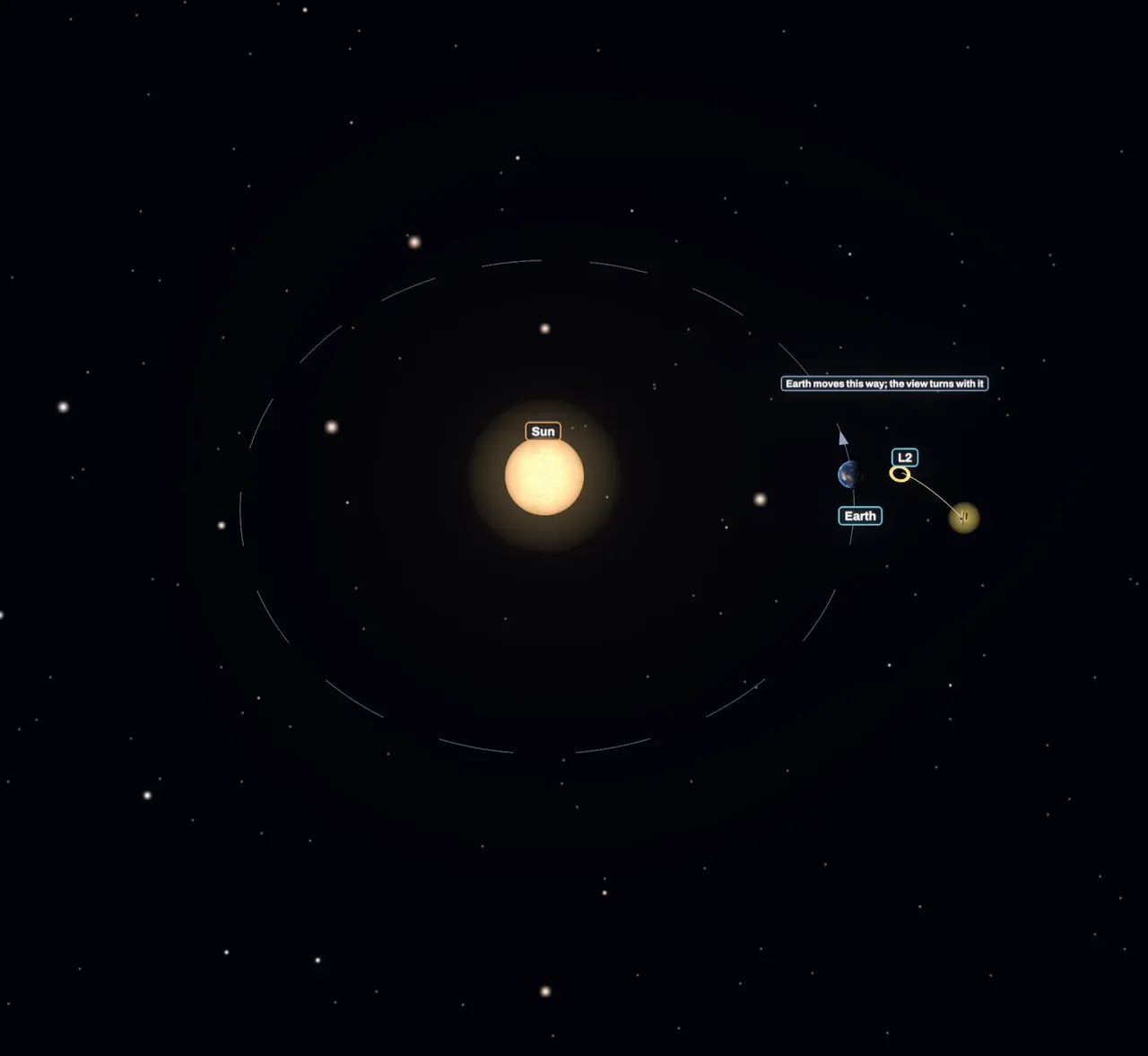
The scene shows them in a view that turns with Earth, once a year. Seen this way, the Sun and Earth hold still, and a probe parked at a Lagrange point holds still too.
Why the pulls balance
To keep pace with Earth on a circle round the Sun, a probe needs exactly the pull that bends its path into that circle at Earth’s rate of turning. Too little pull and it drifts outward; too much and it falls inward.
- L1 lies between the Sun and Earth, about 1.5 million kilometres from Earth. On its own a probe there would orbit faster than Earth, but Earth pulls it outward, away from the Sun, cancelling just enough of the Sun’s pull to slow it to Earth’s pace.
- L2 lies the same distance beyond Earth. Out there a probe would normally fall behind, but Earth’s pull adds to the Sun’s, speeding it up to Earth’s pace.
- L3 sits on the far side of the Sun, almost exactly as far from it as Earth. Earth’s small pull, from across the Sun, adds to the Sun’s and makes up the difference.
- L4 and L5 lie on Earth’s orbit, 60° ahead and 60° behind. Each forms an equilateral triangle with the Sun and Earth, and there the two pulls combine to point at the shared centre of mass the pair turns about, with the right strength.
In the turning view, this balance looks like a force pushing outward from the centre: the centrifugal effect, the same outward fling you feel on a roundabout. It is not a real pull; it is the effect of looking from something that turns. A Lagrange point is where the Sun’s pull, Earth’s pull and that outward fling add up to nothing.
Try it: set Nudge away from the Sun to 0 and step through all five points in Park the probe at. At each one the probe holds still. Then slide it to 0.5% and watch which points let it go.
Hilltops and saddles
Choose On under Show effective gravity. The surface shows the Sun’s and Earth’s pull together with the outward fling, as a landscape. A probe at rest on it is pulled downhill: deep wells at the Sun and Earth, and a slope down to the outside where the fling wins. The Lagrange points are the five flat places on this landscape.
L1, L2 and L3 are saddles, like a mountain pass: downhill on two sides and uphill on the other two. Nudge a probe off one and it slides away, slowly at first and then faster. A spacecraft there must fire small thrusters every few weeks to stay, which is called station-keeping. The bright contours trace the level of each saddle.
L4 and L5 are hilltops, which should be even less stable. But a probe that moves in a turning frame is also turned sideways, by the Coriolis effect, the same effect that turns winds into circles round storms on Earth. As the probe starts to slide off the hill, it is swung round it instead, into a slow loop. Nudge a probe at L4 and its path traces a tadpole shape that never leaves.
Try it: park the probe at L4, slide Nudge away from the Sun to 1.5%, and wait. The path swings into a long, tadpole-shaped loop along Earth’s orbit and back, which takes a few years to complete. Then set Earth’s mass to Past the limit and watch the loops grow until the probe leaves.
The trick works only while the smaller body is light. If it has more than about 4% of the bigger one’s mass (3.85% of the pair’s total), the loops grow until the probe escapes. Every planet is far lighter than the Sun, and every large moon far lighter than its planet, so their L4 and L5 points can collect natural objects. Jupiter’s hold more than ten thousand known Trojan asteroids. Earth has two known Trojans, tiny asteroids at its L4.
Why telescopes park at L2
From L2, the Sun, Earth and Moon always lie in the same direction, behind the spacecraft. A single sunshield can block all three, keeping a telescope dark and cold enough to see faint infrared light, the warmth of very distant galaxies and newborn stars. Its view of the sky is wide open, and it stays at a steady distance from Earth for constant radio contact. The James Webb Space Telescope and Euclid orbit there, as Gaia, Planck and Herschel did before them.
They do not sit exactly on the point. They circle it in large loops, hundreds of thousands of kilometres across, so that they never pass through Earth’s shadow, which would cut off their solar power. Because L2 is a saddle, each one needs a short thruster burn every few weeks.
L1 has the opposite view: it looks at the Sun without interruption, and Earth never gets in the way. Solar observatories like SOHO and storm-warning craft sit there, giving about an hour’s notice of solar storms on their way to Earth. L3 is permanently hidden behind the Sun, so nothing has been sent there.
What this model leaves out
The real Earth has about one three-hundred-thousandth of the Sun’s mass, so the real L1 and L2 are only 1% of the way from Earth to the Sun, about four times the Moon’s distance. The scene uses a far heavier Earth so the points can be seen; heavier still, as the slider allows, the points spread farther. Orbits here are perfect circles in one plane. The real Earth’s orbit is slightly elliptical, and the Moon, Jupiter and the other planets add small pulls, which is another reason spacecraft must correct their course. The probe’s mass is too small to move the Sun or Earth. The surface’s heights are stretched so its shallow ridge shows beside the deep wells, and the Sun and Earth are drawn much larger than they are at this scale.