Five points where a probe goes round the Sun in step with the Earth. Why L1 and L2 are so close to the Earth, why they are unstable, and why L4 and L5 hold asteroids.
Step 1 of 7 · Turning with the Earth
Step 1 of 7
Turning with the Earth
By Kepler’s third law, any body closer to the Sun than the Earth goes round it faster, and any body farther away goes round more slowly. So how can a probe be kept in the same place relative to the Earth? The answer is the Earth’s own gravity. In 1772 Joseph-Louis Lagrange found five points where the pull of the Sun and the Earth together gives exactly the centripetal force of an orbit of one year.
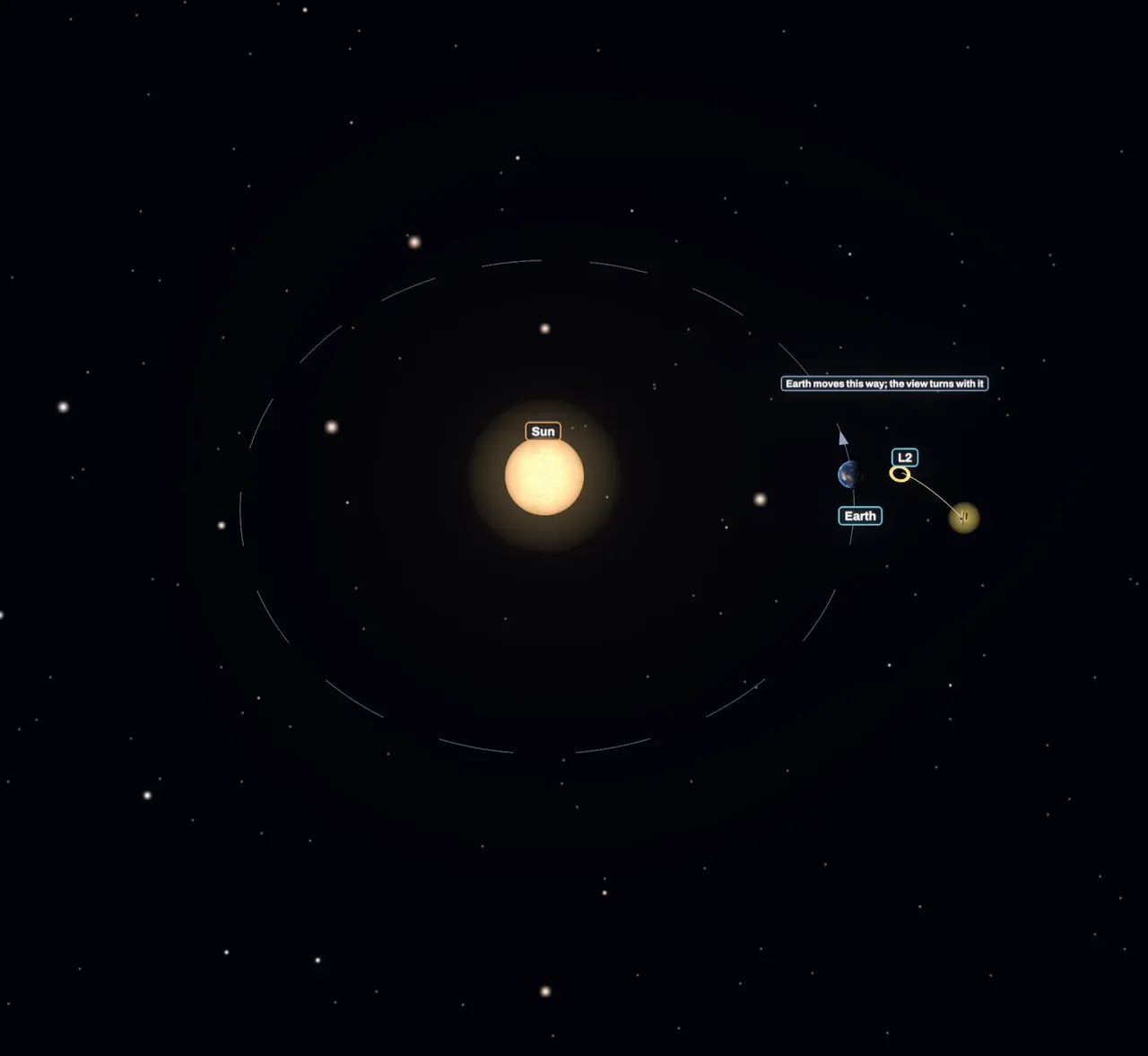
The Scene turns with the Earth, so the Sun and the Earth seem to stand still. A probe parked at one of the points stands still too. To make the points stand out, Earth’s mass in the Scene is of the Sun’s, times the real value. The probe is now parked at L1, between the Sun and the Earth.
Step 2 of 7
How far
L1 and L2 are on either side of the Earth, on the line to the Sun. When , the Earth’s share of the total mass, is small, both are at roughly the same distance from it:
Here is the distance between the Sun and the Earth. For this estimate the difference between the Sun’s pulls at the point and at the Earth is set against the Earth’s pull, which is why a cube root comes out and not a square root. Park the probe at and Earth’s mass are locked.
Step 3 of 7
The real Earth
Earth’s mass is now of the Sun’s, like Jupiter, and L2 has come closer to it. For the real Earth , and its L1 and L2 are so close that in the Scene they would be inside the drawn globe.
Step 4 of 7
A saddle
At the point itself the forces match exactly. What happens to a probe that moves slightly? Now it is parked at L2 and nudged half a per cent of the distance to the Sun, away from the Sun. Run the motion. Once you have chosen, Show effective gravity will lower everything onto the effective-gravity surface: the gravity of both bodies together with the outward fling of the turning. The five points are its flat places.
Step 5 of 7
Trojans
L4 and L5 are sixty degrees ahead of the Earth and sixty degrees behind it, each at the corner of an equilateral triangle with the Sun and the Earth. Park the probe at is locked at L4, and the probe is nudged of the distance to the Sun.
Step 6 of 7
Routh’s limit
Whether L4 and L5 are stable depends on the mass ratio: the small body has to be light enough. Park the probe at is locked at L4, and the probe is nudged slightly.
Step 7 of 7
A telescope at L2
At L1 the SOHO spacecraft has circled since 1996, watching the Sun without a break, never hidden by the Earth. At L2 the James Webb Space Telescope has worked since 2022, looking away from it. Show effective gravity shows the effective-gravity surface, with the probe at L2.
Loading the interactive version…
Loading the interactive version…
Each step sets up the Scene for you, and a control marked “fixed” stays put for that step.
Practice · Choose
A probe at L1, between the Sun and the Earth, goes round the Sun in exactly one year, like the Earth, even though it is closer to the Sun. On an orbit that close it ought to go round faster. What slows it down?
Practice · Choose
A probe at L1, between the Sun and the Earth, goes round the Sun in exactly one year, like the Earth, even though it is closer to the Sun. On an orbit that close it ought to go round faster. What slows it down?
Practice · Calculate
Earth’s mass in the Scene is locked at of the Sun’s, and the probe is parked at L1. How far is L1 from the Earth, as a percentage of the Sun–Earth distance? Look at the Scene, then use the estimate , where is the Earth’s share of the total mass.
Practice · Calculate
Earth’s mass in the Scene is locked at of the Sun’s, and the probe is parked at L1. How far is L1 from the Earth, as a percentage of the Sun–Earth distance? Look at the Scene, then use the estimate , where is the Earth’s share of the total mass.
Practice · Calculate
The James Webb Space Telescope is near the Sun–Earth L2. The Earth’s mass is of the Sun’s, and the distance to the Sun is . Using the estimate , how far is L2 from the Earth?
Practice · Calculate
The James Webb Space Telescope is near the Sun–Earth L2. The Earth’s mass is of the Sun’s, and the distance to the Sun is . Using the estimate , how far is L2 from the Earth?
Practice · Predict, then look
The probe is parked at L2 and nudged slightly, half a per cent of the distance to the Sun, away from the Sun. What will it do once it is let go?
Practice · Predict, then look
The probe is parked at L2 and nudged slightly, half a per cent of the distance to the Sun, away from the Sun. What will it do once it is let go?
Practice · Predict, then look
Now the probe is parked at L4, sixty degrees ahead of the Earth, and nudged of the distance to the Sun. Show effective gravity will show that L4 is a hilltop of the effective-gravity surface. What will the probe do?
Practice · Predict, then look
Now the probe is parked at L4, sixty degrees ahead of the Earth, and nudged of the distance to the Sun. Show effective gravity will show that L4 is a hilltop of the effective-gravity surface. What will the probe do?
Practice · Reach the target
L4 holds a probe only while the small body is light enough. The probe is at L4, nudged slightly. Increase Earth’s mass until L4 stops holding it, and press Check.
Practice · Reach the target
L4 holds a probe only while the small body is light enough. The probe is at L4, nudged slightly. Increase Earth’s mass until L4 stops holding it, and press Check.
Practice · Choose
The James Webb telescope sees very faint infrared light, so it has to stay cold, below . Why was it sent to L2 in particular?
Practice · Choose
The James Webb telescope sees very faint infrared light, so it has to stay cold, below . Why was it sent to L2 in particular?
Lesson complete. Every practice question here is done.