A weight on a string keeps time
Pull a weight on a string aside and let it go. It swings out and back, out and back, and each round trip takes the same time as the last, even as the swings slowly shrink. That steady beat is why pendulums ran the world’s most accurate clocks for nearly three hundred years, from Christiaan Huygens’ first pendulum clock in 1656 until quartz clocks took over in the twentieth century.
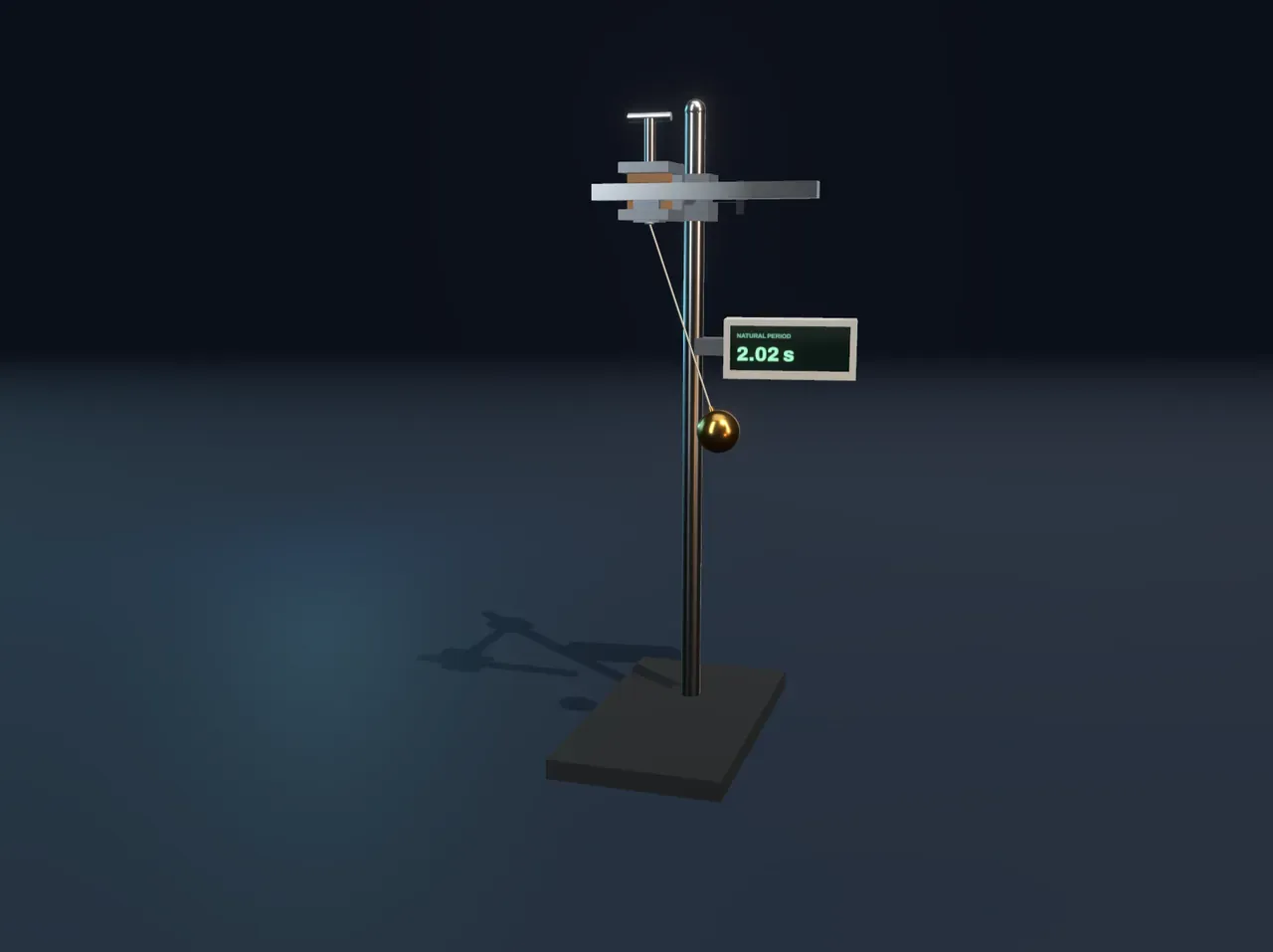
One full swing, out and back again, is the period. For a one-metre string on Earth it is about two seconds. The scene’s timer shows it to the hundredth of a second.
Length sets the beat
Make the string longer and the swing slows down. It does not slow in proportion, though: a string four times as long takes twice as long per swing, and one nine times as long takes three times as long. The period grows with the square root of the length.
The reason is the shape of the path. At any angle, gravity pulls the bob along its arc with the same strength, whatever the string’s length. A long string makes a long arc, so the bob has farther to travel at that same push. A clock pendulum about a metre long takes almost exactly one second for each swing across, which is why tall longcase clocks are the height they are.
Try it: set String length to 0.25 m, then 1 m. The timer goes from about 1.0 s to about 2.0 s: four times the length, twice the period.
Gravity sets the beat too
The pull that brings the bob back is gravity, so a stronger gravity means a quicker swing. On the Moon, where gravity is about a sixth of Earth’s, the same one-metre pendulum would take almost five seconds per swing. On Jupiter, at about two and a half times Earth’s pull, it would take about 1.3 seconds. Put together, the period is 2π times the square root of length divided by gravity: T = 2π√(L/g).
Not the weight, and hardly the swing
Two things that seem as if they should matter barely do. A heavier bob is pulled harder by gravity, but it is also harder to get moving, by exactly the same factor, so it swings at the same pace. Galileo noticed the other surprise around 1600: a wide swing and a narrow one take almost the same time, because the wide swing covers more ground but moves faster along it.
Almost, not exactly. The simple formula assumes small swings. Release the bob at 45° and the period is about 4% longer; at 80° it is about 14% longer, because at wide angles the pull along the arc grows more slowly than the distance from the bottom. The scene integrates the full equation of motion, so the timer shows this.
Reveal the energy and you can watch the bob trade height for speed. At the ends of each swing it stops for an instant, with all its energy stored as potential energy of height. At the bottom it moves fastest, with all its energy as kinetic energy of motion. The pen trace below it draws the swing against time, one grid line for every second.
What this model leaves out
The scene treats the string as weightless and unstretchable and the bob as a single point, so a real pendulum of the same size would differ very slightly. Its friction is simplified: real pendulums lose energy to the air and the pivot, which is why a clock gives its pendulum a small push every swing. A real string also goes slack if the bob is lifted above the pivot, which a rigid rod would not. Finally, the Earth turns beneath any long-running pendulum, slowly rotating its swing, as Léon Foucault showed in Paris in 1851; the scene’s short run leaves that out.