What sets the period of a mass on a string: the length and gravity, not the mass, and hardly the size of the swing.
Step 1 of 6 · A longer string
Step 1 of 6
A longer string
A mass on a string, a pendulum, swings back and forth about its lowest point. Here the restoring force is gravity: when the bob is to one side, the part of gravity along the arc pulls it back towards the bottom. At small angles that part is almost in proportion to the distance from the bottom, so a pendulum too moves, to a good approximation, in simple harmonic motion.
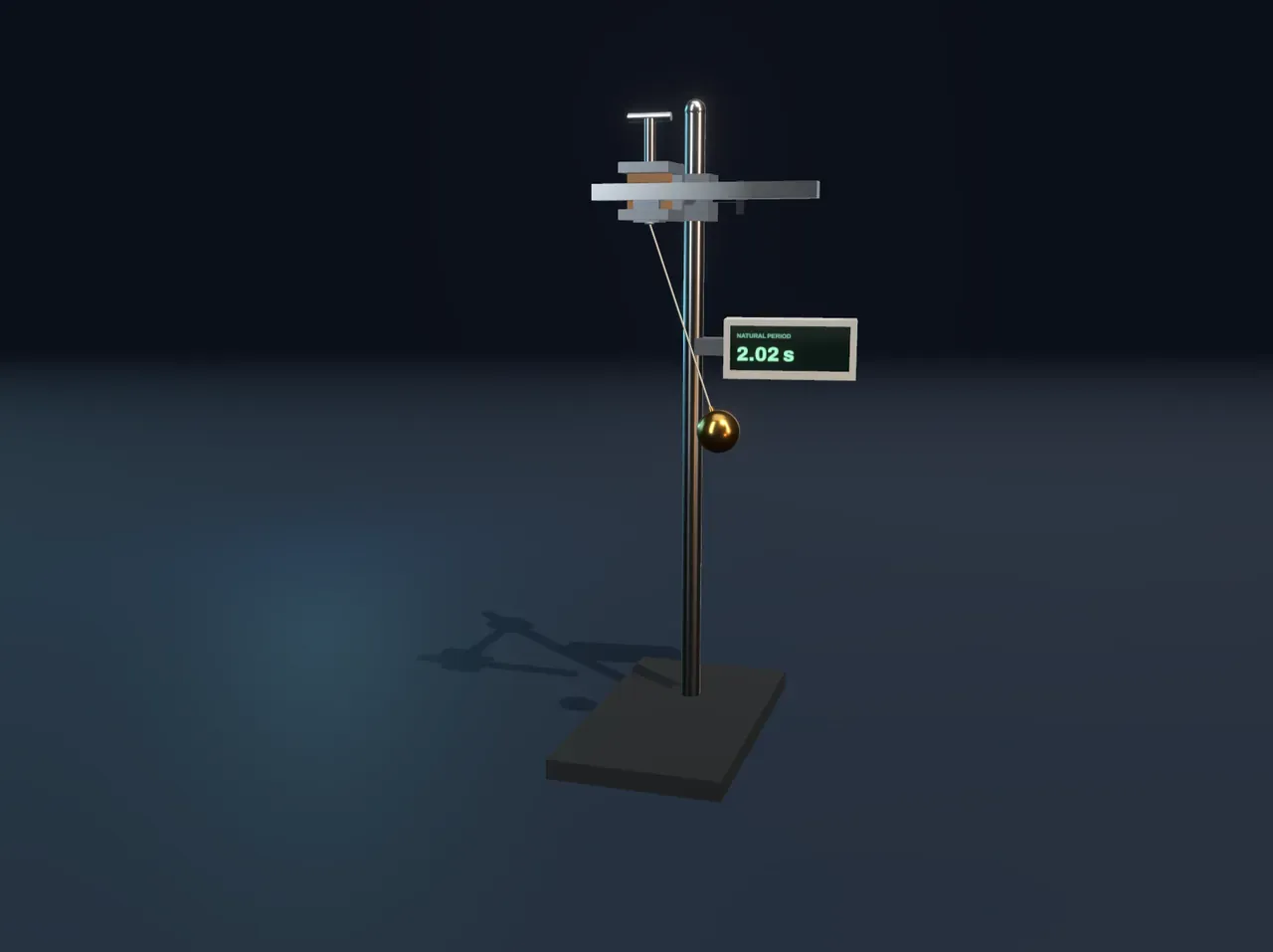
Predict what will happen to the period when the string is made four times longer, from 25 cm to a metre, then watch the timer.
Step 2 of 6
The formula
When the string is tilted at an angle , the part of gravity along the arc is . At small angles, in radians, , and the distance from the bottom along the arc is . So the restoring force is about
That is exactly Hooke’s law, with in place of . Put it into the spring’s formula:
The timer is now hidden. Work out the period of a pendulum 1.5 m long.
Step 3 of 6
A heavier bob
The mass cancelled in the formula. Predict whether that holds in the Scene too: what will happen to the period when the 0.5 kg bob is replaced by a 2 kg one?
Step 4 of 6
On the Moon
Gravity on the Moon is about 1.62 m/s², roughly a sixth of the Earth’s. It is now fixed at Moon, and the timer is hidden. Work out the period of the one-metre pendulum.
Step 5 of 6
A clock on the Moon
An astronaut wants to build a pendulum clock on the Moon whose every full swing takes 4.00 s. How long must the string be? Work it out, then move String length and check on the timer.
Step 6 of 6
Wide swings
The formula rests on the approximation . At it is very good: is about radians, and . At it is not: is about radians, but . The Scene works out the full equation of motion, without the approximation.
Predict what will happen to the period when the bob is released from instead of .
Loading the interactive version…
Loading the interactive version…
Each step sets up the Scene for you, and a control marked “fixed” stays put for that step.
Practice · Predict, then look
The string will be made four times longer, from 25 cm to 1 m. What will happen to the period?
Practice · Predict, then look
The string will be made four times longer, from 25 cm to 1 m. What will happen to the period?
Practice · Calculate
A pendulum 1.5 m long swings on the Earth through a small angle, . What is its period? Use .
Practice · Calculate
A pendulum 1.5 m long swings on the Earth through a small angle, . What is its period? Use .
Practice · Predict, then look
The 0.5 kg bob will be replaced by a 2 kg one, on the same string. What will happen to the period?
Practice · Predict, then look
The 0.5 kg bob will be replaced by a 2 kg one, on the same string. What will happen to the period?
Practice · Calculate
The same pendulum, one metre long and at , swings on the Moon, where . What is its period?
Practice · Calculate
The same pendulum, one metre long and at , swings on the Moon, where . What is its period?
Practice · Reach the target
On the Moon, at , change String length until the period is 4.00 s, then press Check.
Practice · Reach the target
On the Moon, at , change String length until the period is 4.00 s, then press Check.
Practice · Predict, then look
The bob will be released from instead of , on the same string. What will happen to the period?
Practice · Predict, then look
The bob will be released from instead of , on the same string. What will happen to the period?
Lesson complete. Every practice question here is done.