Small pushes at the right rhythm: the natural frequency, why pushes in step build a big swing, and how friction decides how big.
Step 1 of 6 · The natural rhythm
Step 1 of 6
The natural rhythm
So far the oscillators swung on their own, at their own rhythm. That rhythm is the natural frequency : the frequency a pendulum or a mass on a spring oscillates at once you let it go.
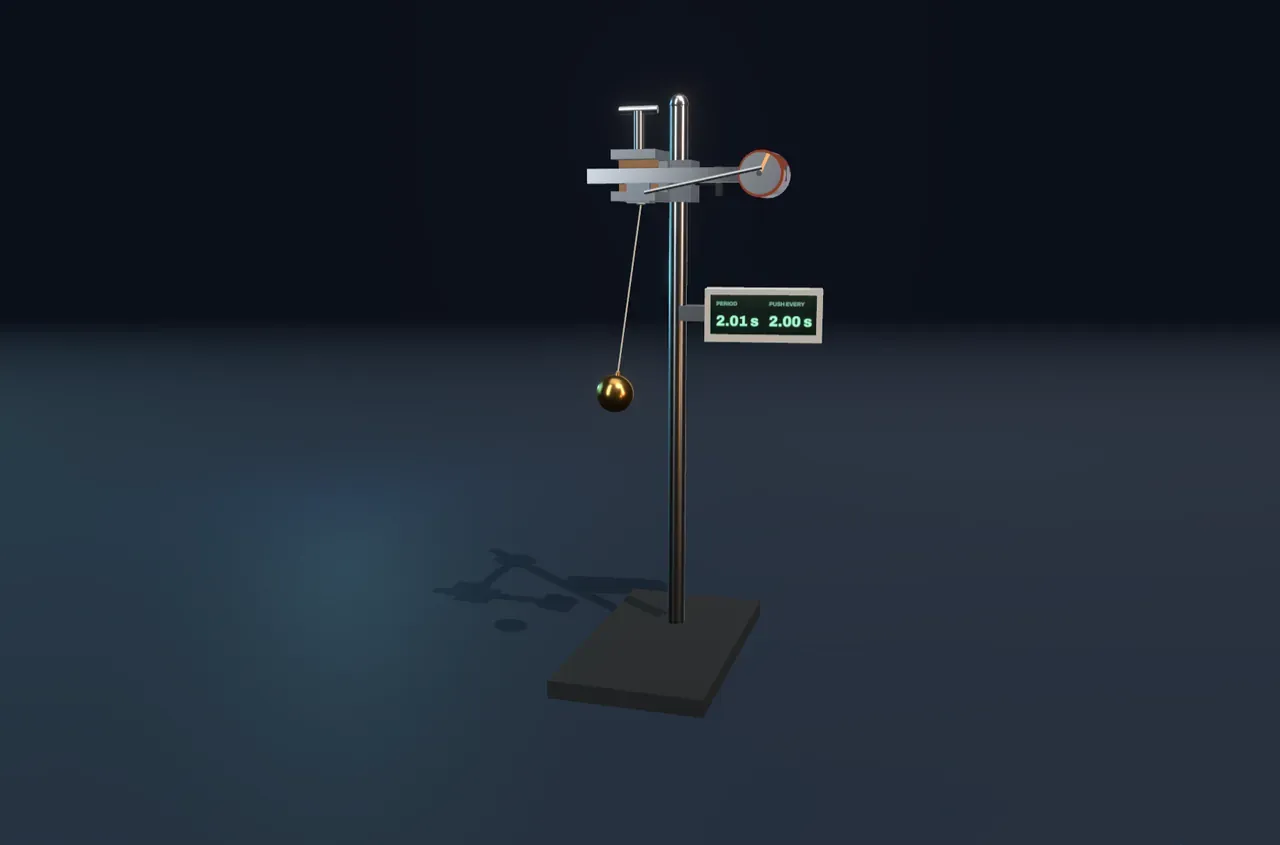
In the Scene a one-metre pendulum hangs from a motor, which moves the point it hangs from to and fro, 3 cm each way, at the rate set by Push rate, in hertz. The timer shows the pendulum’s period and the time from one push to the next. Work out the pendulum’s natural frequency.
Step 2 of 6
In step
A push adds energy only when it comes in the direction the bob is already moving. When the pushes come at the natural frequency, each one lands at the right moment, and the energy builds up from swing to swing. That is resonance: a small repeated push builds a large motion when its rhythm matches the rhythm the object already has.
The motor is now pushing at 0.25 Hz, a push every four seconds, and the pendulum hardly moves. Predict which rate will build the biggest swing. The build-up takes about half a minute: after you predict, wait and watch.
Step 3 of 6
How big
If every push adds energy, why does the swing not grow for ever? Because friction takes energy, and more of it the bigger and faster the swing. The swing settles when the loss in each cycle equals what the pushes put in.
The number on Friction is the damping ratio (zeta): how quickly an oscillation dies away when nothing pushes it. Pushed exactly at the natural frequency, the swing settles at an amplitude
where is the motor’s stroke. The weight now hangs on a spring, tuned to the same natural frequency as the pendulum, because for a spring the formula is exact. For a pendulum it holds only for small swings: a wide swing slows itself down, drifts a little out of step and settles smaller, at about instead of the the formula gives.
The motor is pushing in step. Work out the amplitude the bounce will settle at, then choose On under Show energy and trace and watch it build.
Step 4 of 6
Tuning the friction
The formula says that friction decides how big the swing in step gets. Find the friction at which the bounce settles at 25 cm. The trace shows the bounce building, which takes a few tens of seconds.
Step 5 of 6
Lots of friction
What exactly does friction change? Answer, then set Friction to and watch the trace.
Step 6 of 6
Bridges and footsteps
Resonance turns up wherever something oscillates and pushes repeat: a swing, a guitar string, a glass whose natural note a singer holds, a bridge people walk across. Engineers work out the natural frequencies of structures and add damping where needed, so that a steady rhythm of footsteps, wind or machines does not build a big oscillation in them.
Here the friction is very small. Leave Push rate on In step and watch how far the pendulum goes, then answer the question.
Loading the interactive version…
Loading the interactive version…
Each step sets up the Scene for you, and a control marked “fixed” stays put for that step.
Practice · Calculate
What is the natural frequency of a pendulum 1 m long on the Earth, in hertz?
Practice · Calculate
What is the natural frequency of a pendulum 1 m long on the Earth, in hertz?
Practice · Predict, then look
The motor will push the pendulum, whose natural frequency is about 0.50 Hz, at one of three rates. Which one will build the biggest swing?
Practice · Predict, then look
The motor will push the pendulum, whose natural frequency is about 0.50 Hz, at one of three rates. Which one will build the biggest swing?
Practice · Calculate
The mass on the spring is pushed in step, at 0.50 Hz, and Friction is . The motor’s stroke is 3 cm. At what amplitude will the bounce settle?
Practice · Calculate
The mass on the spring is pushed in step, at 0.50 Hz, and Friction is . The motor’s stroke is 3 cm. At what amplitude will the bounce settle?
Practice · Reach the target
The pushes are in step. Change Friction until the bounce settles at an amplitude of 25 cm, then press Check.
Practice · Reach the target
The pushes are in step. Change Friction until the bounce settles at an amplitude of 25 cm, then press Check.
Practice · Choose
The pushes are in step, and the friction grows five times, from to . What happens to the bounce?
Practice · Choose
The pushes are in step, and the friction grows five times, from to . What happens to the bounce?
Practice · Choose
Soldiers crossing a bridge are told to break step. Why?
Practice · Choose
Soldiers crossing a bridge are told to break step. Why?
Lesson complete. Every practice question here is done.