Small pushes, big swings
Anyone who has pushed a child on a swing knows the trick. You do not shove hard; you give a light push at the same moment in every swing, just as it starts to move away from you. After a dozen pushes the swing is flying, although no single push did much. Push at the wrong moments and the same effort does almost nothing.
That is resonance: a small, repeated push builds a large motion when its rhythm matches the rhythm the object already has.
Everything has a natural rhythm
Pull a pendulum aside and let go, and it swings at its own pace, set by its length and by gravity. Twang a ruler, tap a wine glass or pluck a guitar string, and each vibrates at its own particular rate too. That rate is the object’s natural frequency, measured in hertz, or swings per second. A one-metre pendulum’s is about half a hertz: one swing every two seconds.
In step, every push adds energy
A push adds energy only if it goes the same way the object is already moving. When the pushes come at the natural frequency, every push lands at the right moment, so the energy from each one adds to the last. The swing grows and grows.
When the pushes come too slowly or too fast, they drift in and out of step with the swing. Some help, the next ones hinder, and over time they mostly cancel out. The swing stays small however long you wait.
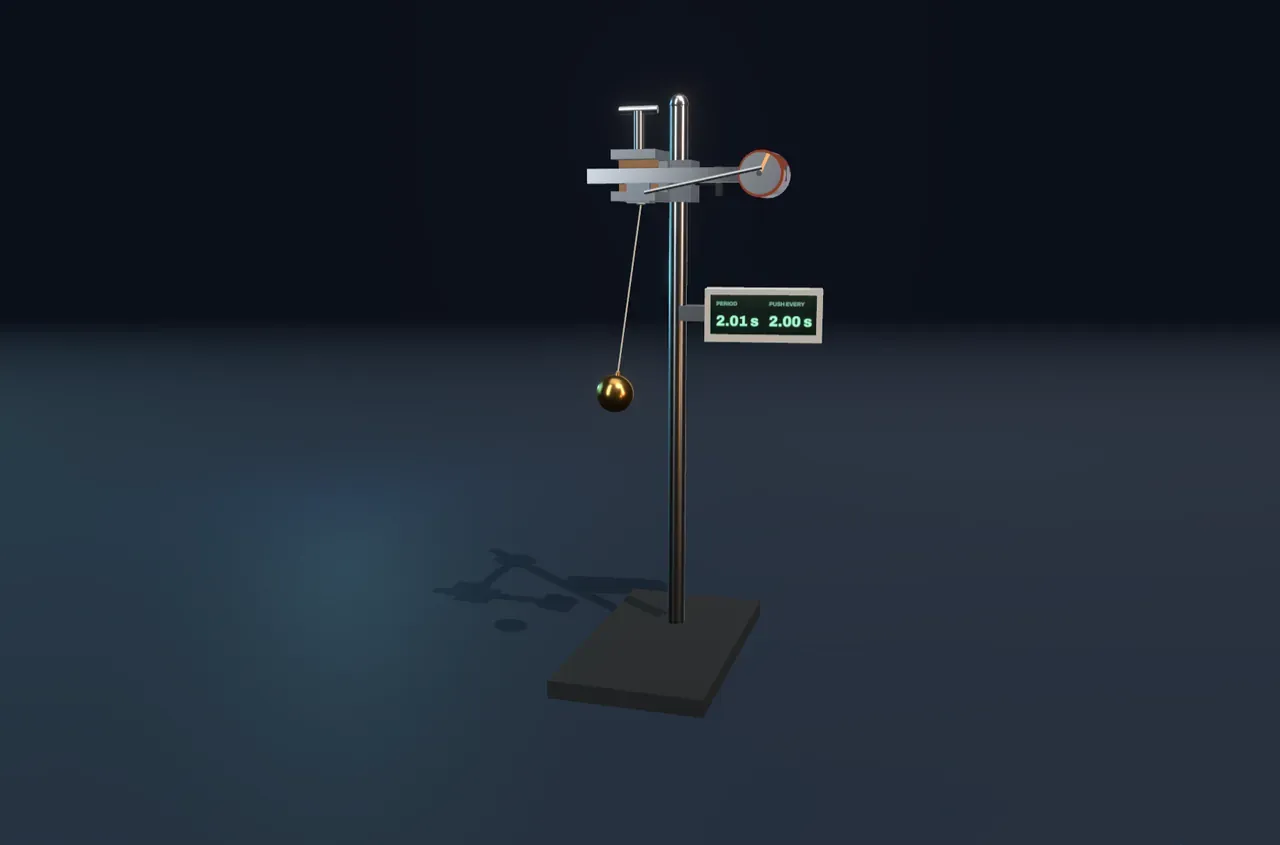
Try it: start with the push rate In step and watch the pendulum build over half a minute. Then pick Too slow or Too fast, and watch the big swing die away into a twitch.
The motor in the scene moves the pivot by only 3 cm, yet in step it builds a swing of about 25° on each side, a sweep of nearly a metre.
Friction sets the limit
If every push adds energy, why does the swing not grow forever? Because friction takes energy away, and it takes more the faster the swing moves. The swing grows until the energy lost in each cycle equals the energy each push adds, then stays at that size. Less friction means a bigger final swing, and a sharper response: only push rates very close to the natural one have much effect.
Reveal the energy to watch this happen. The column shows the swing’s energy rising as it builds, sloshing between motion and height in every cycle, and the trace below draws the growing swing.
The same rule holds for a weight on a spring. Choose A spring: it has been tuned to the pendulum’s natural period, and pushes in step build its bounce in exactly the same way.
Glasses, bridges and buildings
A singer holding the natural note of a thin wine glass can, with enough volume, make it vibrate until it cracks. Engineers worry about the reverse. When London’s Millennium Bridge opened in 2000, it began to sway sideways under the crowd; people walking on a moving deck fell into step with the sway, feeding it, and the bridge closed after two days until dampers were added. Soldiers are traditionally told to break step when marching over a bridge for the same reason.
What this model leaves out
The scene shows one simple oscillator with one natural frequency. Real structures have many, and can resonate in several ways at once. Friction here is a smooth drag in proportion to speed, a good match for air and a rough one for rubbing joints. Very wide swings also change a pendulum’s own natural rate slightly, which the scene does include, so the biggest build-ups sit just below the matched push rate. Not every dramatic shaking is resonance either: the Tacoma Narrows Bridge, which tore itself apart in 1940, was driven by wind feeding its own twisting motion, a related effect called flutter.