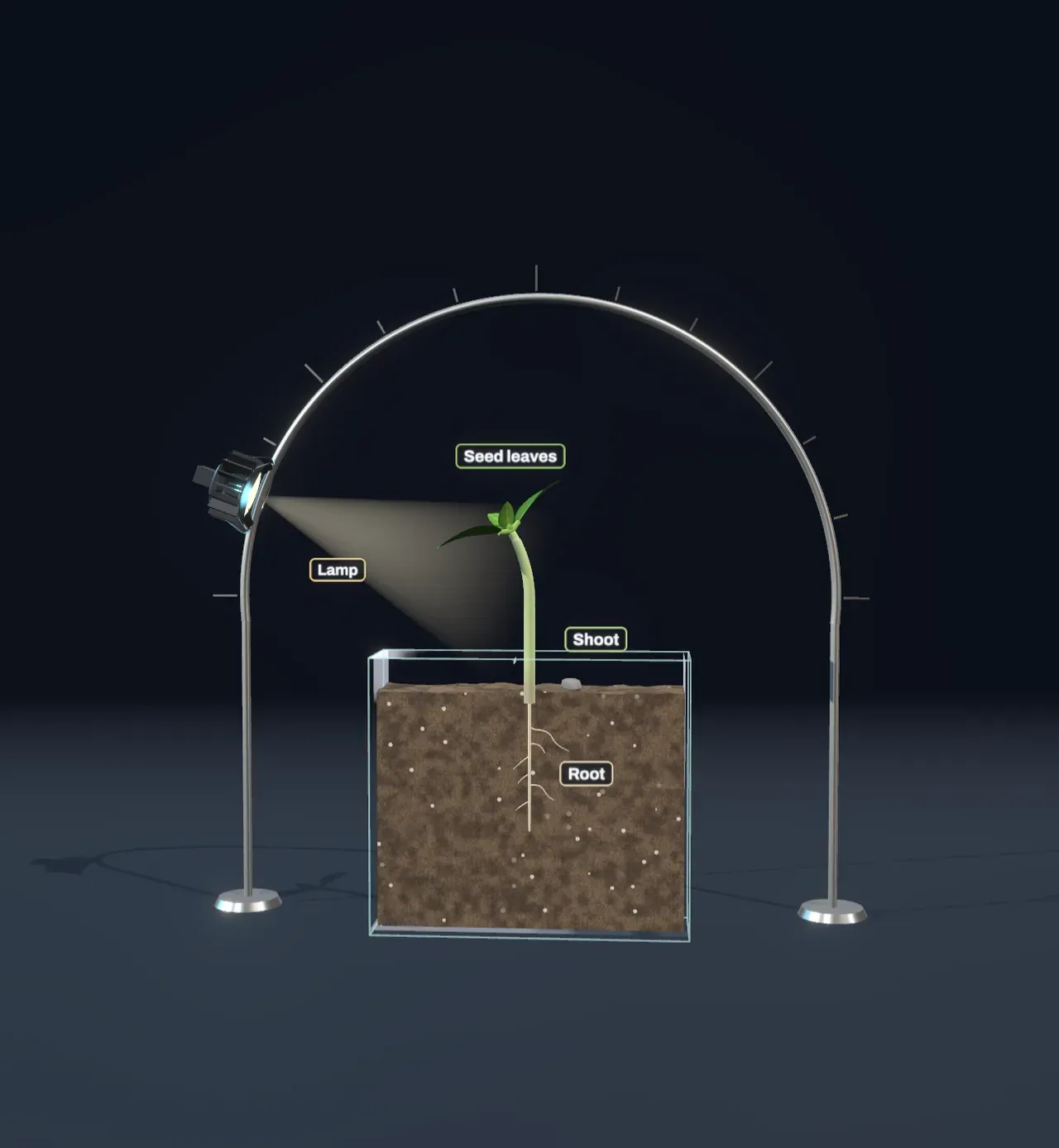
A plant built in two directions
A seedling grows two ways at once. Its shoot grows up into the light and carries the leaves, which make the plant’s food by photosynthesis. Its root grows down into the soil, anchors the plant and takes up water and minerals, which travel up to the leaves as plant transpiration describes. The sunflower in the Scene is about a week old. Its stem below the leaves is the hypocotyl, and the two thick, oval leaves at its top are seed leaves, or cotyledons, which held the food stored in the seed. Between them, the first pair of true leaves is opening. The empty, striped seed hull lies on the soil.
A plant grows only at a few places. At the tip of each shoot and each root sits a meristem, a small cluster of cells that keeps dividing for the plant’s whole life. Behind each tip, the new cells grow longer in a growing zone: in the seedling’s shoot, the top two centimetres or so; in its root, only the few millimetres behind the tip. Below that the cells stop growing. Whatever shape the stem has when it leaves the growing zone, it keeps.
A plant cell grows by taking in water. Its large central vacuole swells against the cell wall, and the wall gives way only where it has been loosened. A young cell can grow ten or more times longer this way without making any new cell material inside, which is why a seedling can grow a few millimetres in an hour.
Growing towards the light
A plant cannot walk to the light, but it can steer towards it. A tropism is a growth movement towards or away from something coming from one direction: towards light (phototropism), with or against gravity (gravitropism), towards touch, or towards water.
In 1880 Charles Darwin and his son Francis grew grass seedlings in the dark and lit them from one side. Within hours they bent towards the light. When the Darwins covered the very tip with a tiny cap, the seedling did not bend at all; when they covered the part below the tip, it bent as usual. The tip sees the light, they concluded, and something travels from it to the part that bends. In 1928 Frits Went cut tips off oat seedlings, stood them on small blocks of jelly, and placed the blocks on one side of cut stumps: the stumps bent away from that side. The substance that had soaked out of the tips was named auxin, from a Greek word meaning “to grow”.
Try it: set Lamp direction to −70°, so the lamp shines from the left, then drag Time since the change from 0 h to 24 h. For half an hour nothing visible happens; then the top of the shoot curves towards the lamp, quickly at first and then more slowly.
Plants sense the light’s direction with blue-light receptors called phototropins. The side of the stem facing the lamp gets more blue light than the far side, which the stem’s own tissue shades.
Auxin moves to the shaded side
Auxin is made in the shoot tip and the young leaves, and it is passed down the stem from cell to cell by carrier proteins in the cell membranes. When light comes from one side, the carriers in the cells near the tip move, and more of the auxin flows down the shaded side.
Auxin makes a shoot cell grow faster. It switches on pumps that push hydrogen ions into the cell wall; the wall becomes more acidic, proteins in it loosen the links between its cellulose fibres, and the swollen vacuole stretches the cell further. So the cells on the shaded side stretch more than those on the lit side, and the stem curves towards the light, just as a strip of two metals curves when one of them expands more.
The difference does not need to be large. If a stem of diameter bends into an arc of radius , the outside of the bend is longer than the inside by
For a sunflower hypocotyl 4 mm thick bent into a curve of radius 2 cm, the cells on the outside need to grow only about a fifth more than those on the inside.
Try it: step Zoom to the root tip to Shoot. Amber specks of auxin run down from the tip and drift to the side away from the lamp. The cells on that side are longer, and the chart shows how the auxin is shared between the sides. Drag Time since the change to 24 h: the auxin is even again, but the long cells on the outside of the bend stay long.
Which way is down?
Lay a potted seedling on its side and in a few hours its shoot curves up and its root curves down. A plant has no inner ear, but some of its cells hold statoliths: grains of starch, packed inside small bags called amyloplasts, that are denser than the rest of the cell and sink to whichever side is down within minutes. In the root they sit in the middle cells of the root cap, the protective cap over the root tip; in the shoot, in a sheath of cells round its veins.
When a root is tipped over, the statoliths settle on the new low side of the cap’s cells, and the cells send more auxin up the root’s low side. Here comes the surprise: in a root, extra auxin slows growth. Roots are far more sensitive to auxin than shoots, and the amount that makes a shoot cell grow faster holds a root cell back. So the root’s upper side grows faster than its lower side, and the root curves down. In a tipped shoot, auxin also gathers on the low side, where it speeds growth, so the shoot curves up. One hormone, gathering on the same side, makes a root and a shoot bend in opposite directions.
Try it: set Lamp direction to 0° and Box tilt to 90°, then Time since the change to 0 h, and step Zoom to the root tip to Root tip. The dark grains (statoliths, drawn as if stained with iodine) still lie towards the old bottom of each cell. Set it to 1 h: they have settled on the new low side, and amber auxin gathers along the root’s lower edge.
Because a root is long and grows only near its tip, the turn stays behind as a bend, and the root grows on in its new direction. That is why roots of tipped seedlings, or of trees on a slope, show sharp elbows.
Light against gravity
Most of the time a shoot feels both pulls at once. Light from the side tells it to lean; gravity tells it to stand up straight. Each pull grows with the sine of the angle between the shoot and the direction it pulls in, and the tip settles where the two are equal. In the Scene the pull towards light weighs three times as much as the pull upwards, so for a lamp at angle from overhead the shoot settles at angle where
A lamp 70° to one side gives a lean of about 54°. In weaker light, gravity would win more of the argument.
Try it: set Lamp direction to 70° and Box tilt to 90°. The box lies with its top pointing at the lamp, so the shoot first points nearly at it, and it is mostly gravity that makes it curve up. It ends leaning between the two, at the same angle as an upright seedling under the same lamp.
The shoot slows down as it nears its new direction, because the pulls nearly cancel and the auxin becomes even again. The curve it made stays in the stem, and the new growth above it runs straight.
Other turns plants make
Tendrils of peas and climbing plants coil round whatever they touch (thigmotropism), and roots grow towards wetter soil (hydrotropism). Young sunflowers do more than lean: through the day their buds follow the Sun from east to west and swing back east at night, by growing faster first on one side of the stem and then on the other, under the control of their internal clock. A mature sunflower head stops and faces east.
Some fast plant movements are not tropisms at all. The leaflets of the sensitive plant fold when touched and the Venus flytrap snaps shut, whichever direction the touch comes from; they move by moving water in and out of cells, not by growing. How plants use their shoots to flower, and how flowers are pollinated and become seeds, is the story of plant reproduction.
What this model leaves out
The Scene’s shoot follows two simple rules: every slice of the growing zone curves at a rate proportional to the net pull at the tip, and curvature already made is kept. Real seedlings also straighten themselves along their length (autotropism), sense gravity along the whole growing zone rather than only at the tip, and may overshoot and wobble before settling. The lamp’s direction is taken as the same everywhere, as if it were far away, and its brightness never changes; in dim light the balance moves towards gravity. The root turns by the same kind of rule, at a fixed speed, and ignores the soil it pushes through.
The amounts of auxin and the share on each side (up to 70% on the side growing faster) are typical of measurements, not calculated from transport. The lamp moving and the box tipping are shown as if they happened together, at one instant, after the seedling had grown straight up for a week. The close-ups exaggerate the thickness of the stem and the size of its cells so that a few dozen can stand for many thousands, and colour auxin, which is invisible.