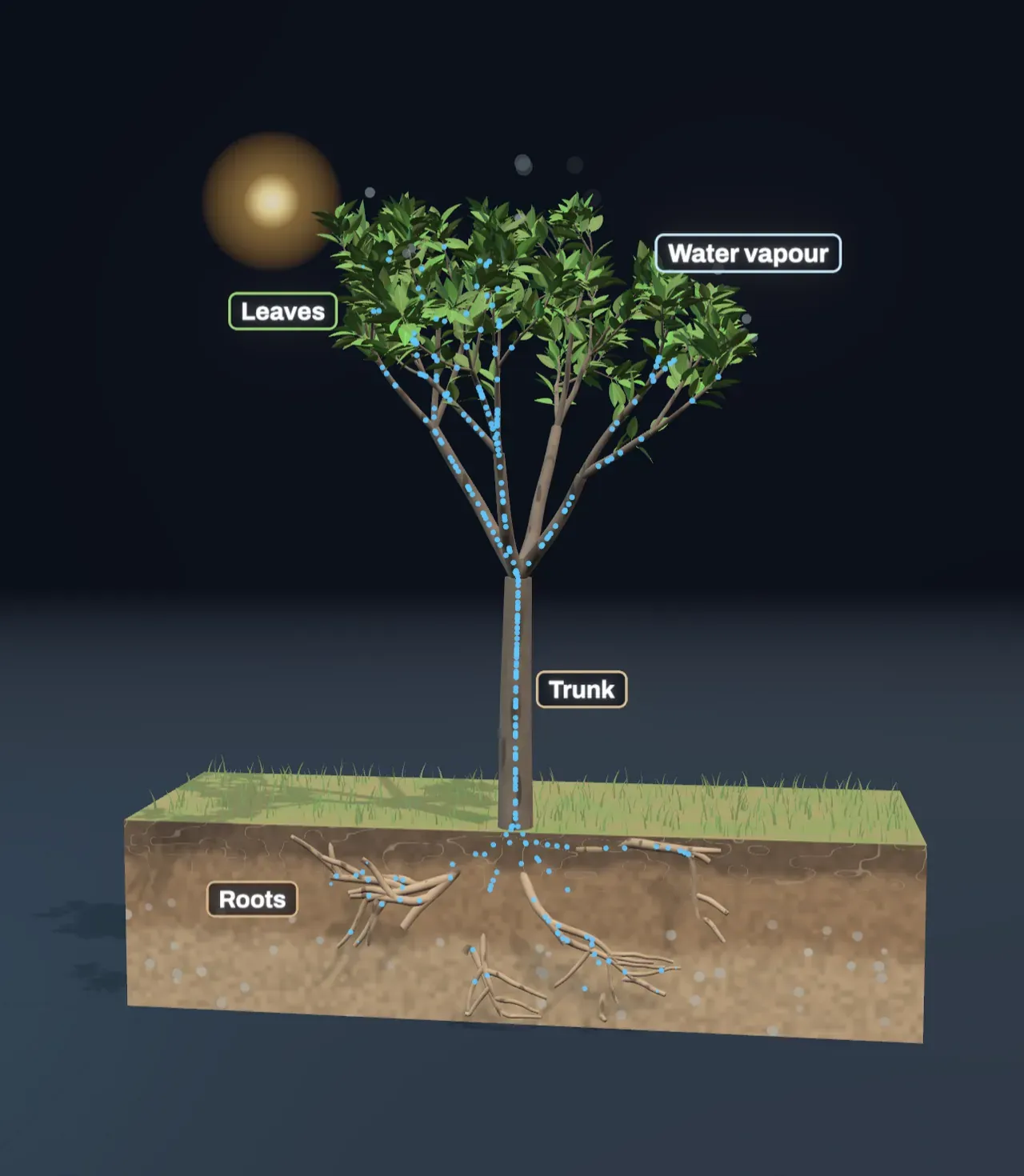
A tree drinks through its leaves
A tree standing in the summer sun is moving water. It takes water in through its roots, carries it up its trunk and out along its branches, and lets it go from its leaves as invisible vapour. A big tree can lift several hundred litres on a hot day. Hardly any of it stays: about 97 to 99 out of every 100 litres a plant takes up leave again through the leaves. That loss is called transpiration.
No part of the tree is a pump. There is no heart and no muscle, and the cells the water climbs through are dead. Yet in the tallest trees, coast redwoods about 115 metres tall, water reaches leaves higher than a thirty-storey building. The force that lifts it comes from the top, not the bottom: the leaves pull.
Try it: slide Sunlight up to 1000 W/m². The specks of water climb faster and more vapour drifts off the crown. Then slide it down to 0: the flow almost stops.
Evaporation does the pulling
Step Follow the water down to Leaf. A leaf is only a fraction of a millimetre thick, but it is built in layers. A waxy cuticle on top keeps water in. Under it stand the long palisade cells, packed with chloroplasts for photosynthesis. Below them, the rounder spongy cells are loosely packed, with air spaces between them, and the underside is dotted with stomata: tiny pores, each between two bean-shaped guard cells, a hundred or more in every square millimetre.
The walls of the cells inside the leaf are wet, and water evaporates from them into the air spaces, which become almost saturated with vapour. Outside, the air is drier, so vapour diffuses out through the open stomata, from where there is more of it to where there is less.
Here is the key step. The water in a cell wall is held in pores far narrower than a hair, by the same pull that makes water climb a thin tube. As water evaporates, the curved water surfaces in those pores draw back and pull on the water behind them. That water pulls on the water in the cell, which pulls on the water in the vein, and so on, all the way down the tree.
Try it: with Follow the water down at Leaf, watch the vapour molecules leave a stoma. Slide Sunlight down to 0 and the guard cells close the pores; slide it up to 1000 W/m² and they open wide.
A rope of water
Step Follow the water down to Trunk. Water climbs through the xylem, the wood’s plumbing: long chains of vessels, dead cells joined end to end with their end walls dissolved away, their walls stiffened with lignin and pitted with thin spots that let water pass sideways. In a living trunk, the outer few centimetres of wood carry almost all of it.
The water in the vessels is not pushed up; it hangs from the leaves. Water molecules cling to each other through hydrogen bonds, so strongly that a thin, unbroken column of water can be pulled like a rope without snapping. They also cling to the vessel walls. This is the cohesion–tension explanation of how water rises. The water in the xylem is under tension: its pressure is below zero, less than a vacuum. A suction pump at the top of a pipe could never lift water more than about 10 metres, because it relies on the air outside to push the water up. A tree does not: it pulls on water that holds together.
A rope of water can still break. If the tension gets too strong, or a bubble of air leaks in through a damaged wall, the column in a vessel snaps and the vessel fills with air: an embolism. The pits stop the bubble spreading, and water detours through the neighbouring vessels. Trees lose some vessels this way every summer, and grow new wood to replace them.
Try it: with Follow the water down at Trunk, find the vessel with an air bubble in it. The water molecules in the other vessels climb together, faster as you raise Sunlight or lower Humidity.
Downhill all the way
Botanists measure how strongly water is held, or pulled, with its water potential, in megapascals (MPa). Pure water at rest has a water potential of zero. Dry soil, a wilting leaf or dry air holds water more strongly, so their water potential is negative. Water always moves from a higher water potential to a lower one, like a ball rolling downhill.
The chart beside the Scene shows the hill. Moist soil sits at about −0.1 MPa. The roots are a little lower, the top of the trunk lower again, and a leaf on a sunny day around −1 MPa. Then comes the air. Its water potential depends on how close it is to saturated:
where is the gas constant, the temperature, the volume of a mole of liquid water and RH the relative humidity. At 25 °C and 50% humidity that is about −95 MPa, a hundred times further down than everything else put together. The step from leaf to air is by far the steepest on the whole path, and it is what drives the rest.
Try it: slide Humidity up to 90%. The air’s bar on the chart shrinks to about −14 MPa, and the tree lifts less than half as much water.
Sun, dry air and wind
Three things set how fast a leaf loses water: how wide its stomata are open, how dry the air is, and how much of the still air clinging to the leaf the wind strips away.
Light opens the stomata. In sunshine, guard cells take in potassium ions and water follows them by osmosis; the cells swell and bow apart, opening the pore. In the dark they lose the ions, go slack and close. Light also warms the leaf, and a warmer leaf holds more vapour in its air spaces, so it pushes vapour out faster.
Dry air steepens the slope from the leaf to the air. Going from 50% to 15% humidity raises the flow by about half.
Wind thins the layer of still air on the leaf, a millimetre or so thick, that vapour has to cross before the moving air takes it away. But wind also cools the leaf. In a breeze the two effects nearly cancel, so the tree loses only a little more water in a gale. Wind matters most in still air; in muggy air a breeze can even slow transpiration a little, because cooling the leaf counts for more than clearing the still air.
A leaf cannot let water go without limit. As the pull grows, the leaf’s water potential falls, and the guard cells start to close, partly in response to a hormone, abscisic acid, that roots and leaves make when water is short. That saves water but costs food: the same pores let in the carbon dioxide the leaf needs for photosynthesis. A typical leaf loses a few hundred molecules of water for every molecule of carbon dioxide it takes in.
Transpiration also cools. Each gram of water that evaporates carries away about 2,400 joules of heat, so a sunlit leaf with open stomata in a breeze stays close to the air’s temperature, while the same leaf in still air runs several degrees warmer.
Try it: set Humidity to 15%, Sunlight to 1000 W/m² and Wind to 8 m/s. The leaves pull so hard that the stomata start to close: on the chart, the green bar falls short of the dashed mark where the light alone would put it. Then slide Wind down to 0 and watch the leaf’s temperature climb.
Into the roots
Step Follow the water down to Root. Most of the water enters a little way behind a root’s tip, through root hairs: thin outgrowths of single skin cells, which reach between the soil grains and multiply the root’s surface many times. In moist soil, water clings in thin films round the grains and fills the smaller spaces between them.
The cells of the root hold more dissolved particles than the soil water, so water moves in by osmosis. Inside, it crosses the cortex, mostly through the porous cell walls, until it meets the endodermis, a ring of cells around the root’s core. Their walls are sealed by a waxy band, the Casparian strip, so here every drop has to pass through a cell membrane. That gives the root a gate: it can let in the minerals the plant needs and keep out much that it does not. Past the endodermis, the water reaches the xylem and joins the column to the leaves.
Roots can push a little, too. At night, when the stomata are shut, roots keep loading minerals into the xylem and water follows them by osmosis. That root pressure is why some plants have drops on the edges of their leaves at dawn, and why a cut birch drips sap in spring. But it is weak, a few tenths of a megapascal at most, and in a tree in full leaf on a summer day it is not there at all. The pull from the leaves does the lifting.
Where the water goes
The vapour that leaves the tree joins the water cycle. Over land, more than half of the water that rises into the air comes out of plants rather than from lakes and soil, and a large forest returns so much that it helps make its own rain. A plant pays for that loss in water, and in exchange it gets a steady flow of minerals from the soil to its leaves, cool leaves in the sun and the open pores that photosynthesis needs.
Water climbing the xylem is half of a plant’s transport. Sugars made in the leaves travel the other way, and up as well, in the living cells of the phloem. How a plant grows towards the light and away from gravity belongs to plant structure and tropisms.
What this model leaves out
The Scene treats every leaf like one sunlit leaf, with the air always at 25 °C and the soil always moist. In a drought the soil’s water potential falls, the whole hill on the chart starts lower, and the stomata close much sooner. Real stomata also respond to carbon dioxide and to the dryness of the air directly, and trees store water in their trunks, which shrink a little by day and swell again at night; the model leaves all that out.
The leaf’s energy balance is simplified to the sunlight it absorbs, the heat the air and its own glow carry away, and the heat used by evaporation. The tree’s resistance to flow is fixed, and the drop in water potential along the way is split between roots, trunk and leaf in fixed shares. No vessel breaks as you push the settings: the one with an air bubble in it is always there.
The pictures are drawn at very different scales. Next to the tree, the leaf section and the vessels are drawn about twenty thousand times too big, the root tip about five thousand times, and the water molecules about a billion times. A real leaf has far more cells and stomata, and a real root far more hairs.