Dry air, wind and sunshine speed up transpiration, and moist air slows it, even when the leaf warms up. What drives the flow is the difference between the saturated air inside the leaf and the air outside, and when the tree closes its stomata to keep from drying out.
Step 1 of 6 · Dry air
Step 1 of 6
Dry air
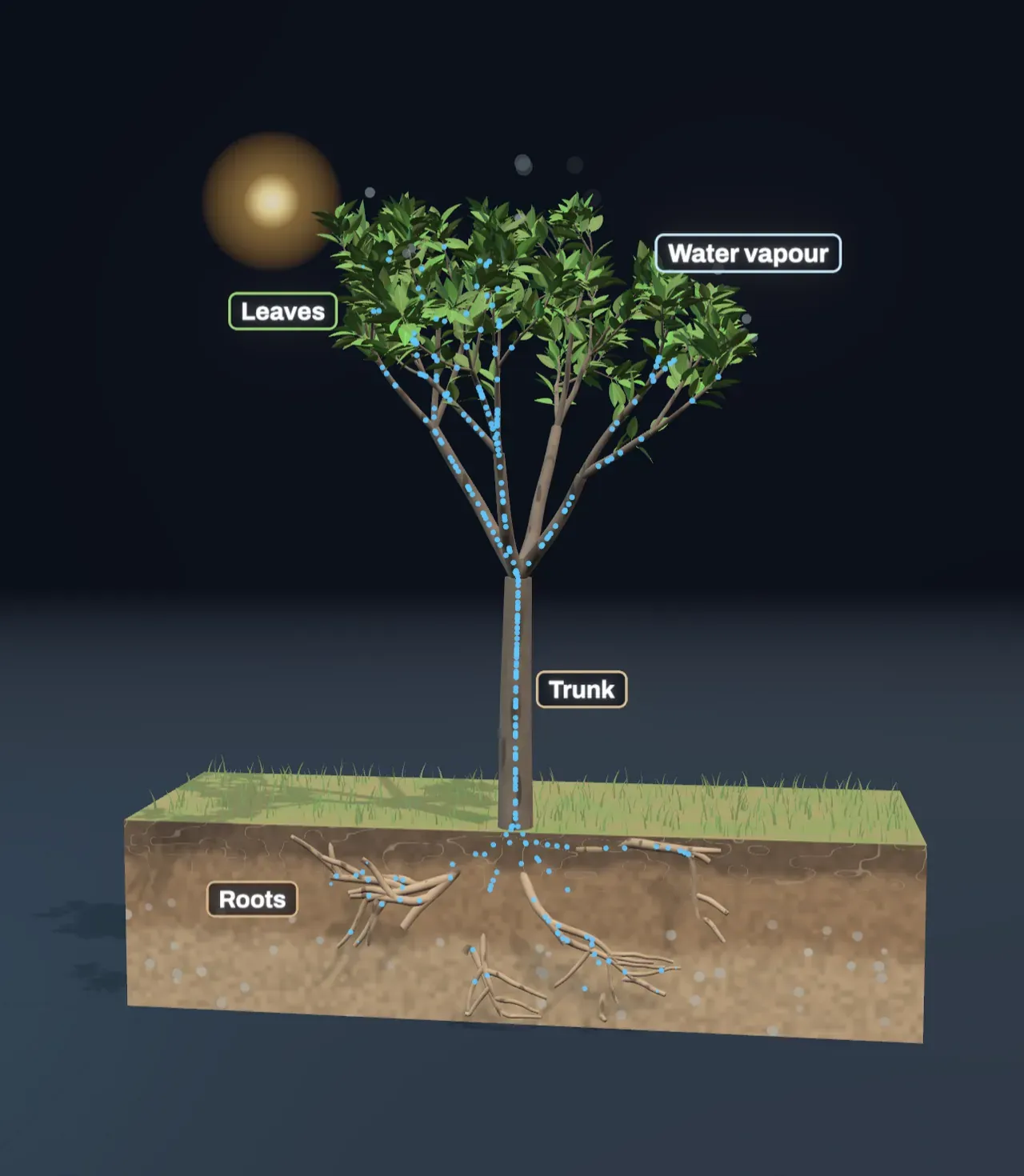
Inside the leaf, in the spaces between the spongy cells, the air is saturated with water vapour: it holds as much as it can. The vapour leaves through the stomata by diffusion, from where there is plenty of vapour to where there is less, and the bigger the difference, the faster it goes. Washing dries faster on a dry day for the same reason.
The chart beside the Scene shows the same thing in the language of water potential: water always flows from a higher potential to a lower one, from the moist soil, through the roots and the trunk, to the leaf and from there to the air. Predict what happens when the air dries out.
Step 2 of 6
Muggy air
Now the opposite: very moist air, like a summer day at the seaside. When the leaf evaporates less, it also cools less, because evaporation takes heat. Watch the leaf’s temperature on the chart as the humidity changes.
Step 3 of 6
Half the flow
Sunlight and Wind are fixed now, and only Humidity is free. If transpiration depends on the difference between the saturated air in the leaf and the air outside, how humid must the air be to halve it? Guess first, then search with the chart.
Step 4 of 6
Wind
On a leaf in still air sits a thin layer of moist air that does not move, and in the leaf cut across you see it as Still air. The vapour has to cross it too. Here the air is still; predict what a strong wind will do.
Step 5 of 6
Saving water
The stomata are a trade-off. Open, they let carbon dioxide in for photosynthesis and water out. When the leaf loses water faster than the xylem brings it, its water potential falls, and the guard cells start to close the stomata, even while the sun is still strong. All three controls are free: find when that happens. On the chart the dashed mark shows how far the light alone would open the stomata.
Step 6 of 6
The whole tree
The chart gives two numbers: the rate of loss from each square metre of leaf, in millimoles of water a second, and the water the whole tree lifts, in litres an hour. You can work out the second from the first, if you know the leaf area and the mass of a mole of water, and practise converting units on the way.
Loading the interactive version…
Loading the interactive version…
Each step sets up the Scene for you, and a control marked “fixed” stays put for that step.
Practice · Predict, then look
Humidity drops from 50% to 15%, as in a desert, and everything else stays the same. What happens to the amount of water the tree lifts?
Practice · Predict, then look
Humidity drops from 50% to 15%, as in a desert, and everything else stays the same. What happens to the amount of water the tree lifts?
Practice · Predict, then look
Humidity rises to 90%, muggy air. On the chart you will see the leaf warm up by almost two degrees, because it evaporates less, and water that does not evaporate does not cool it. Will the warmer leaf lose more water or less?
Practice · Predict, then look
Humidity rises to 90%, muggy air. On the chart you will see the leaf warm up by almost two degrees, because it evaporates less, and water that does not evaporate does not cool it. Will the warmer leaf lose more water or less?
Practice · Reach the target
At 50% humidity the tree lifts about 10.5 L an hour. Sunlight and Wind are now fixed. Change Humidity until the tree lifts about half, 5.2 L an hour, then press Check.
Practice · Reach the target
At 50% humidity the tree lifts about 10.5 L an hour. Sunlight and Wind are now fixed. Change Humidity until the tree lifts about half, 5.2 L an hour, then press Check.
Practice · Predict, then look
The air is still. What happens to the amount of water the tree lifts when Wind rises to 8 m/s, a strong wind?
Practice · Predict, then look
The air is still. What happens to the amount of water the tree lifts when Wind rises to 8 m/s, a strong wind?
Practice · Reach the target
On an ordinary sunny day the tree keeps its stomata as open as the light allows. Find conditions, with any of the three controls, in which the leaves start to close their stomata to save water, then press Check.
Practice · Reach the target
On an ordinary sunny day the tree keeps its stomata as open as the light allows. Find conditions, with any of the three controls, in which the leaves start to close their stomata to save water, then press Check.
Practice · Calculate
The chart shows that each square metre of leaf loses 4.0 millimoles of water a second. The tree has 40 m² of leaves, and a millimole of water weighs 18 mg. How many grams of water does the whole tree lose each second? Answer in grams.
Practice · Calculate
The chart shows that each square metre of leaf loses 4.0 millimoles of water a second. The tree has 40 m² of leaves, and a millimole of water weighs 18 mg. How many grams of water does the whole tree lose each second? Answer in grams.
Lesson complete. Every practice question here is done.