Five perfect shapes
Look at a set of dice from a board game. Next to the ordinary cube there are dice with 4, 8, 12 and 20 sides. Each one is fair because every face is the same regular polygon and every corner looks exactly like every other. A solid with those properties is called a Platonic solid, and there are only five of them:
- the tetrahedron: 4 triangles, 3 meeting at each corner;
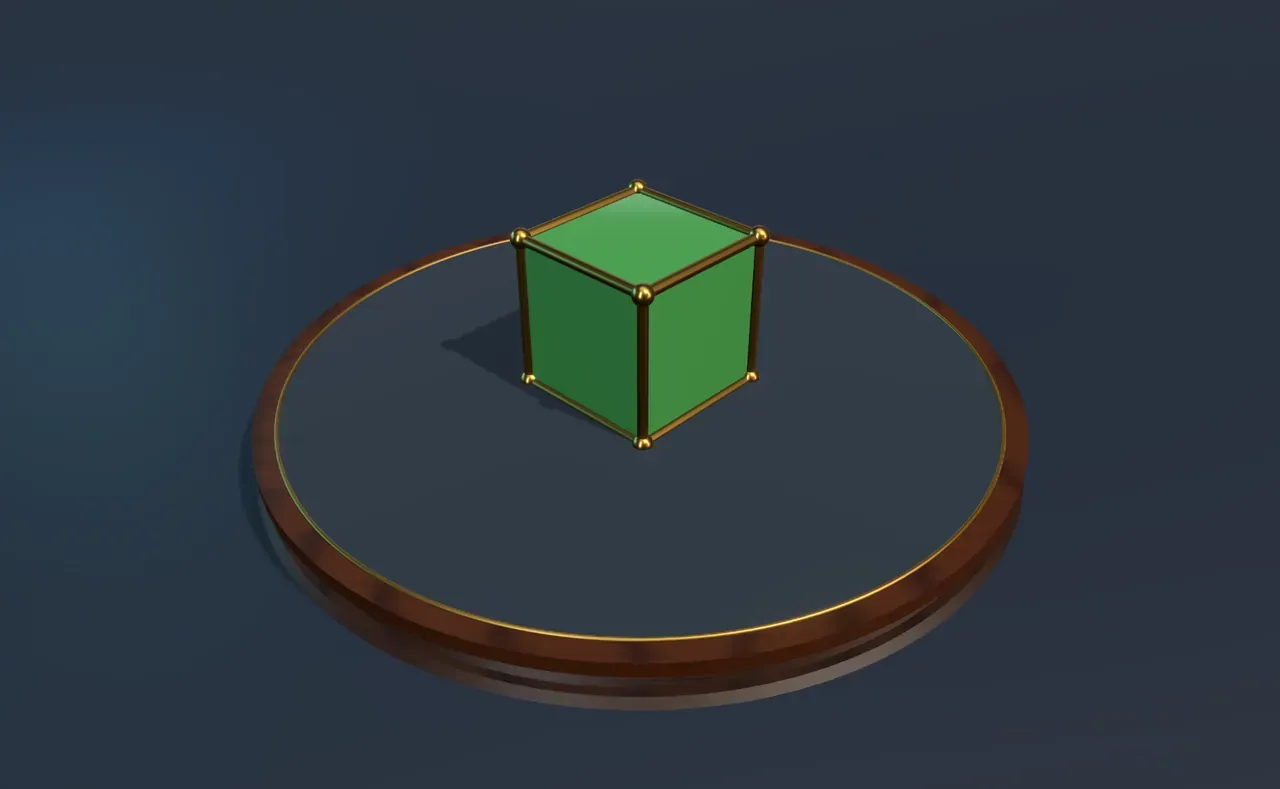
- the cube: 6 squares, 3 at each corner;
- the octahedron: 8 triangles, 4 at each corner;
- the dodecahedron: 12 pentagons, 3 at each corner;
- the icosahedron: 20 triangles, 5 at each corner.
They are named after Plato, who around 360 BC matched four of them to the elements fire, earth, air and water and gave the dodecahedron to the heavens. About sixty years later Euclid ended his Elements with a proof that no sixth one exists.
Why only five
Everything happens at a corner. At least three faces must meet there, or they could not close round a point. And when you press the faces at a corner flat, they must leave a gap: if their angles added up to a full 360°, they would lie flat and never fold up into a point.
Try it: choose Cube, then press Corner under Unfold. Three squares of 90° add up to 270°, leaving a 90° gap. Now try Dodecahedron: three pentagons of 108° leave only 36°.
That rule leaves very few choices. A triangle’s corner is 60°, so three, four or five triangles fit (180°, 240° or 300°), giving the tetrahedron, octahedron and icosahedron; six would make exactly 360° and lie flat. Three squares fit (the cube), but four make a flat floor. Three pentagons fit (the dodecahedron). Three hexagons already make 360°, and any polygon with more sides has even wider corners. That is the whole list: five.
The gap at a corner is called its angle defect. Add up the defects at every corner of any of these solids and you always get 720°, two full turns: 8 corners of 90° on the cube, 20 corners of 36° on the dodecahedron.
Counting corners, edges and faces
Press Count and the solid’s corners (V, for vertices), edges (E) and faces (F) light up one at a time. For the cube, V = 8, E = 12 and F = 6, and 8 − 12 + 6 = 2. Every one of the five gives the same answer:
V − E + F = 2
Leonhard Euler noticed around 1750 that this holds for every solid without holes, not just the regular ones. It is called Euler’s formula.
Unfolding into a net
Press Net and the solid opens out flat on the table, every face swinging about one edge it shares with a neighbour. The flat shape is a net: cut it out of card, fold along the blue edges and it closes back up into the solid. The cube alone has 11 different nets; the one shown is whichever compact net fits the table best.
The net also explains Euler’s formula. The blue folds hold all F faces together in one piece without any loop, which takes exactly F − 1 of them. The pink cuts must reach every corner, or that corner could not spread flat, and they never close a loop either, or a piece would fall out; joining V corners that way takes exactly V − 1 edges. Every edge is either a fold or a cut, so E = (F − 1) + (V − 1), which rearranges to V − E + F = 2.
Where the shapes turn up
Salt grows in cubic crystals. Many viruses build their protein shells as icosahedra, because twenty identical triangles make a closed case from many copies of one small part. Dice makers use all five shapes, since a regular solid lands on each face equally often.
What this model leaves out
The solid is built from tiles with thickness, mitred so they meet along each edge, and a brass rod is drawn along every edge; the mathematics concerns only the outer faces. While the net opens, faces can pass through each other for a moment; only the start and the flat net are real positions of a folded card. The corner beside the solid is a separate copy of the faces at one corner, laid flat to show the gap. Euler’s formula as stated here applies to solids without holes: a shape like a picture frame gives a different total.