Why the faces at a corner must leave a gap, why that leaves only five solids, and how a solid's net explains Euler's formula.
Step 1 of 9 · A gap at the corner
Step 1 of 9
A gap at the corner
A Platonic solid is built from one regular polygon, over and over, and all its corners are alike. Everything is decided at the corner: at least three faces meet there, and to fold up into a point their angles must add up to less than .
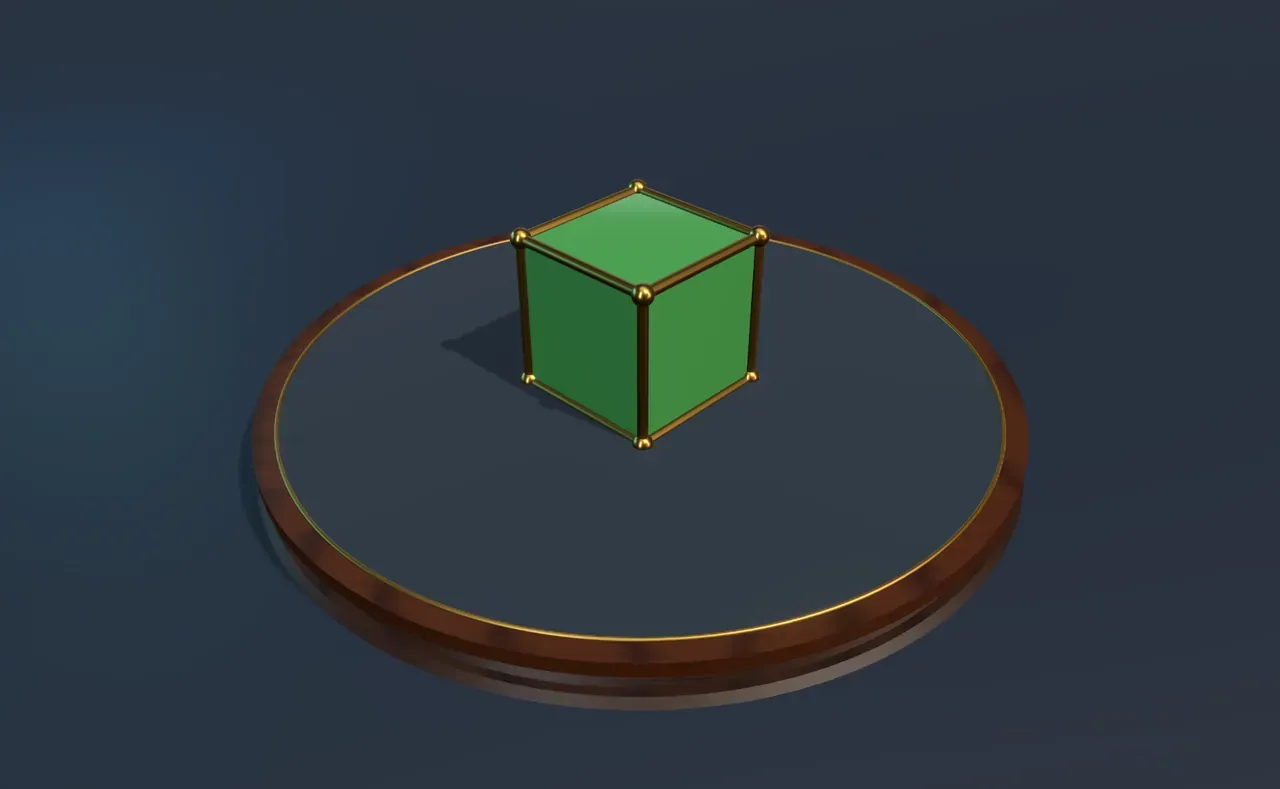
The gap left when the faces at a corner are pressed flat is called the angle defect. Predict how big it is for the cube, then look.
Step 2 of 9
The icosahedron
In every Platonic solid the defect is the same at every corner, and it equals minus the face angles at the corner. In the Icosahedron five equilateral triangles meet at each corner. The Solid and Unfold are fixed now.
Step 3 of 9
Only five
Each angle of an equilateral triangle is , of a square , and of a regular pentagon . Try every possibility: three, four or five triangles at a corner, three squares, three pentagons. Each leaves a gap, and gives one solid. Choose a Solid and check the gap for each.
Step 4 of 9
The net and Euler’s formula
At the Count stage the corners (), edges () and faces () are counted, and for every solid . The net explains why. The folds hold all the faces in one piece without a loop, so there are of them. The cuts reach every corner, and they never close a loop either. Every edge is a fold or a cut. The Solid and Unfold are fixed now.
Step 5 of 9
Faces from Euler
At Count you see all three numbers. Knowing two of them, Euler’s formula gives the third.
Step 6 of 9
Faces and corners
Each regular solid is fixed by two numbers: how many sides each face has, and how many faces meet at each corner. At Corner you see one corner up close.
Step 7 of 9
A pentagon
To know how many faces fit at a corner, you need to know how big each of their angles is.
Step 8 of 9
All the gaps together
At every corner something is missing from a flat plane, and those gaps are what close the solid up. How much is missing at all the corners together?
Step 9 of 9
Between two faces
A solid has one more angle: the angle at which two faces meet along an edge, like the pages of an open book.
Loading the interactive version…
Loading the interactive version…
Each step sets up the Scene for you, and a control marked “fixed” stays put for that step.
Practice · Predict, then look
Three squares meet at each corner of the cube, and each angle of a square is . Press all three flat on the table. How many degrees will they be short of a full turn?
Practice · Predict, then look
Three squares meet at each corner of the cube, and each angle of a square is . Press all three flat on the table. How many degrees will they be short of a full turn?
Practice · Calculate
In the icosahedron five equilateral triangles meet at every corner. What is the angle defect at each corner?
Practice · Calculate
In the icosahedron five equilateral triangles meet at every corner. What is the angle defect at each corner?
Practice · Choose
Why is there no Platonic solid with regular hexagons for faces?
Practice · Choose
Why is there no Platonic solid with regular hexagons for faces?
Practice · Calculate
The icosahedron has corners, edges and faces. You cut it along some of its edges and lay it out as one flat net. How many edges must you cut?
Practice · Calculate
The icosahedron has corners, edges and faces. You cut it along some of its edges and lay it out as one flat net. How many edges must you cut?
Practice · Calculate
One regular solid has corners and edges. By , how many faces does it have?
Practice · Calculate
One regular solid has corners and edges. By , how many faces does it have?
Practice · Reach the target
Choose the Solid whose faces are triangles, with exactly faces meeting at each corner. Press Check.
Practice · Reach the target
Choose the Solid whose faces are triangles, with exactly faces meeting at each corner. Press Check.
Practice · Calculate
Each face of the Dodecahedron is a regular pentagon. How many degrees is each angle of such a pentagon? The angles of a polygon with sides add up to .
Practice · Calculate
Each face of the Dodecahedron is a regular pentagon. How many degrees is each angle of such a pentagon? The angles of a polygon with sides add up to .
Practice · Predict, then look
A cube has corners, each short: together. The Dodecahedron has corners, each only short. Predict: what do the gaps at all the dodecahedron’s corners add up to?
Practice · Predict, then look
A cube has corners, each short: together. The Dodecahedron has corners, each only short. Predict: what do the gaps at all the dodecahedron’s corners add up to?
Practice · Calculate
In the Tetrahedron the angle between two faces that share an edge has . What is the angle, in degrees?
Practice · Calculate
In the Tetrahedron the angle between two faces that share an edge has . What is the angle, in degrees?
Lesson complete. Every practice question here is done.