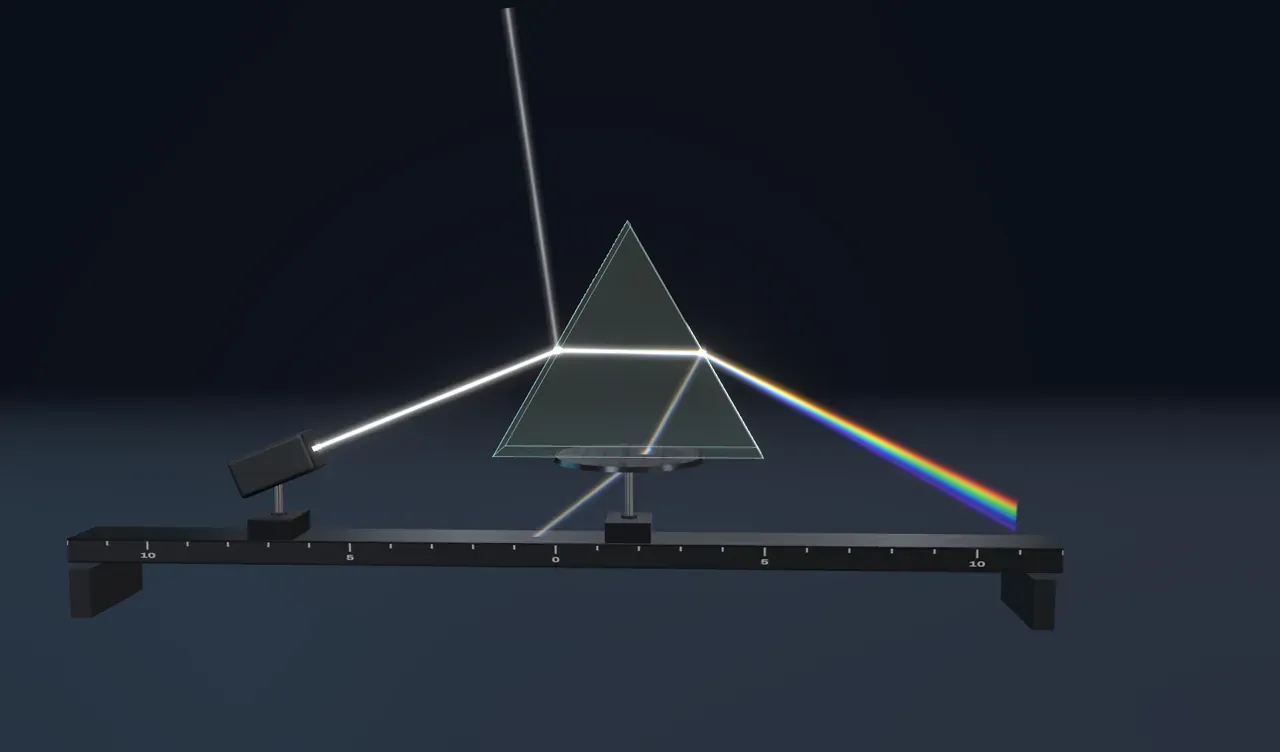
Colours that were there all along
Hang a glass prism in a sunny window and patches of colour appear across the room: red, orange, yellow, green, blue and violet, always in that order. It is tempting to think the glass adds the colour. In the 1660s Isaac Newton showed it does not. He split sunlight with one prism, picked out a single colour, and sent it through a second prism. The second prism bent it again but could not split it further. And when he gathered all the colours back together, they made white. White light is a mixture, and the prism only sorts it.
Each colour bends by its own amount
Light slows down in glass, and that is why it bends at a slanted surface. The slowdown is slightly different for each colour. Violet light is slowed the most, so glass has a higher refractive index for violet than for red, and violet bends more at every surface. This spreading of colours is called dispersion. In the scene’s flint glass the index runs from about 1.65 for violet down to about 1.61 for deep red.
A flat window does not split light noticeably, because the bend on the way in is undone on the way out. A prism’s faces are tilted to each other, so the two bends add up instead of cancelling, and the colours leave at slightly different angles. The farther they travel, the wider the fan.
Try it: with Glass prism chosen, move Angle of incidence to see the beam swing. Turn off White light: a single red beam bends just as before but stays one colour. Turn it back on and choose On under Show the angles.
A raindrop is a tiny prism
Sunlight entering a round raindrop bends at its surface, reflects once off the back, and bends again on the way out. Choose Raindrop and set Angle of incidence to 59°. The light leaves heading back towards the Sun’s side, about 42° away from the direction it came in. Now nudge the angle either way. The returning angle falls below 42°, never above it. Light striking the drop at every height comes back at angles up to that limit and bunches up near it, so drops send back a bright concentration of light at about 42°. René Descartes worked this out in 1637 by tracing rays through a drop, much as the scene does.
Because water’s index also depends on colour, the limit is a little different for each: about 42.4° for red and 40.7° for violet.
Why a circle
Stand with the Sun at your back and rain in front. Every drop that sits about 42° away from the point directly opposite the Sun (the shadow of your head) sends red light to your eye; drops a little nearer that point send violet. All the drops at one angle from a point form a circle, so the bow is part of a circle, red on the outside. The ground usually hides the lower part; from an aircraft you can sometimes see the whole ring. Each person sees their own rainbow, made by their own set of drops.
What this model leaves out
The scene shows one beam in a slice through the drop, while a real bow is the sum of light from millions of drops at every height. Light that reflects twice inside a drop makes a fainter secondary bow at about 51°, with its colours reversed. The model traces rays only, so it misses the faint extra bands just inside a bright rainbow, which come from light behaving as a wave. Real sunlight is a smooth spectrum rather than ten separate colours.