White light is a mixture of colours, and each colour bends at a slightly different angle in glass and water: dispersion in a prism, a refractive index that depends on wavelength, and a raindrop that sends light back at up to 42° and makes a bow, red on the outside.
Step 1 of 9 · Colours that were there all along
Step 1 of 9
Colours that were there all along
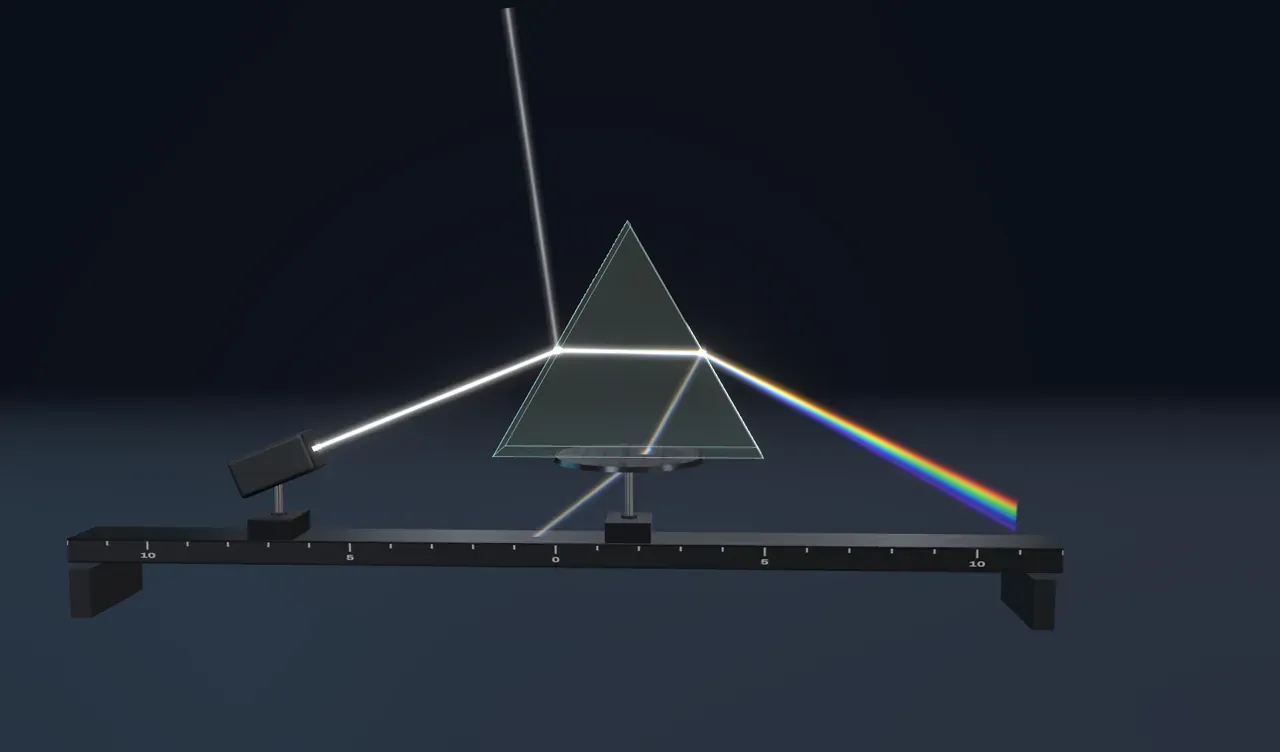
Hang a glass prism in a sunny window and patches of colour appear in the room: red, orange, yellow, green, blue and violet, always in that order. It is tempting to think the glass adds the colours. Glass prism is fixed, and White light is on. Predict what will happen when a beam of a single colour enters the prism.
Step 2 of 9
Each colour bends its own way
We saw that light bends going into glass because it slows down there, and that the refractive index sets by how much. The slowdown is slightly different for each colour, and so is the refractive index. This spreading of white light into colours is called dispersion.
A flat window does not split light noticeably: the bend on the way out undoes the bend on the way in. A prism’s faces are tilted to each other, so the two bends add up, and the colours leave at slightly different angles. Show the angles draws the normals and the angles.
Step 3 of 9
Index and wavelength
Now a violet beam, 410 nm, enters the prism. In glass and water the refractive index depends on wavelength, roughly by Cauchy’s formula:
is small and positive, so the shorter the wavelength, the larger . Glass prism and White light are fixed.
Step 4 of 9
Inside a raindrop
We have chosen Raindrop. Sunlight enters a round drop, bends at its surface, reflects once off the back, and bends again on the way out. It leaves heading back towards the Sun, and the angle between it and the sunlight is printed by the outgoing ray. The angle depends on the Angle of incidence: how far from the drop’s centre the beam strikes.
Step 5 of 9
A limit
René Descartes worked out the rays’ paths through a drop in , just as the Scene does. He found that light comes back at many angles, but never at more than about , and that near that limit it piles up. Predict what happens beyond the rainbow ray, at .
Try it: after checking, turn off White light and set Angle of incidence back to . For a single red beam the limit is a little above .
Step 6 of 9
Why a bow
Stand with the Sun at your back and rain in front. Every drop about from the point opposite the Sun, the shadow of your head, sends light to your eye. All the points at one angle from a point form a circle, so the bow is part of a circle. The ground usually hides the lower part, and each person sees their own bow, made by their own drops.
Step 7 of 9
How far the prism turns it
Back to the prism. Show the angles marks the normals at both faces and the angles the ray makes with them.
Step 8 of 9
Back from the drop
In a drop the light turns almost right round. Let us work out how far.
Step 9 of 9
Descartes’ sums
In 1637 René Descartes traced, ray by ray, how light passes through a drop, and found the rainbow’s angle without measuring it.
Loading the interactive version…
Loading the interactive version…
Each step sets up the Scene for you, and a control marked “fixed” stays put for that step.
Practice · Predict, then look
White light enters the prism and leaves it as a fan of colours. Now we turn off White light, and a red beam alone enters at the same angle. What will leave the prism?
Practice · Predict, then look
White light enters the prism and leaves it as a fan of colours. Now we turn off White light, and a red beam alone enters at the same angle. What will leave the prism?
Practice · Choose
Look at the fan leaving the prism. Which colour bends the most, and why?
Practice · Choose
Look at the fan leaving the prism. Which colour bends the most, and why?
Practice · Calculate
The flint glass of the prism has a refractive index of in yellow light, 589 nm. It changes with wavelength by Cauchy’s formula, , with B = 0.0089 µm². What is the refractive index for violet light, 410 nm?
Practice · Calculate
The flint glass of the prism has a refractive index of in yellow light, 589 nm. It changes with wavelength by Cauchy’s formula, , with B = 0.0089 µm². What is the refractive index for violet light, 410 nm?
Practice · Reach the target
In the raindrop the light bends going in, reflects off the back and bends coming out. The angle printed by the outgoing ray is the angle between it and the direction the sunlight came from. Change Angle of incidence until the light leaves at , and press Check.
Practice · Reach the target
In the raindrop the light bends going in, reflects off the back and bends coming out. The angle printed by the outgoing ray is the angle between it and the direction the sunlight came from. Change Angle of incidence until the light leaves at , and press Check.
Practice · Predict, then look
At the rainbow ray, , the light comes back at about . What will happen to the return angle if we raise Angle of incidence to ?
Practice · Predict, then look
At the rainbow ray, , the light comes back at about . What will happen to the return angle if we raise Angle of incidence to ?
Practice · Choose
For red the limit of a water drop is about , and for violet about . In a rainbow, which colour is on the outside, on the bigger arc?
Practice · Choose
For red the limit of a water drop is about , and for violet about . In a rainbow, which colour is on the outside, on the bigger arc?
Practice · Calculate
The prism’s two faces meet at . The yellow light strikes the first face at an Angle of incidence of and leaves the second at from its normal. By how many degrees has it turned from the direction it came in?
Practice · Calculate
The prism’s two faces meet at . The yellow light strikes the first face at an Angle of incidence of and leaves the second at from its normal. By how many degrees has it turned from the direction it came in?
Practice · Calculate
The light strikes the raindrop at an Angle of incidence of and bends inwards to . It bends going in, reflects once off the back and bends again coming out. The total turn is . By how many degrees has it turned?
Practice · Calculate
The light strikes the raindrop at an Angle of incidence of and bends inwards to . It bends going in, reflects once off the back and bends again coming out. The total turn is . By how many degrees has it turned?
Practice · Calculate
Descartes found that in a drop the turn is smallest when . For water . Find , the angle of refraction , and the return angle : the angle of the rainbow.
Practice · Calculate
Descartes found that in a drop the turn is smallest when . For water . Find , the angle of refraction , and the return angle : the angle of the rainbow.
Lesson complete. Every practice question here is done.