A converging lens gathers light to a focus and a diverging lens spreads it; the thin-lens equation, magnification, real and virtual images, and what happens when half a lens is covered.
Step 1 of 6 · The focal point
Step 1 of 6
The focal point
A lens is a piece of glass with curved surfaces, so every ray is refracted in it twice, on the way in and on the way out. A converging lens is thicker in the middle: it turns every ray towards the axis, the line through the centre of the lens and square to it. In the Scene a ray box sends rays parallel to the axis into the lens, and they meet at a single point behind it, the focal point. Its distance from the lens is the focal length , here 5 cm. The marks on the rail measure centimetres from the lens.
A diverging lens is thinner in the middle. Predict what it will do to the same rays, then watch the Scene swap the lens and switch on Draw the rays.
Step 2 of 6
The thin-lens equation
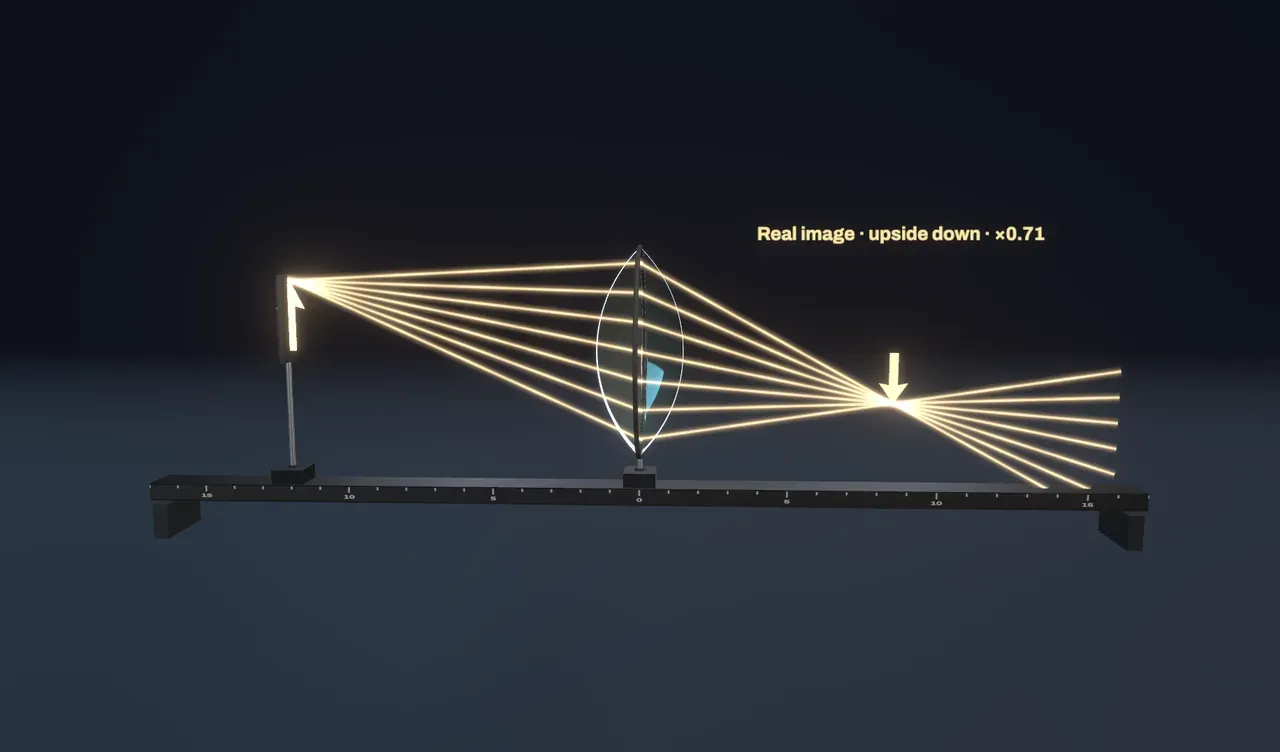
Now there is a lit arrow on the bench, the object, 12 cm in front of the lens. The rays from the arrow’s tip meet again beyond the lens, and there a real image forms: a screen placed there would show the arrow, upside down. The distances obey the thin-lens equation:
is the object’s distance from the lens and the image’s. The caption describing the image is hidden in this step. Work it out, then compare with where the image stands on the scale.
Step 3 of 6
Magnification
The image is not as tall as the object. The ratio of the heights is the magnification, and it equals the ratio of the distances:
The ray through the centre of the lens shows why: it carries straight on and makes two similar triangles, one from the arrow to the lens and one from the lens to the image.
Step 4 of 6
The same size
Now you can move both Object distance and Focal length. When the object is far away, the image is small and close to the focal point, as in a camera. As it comes closer, the image grows and moves away. Where exactly is it the same size as the object? Work it out, then find it on the bench.
Step 5 of 6
A magnifying glass
What happens when the object is closer to the lens than the focal point? In the equation, is larger than , so comes out negative. What does that mean on the bench? Predict, then watch the Scene bring the arrow to 3 cm and switch on Draw the rays.
Step 6 of 6
Half a lens
Look at the rays leaving the arrow’s tip: they strike the lens at different heights, top, middle and bottom, and all of them meet again at the same point, the tip of the image. The same holds for every point of the arrow. What happens if part of the lens is covered?
Loading the interactive version…
Loading the interactive version…
Each step sets up the Scene for you, and a control marked “fixed” stays put for that step.
Practice · Predict, then look
Rays parallel to the axis meet at the focal point, 5 cm behind the converging lens. What will the same rays do in a diverging lens with the same focal length?
Practice · Predict, then look
Rays parallel to the axis meet at the focal point, 5 cm behind the converging lens. What will the same rays do in a diverging lens with the same focal length?
Practice · Calculate
A lit arrow stands 12 cm in front of a converging lens whose focal length is 5 cm. How far behind the lens does the image form?
Practice · Calculate
A lit arrow stands 12 cm in front of a converging lens whose focal length is 5 cm. How far behind the lens does the image form?
Practice · Calculate
In the same set-up, the object is 12 cm from the lens and the image about 8.57 cm behind it. What is the magnification ?
Practice · Calculate
In the same set-up, the object is 12 cm from the lens and the image about 8.57 cm behind it. What is the magnification ?
Practice · Reach the target
Change Object distance and Focal length until the image is exactly the same size as the object (upside down), then press Check.
Practice · Reach the target
Change Object distance and Focal length until the image is exactly the same size as the object (upside down), then press Check.
Practice · Predict, then look
The arrow stands 7.5 cm from the lens (), and the image is real, upside down and enlarged. What will happen when it is brought to 3 cm, closer than the focal point?
Practice · Predict, then look
The arrow stands 7.5 cm from the lens (), and the image is real, upside down and enlarged. What will happen when it is brought to 3 cm, closer than the focal point?
Practice · Choose
The lens forms a sharp image of the arrow on a screen. The top half of the lens is covered with card. What will happen to the image on the screen?
Practice · Choose
The lens forms a sharp image of the arrow on a screen. The top half of the lens is covered with card. What will happen to the image on the screen?
Lesson complete. Every practice question here is done.