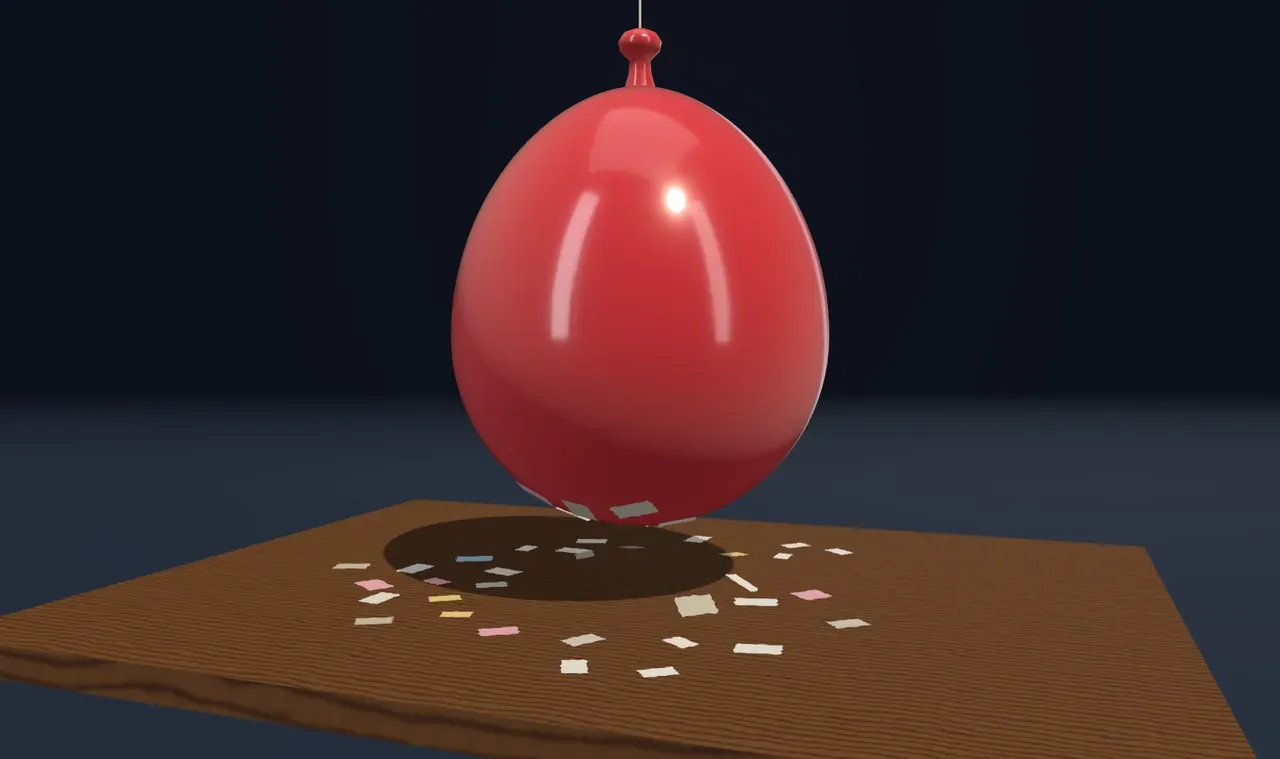
A pull from nothing
Rub a balloon on your hair, hold it over some torn paper, and the scraps stand up, quiver, and leap onto the rubber. The same balloon will cling to a wall, and pull a thin stream of tap water sideways. Before you rubbed it, it did none of these things.
Rubbing changed one thing: it moved charge. And the strange part is not that the balloon is charged. It is that the paper is not, and still it jumps.
Where the charge comes from
Everything is made of atoms, and every atom holds positive protons in its nucleus and the same number of negative electrons around it. The charges cancel, which is why ordinary things push and pull on each other so little.
When two different materials touch, electrons at the surface can move from one to the other. Hair holds its outermost electrons less tightly than rubber does, so rubbing leaves the balloon with something like a trillion extra electrons and your hair short of the same number. The balloon is now negatively charged; your hair is positively charged by exactly the same amount, which is why the strands lift and spread apart.
Rubber does not let electrons travel through it, so they stay where they landed, on the patch you rubbed. That is why it is called static electricity: charge that sits still, rather than flowing as a current through a wire.
Like charges repel, unlike attract
Two charges push or pull on each other along the line between them. Two negatives push apart; a negative and a positive pull together. The force grows with each charge and weakens with the square of the distance between them: halve the gap and the push or pull becomes four times stronger.
The space around a charge is filled by its electric field, which says which way, and how hard, a small positive charge would be pushed at each point. Around the negative balloon the field points inward, towards the balloon.
Pulling on something neutral
A scrap of paper has as many positive as negative charges, so on the face of it the balloon should have nothing to grip. But the charges in the paper are not fixed in place. Paper always holds a trace of water, and that lets them move a little. Near the negative balloon, the scrap’s electrons drift to its far side and leave its near side short of electrons, so slightly positive.
The scrap is still neutral overall. Its charges have only shifted, which is called polarisation. But now its positive side is closer to the balloon than its negative side. The pull on the near positives beats the push on the far negatives, because the force weakens with distance, and the scrap is drawn in.
Try it: open Show charges and field and watch the + and − on a scrap near the edge of the board. Then slide Charge rubbed on down to 0 nC and see them mix back together.
Because the balloon’s charge both makes the shift and pulls on it, doubling the charge quadruples the pull. And because the shift and the difference in distance both shrink as the balloon moves away, the pull fades very fast: in this model, doubling the gap from the charge cuts it about thirty-fold.
Try it: slide Charge rubbed on up to 400 nC, then drag Gap above the paper from 3 cm to 10 cm. Scraps fall back as the gap opens, and none lift at all once it is a hand away.
Why tissue jumps first
A scrap lifts when the upward part of the pull beats its weight. Tissue paper is about a quarter as heavy as printer paper of the same size, so it lifts sooner, from further away and from a less rubbed balloon. Before it lifts, a scrap often stands up on one edge: that turns it to line up with the field, which lets its charges shift further and makes the pull stronger still.
The field lines in the scene show the same story. They end on the balloon’s negative charges, and near a scrap they bend out of its positive side, where the shifted charges sit.
Sparks and shocks
A charge can only build up so far. When the field near a charged object grows strong enough, it tears electrons off molecules in the air, and the air conducts for a moment: a spark. Walk across a nylon carpet in dry weather and you can collect enough charge for one to jump from your fingertip to a door handle. A thundercloud does the same on a vast scale, and lightning is its spark.
Damp air makes all of this harder. A thin film of water on surfaces lets charge leak away, which is why static tricks work best on cold, dry days.
What this model leaves out
The scene treats the rubbed patch as a single point charge just inside the balloon and each scrap as a small conducting bead as wide as itself. That gives the right shape to the pull, steeply rising with charge and steeply falling with distance, and forces of the right size for real paper; it is not a measurement. The board also responds to the field and adds a little to the pull, and real scraps differ more than these do.
Once a scrap touches the balloon, some of the balloon’s electrons can cross onto it. It is then charged like the balloon and may be flung off again, which is why scraps sometimes dance up and down. The scene keeps every scrap neutral, so the only thing holding it is the shift of its own charges.