Rubbing moves electrons: positive and negative charge, conservation of charge, counting the electrons in a charge, and why a charged balloon pulls on neutral paper.
Step 1 of 4 · Rubbing moves electrons
Step 1 of 4
Rubbing moves electrons
Everything is made of atoms. In the nucleus of every atom there are protons, whose charge is positive, and around the nucleus move electrons, whose charge is negative and exactly the same size. A whole atom has as many of one as of the other, so it is neutral: the charges cancel.
When you rub a rubber balloon on dry hair, some of the electrons on the surface of the hair move onto the rubber. The protons do not move: they are bound in the nuclei, deep inside the atoms. The balloon gains extra electrons and becomes negatively charged, and the hair is missing exactly those electrons, so it is positively charged by the same amount. No charge was made and none was destroyed; it only moved from one place to another. This is conservation of charge.
Rubber is an insulator: electrons do not move freely through it, so the extra ones stay on the patch you rubbed. On a metal, a conductor, they would spread at once over the whole body.
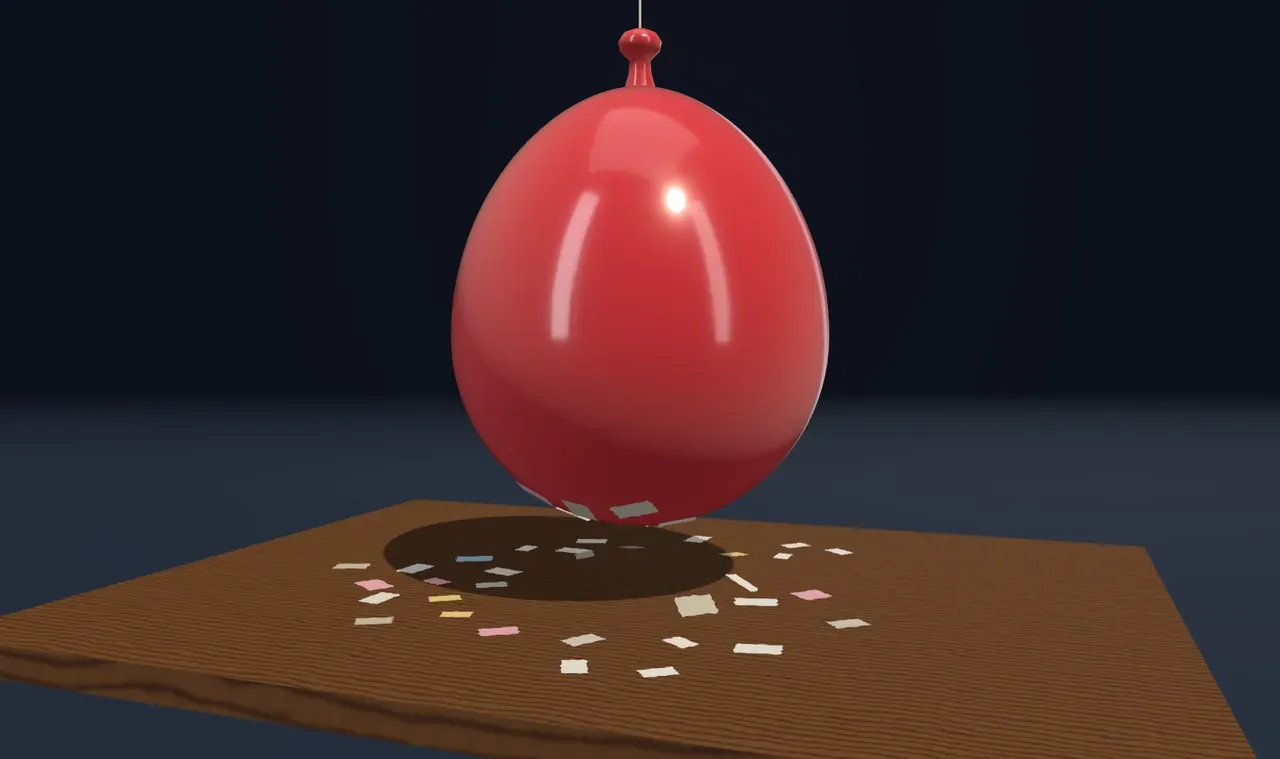
The balloon in the Scene has not been rubbed yet. Answer, then move Charge rubbed on and see what changes.
Step 2 of 4
Counting electrons
Charge is measured in coulombs, C. One coulomb is a great deal of charge, so static electricity is measured in nanocoulombs: .
Charge comes in a smallest portion: the charge of one electron, the elementary charge . Every charge is a whole number of these portions. If a body carries extra electrons, the size of its charge is
The balloon has been well rubbed, to 250 nC. Show charges and field shows the charges, and each − on the rubbed patch stands for 5 nC. How many extra electrons does it carry altogether?
Step 3 of 4
Neutral paper
On the board lie scraps of paper: printer paper, newsprint and tissue. None of them has been rubbed or has touched anything charged, so all of them are neutral. The balloon above them has not been rubbed yet either.
Predict what will happen when the balloon gets a charge, then watch: the Scene will rub it and slide Show charges and field open.
Step 4 of 4
Polarisation
A scrap of paper has as many positive charges as negative ones, but they are not fixed in place: paper always holds a little water, which lets electrons move a little. Near the negative balloon, the electrons of each scrap are pushed to its far side, and the near side is left slightly positive. The scrap is still neutral overall; its charges have only moved. This is called polarisation.
Now the scrap’s positive side is closer to the balloon than its negative side. Opposite charges attract and like charges repel, and the force weakens with distance, so the pull on the near side beats the push on the far side, and the scrap is drawn towards the balloon. Look at the + and − of one scrap in the Scene.
Try it: drag Gap above the paper from 3 cm to 10 cm, a hand away. The pull fades so fast with distance that the scraps fall back.
Loading the interactive version…
Loading the interactive version…
Each step sets up the Scene for you, and a control marked “fixed” stays put for that step.
Practice · Choose
After being rubbed on hair, the balloon is negatively charged. What happened during the rubbing?
Practice · Choose
After being rubbed on hair, the balloon is negatively charged. What happened during the rubbing?
Practice · Calculate
The balloon carries a charge of 250 nC. How many extra electrons are on it? Use . You can type a large number like this: 2.5e12 is .
Practice · Calculate
The balloon carries a charge of 250 nC. How many extra electrons are on it? Use . You can type a large number like this: 2.5e12 is .
Practice · Predict, then look
The balloon hangs 3 cm above neutral scraps of paper. It is rubbed to 250 nC. What will happen to the scraps?
Practice · Predict, then look
The balloon hangs 3 cm above neutral scraps of paper. It is rubbed to 250 nC. What will happen to the scraps?
Practice · Choose
A glass rod rubbed with silk carries a positive charge. It is brought close to the same neutral scraps of paper. What will happen?
Practice · Choose
A glass rod rubbed with silk carries a positive charge. It is brought close to the same neutral scraps of paper. What will happen?
Lesson complete. Every practice question here is done.