Same after a turn
Turn a snowflake by a sixth of a full turn and it looks exactly as it did before. Turn a starfish by a fifth of a turn and the same thing happens. A shape has rotational symmetry when some turn short of a full circle leaves it looking unchanged; if the smallest such turn is 360° ÷ n, the symmetry is n-fold and the point it turns about is the centre of rotation.
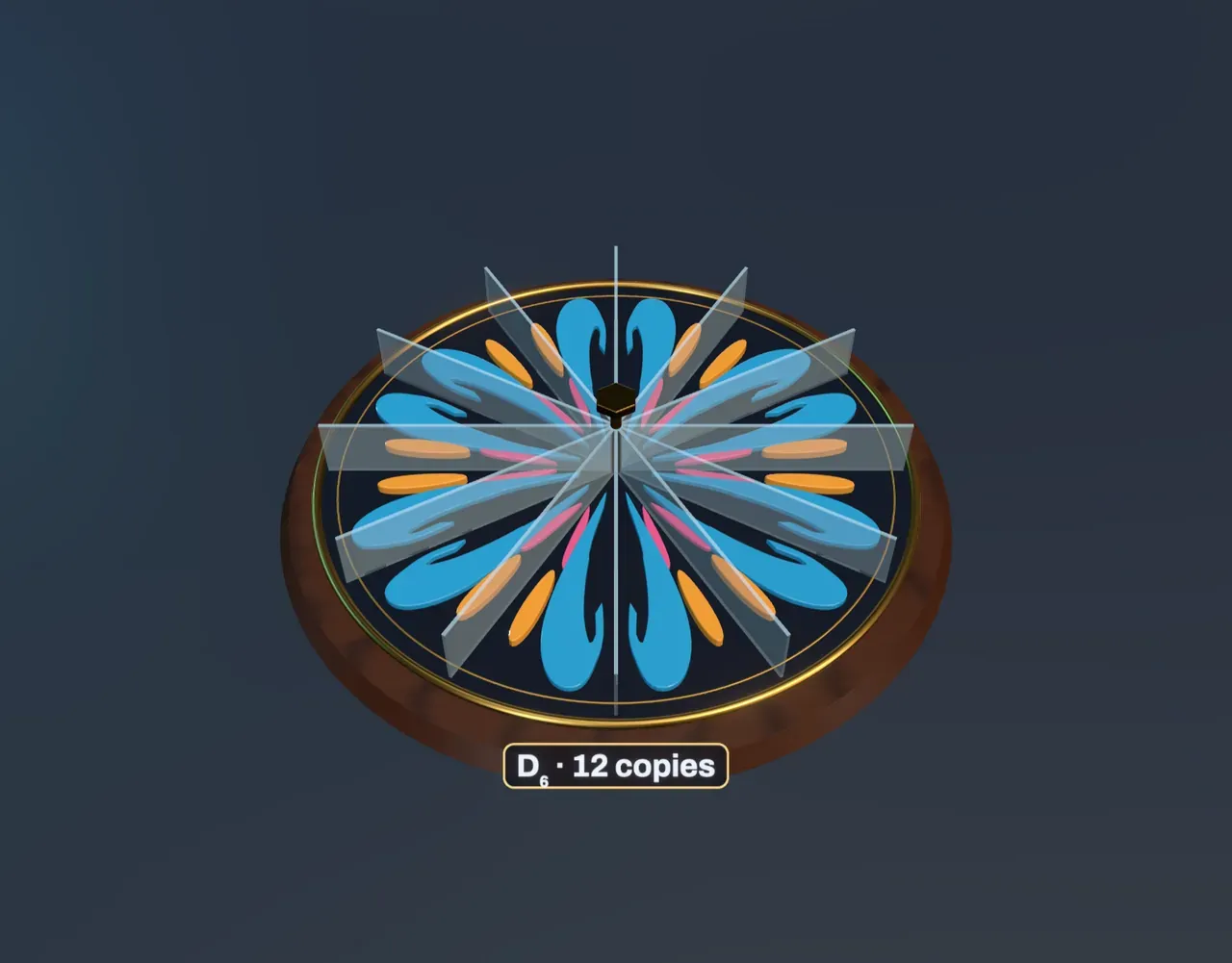
The plate in the Scene starts from one small motif, a curled frond with a bead and a leaf, that has no symmetry at all. Everything else on the plate is a copy of it, turned about the brass pin by 360° ÷ n, 2 × 360° ÷ n and so on. Every few seconds the plate turns by one step, and when it stops nothing has changed.
Mirrors
A butterfly has a different kind of symmetry: its left side is the reflection of its right. The line you could stand a mirror on is a mirror line. Switching Mirrors on stands a glass pane on each mirror line of the pattern, and gives every copy of the motif a reflected twin, curling the other way.
Try it: set Rotation order to 5 with the Starfish preset, then switch Mirrors between On and Off. With mirrors off the fronds all curl the same way, like a pinwheel; with mirrors on each one gains a twin and the pattern can be folded along every pane.
Naming the group
All the moves that leave a pattern unchanged, including doing nothing, make up its symmetry group. With turns only, there are n of them, and the group is called the cyclic group Cₙ. Add the mirrors and there are 2n: n turns and n reflections, the dihedral group Dₙ. A butterfly is D₁, a pinwheel C₄, a snowflake D₆. A pattern that only repeats around one point always has one of these two kinds of group.
Doing one move after another always gives another move in the group. Two reflections in mirrors that meet at an angle add up to a turn by twice that angle, which is why patterns with two mirror lines also have rotational symmetry.
Snowflakes and crystals
Press Snowflake under Find the symmetry. A real snowflake always has six arms, because water molecules in ice lock together in a hexagonal pattern, and the crystal grows fastest along its six directions. Each arm grows in almost the same air at the same moment, so the arms come out matching. The Scene grows its ice crystal with whatever order you choose, but only the six-fold one could fall from the sky.
Press Crystal and a mineral crystal rises from the plate: a prism with a pointed cap, whose cross-section has the same turns and mirrors as the pattern. The faces of a real crystal follow the arrangement of its atoms, which repeats in rows in every direction like a three-dimensional wallpaper.
Why a floor cannot be five-fold
Press Tiling and the motif is painted on a floor of tiles. With 1-, 2-, 3-, 4- or 6-fold patterns the tiles cover the floor and repeat forever. With 5, 7 or 8 they do not. Three regular pentagons at a corner add up to 324°, leaving a 36° gap; three heptagons or octagons add up to more than 360° and overlap.
This is not a failure of the tile shape but a law, the crystallographic restriction. Suppose a repeating floor had five-fold centres, and pick two of them as close together as any two can be. Turning each about the other by 72° produces two more five-fold centres that are closer together than the first pair, which is impossible. The same trick rules out every order above 6. Only 1, 2, 3, 4 and 6 survive, and the same rule applies to the atoms in a crystal.
There are still patterns with five-fold symmetry that never repeat. In the 1970s Roger Penrose found tilings of two shapes that cover the plane without ever repeating, and in 1982 Dan Shechtman found an alloy whose atoms are arranged the same way, a quasicrystal. He was awarded the 2011 Nobel Prize in Chemistry for it.
What this model leaves out
The plate shows symmetry around a single point. Repeating floors can also have glide reflections and several kinds of rotation centre, which together give exactly 17 kinds of wallpaper pattern; the floor here only shows that the chosen turn fits. The snowflake and crystal are idealised: real snowflakes are never perfectly identical in every arm, real crystals have their own shapes and angles, and the five-, seven- and eight-fold versions are drawn only for comparison. The 5-, 7- and 8-fold floors show one ring of tiles to make the gap or the overlap visible; they are not an attempt to tile the whole floor.