A symmetry is a move that leaves a shape as it was: turns and reflections, how many symmetries a pattern has, how two reflections make a turn, and why a floor can repeat only turns of order 1, 2, 3, 4 or 6.
Step 1 of 8 · Counting symmetries
Step 1 of 8
Counting symmetries
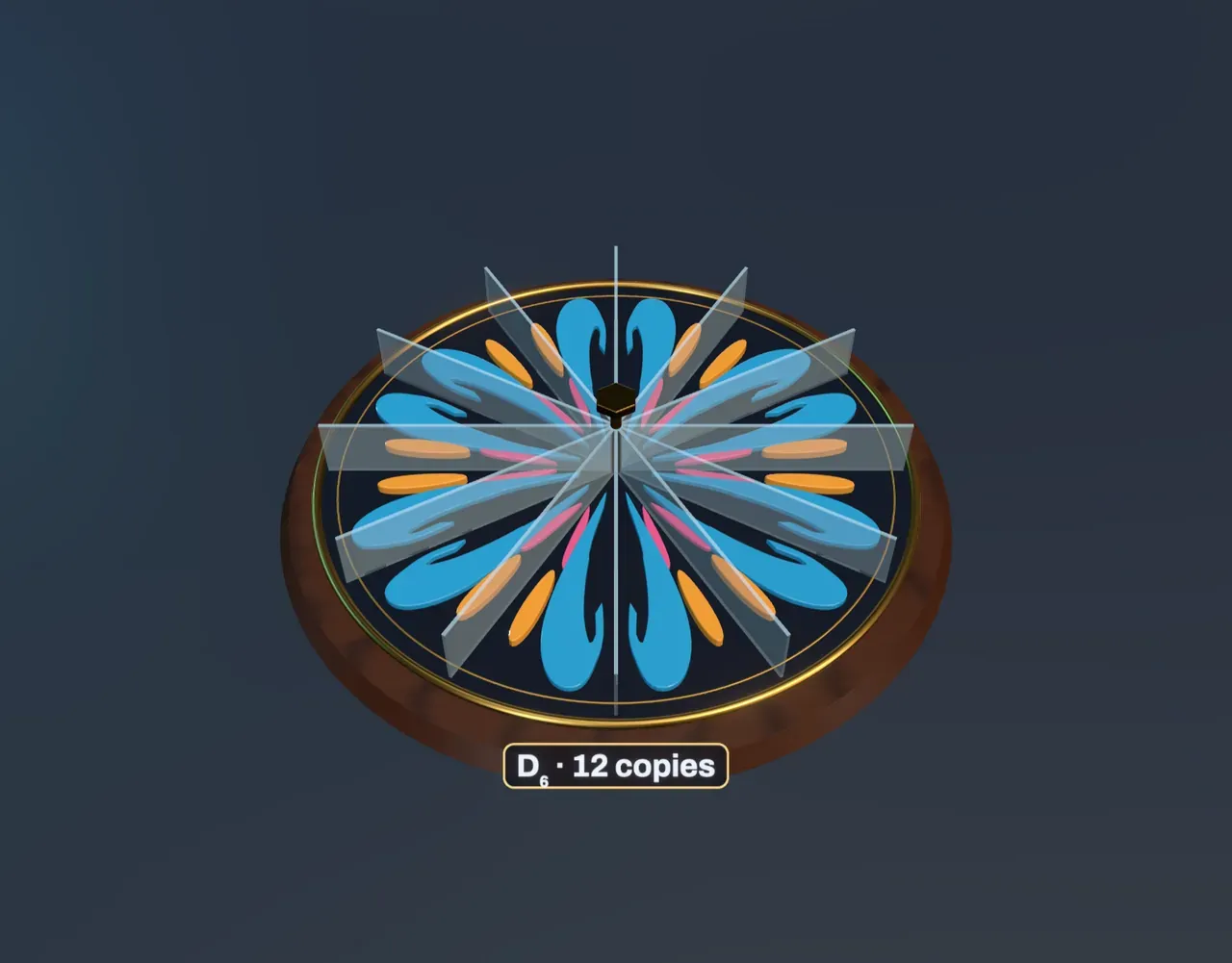
A symmetry of a shape is a map that keeps distances and leaves the shape exactly as it was. On the plate one motif, a curled frond, a bead and a small leaf, is copied by every turn and every mirror. A turn by leaves the pattern as it is, and so does every turn by a multiple of that angle, including the turn by zero, which does nothing. With Mirrors on, so does a reflection in each of the mirrors.
The collection of a shape’s symmetries is called its group: two symmetries one after the other make a symmetry again. Without mirrors it is , and with mirrors . Here the pattern is a snowflake, . Count its symmetries.
Step 2 of 8
Same size, different shapes
The size of a group is its number of symmetries. has , and has . Change Rotation order and Mirrors to find a pattern with exactly symmetries. There is more than one way.
Step 3 of 8
The angle between mirrors
A starfish has arms, and a mirror line runs along each arm. The smallest turn that brings it back is . Find the angle between two neighbouring mirrors.
Step 4 of 8
Two reflections
Each reflection turns the pattern into its mirror image; in the language of this Unit its determinant is . What happens when you reflect twice, in different mirrors? Think about what happens to a point lying on the first mirror.
Step 5 of 8
Tilings
Step through Find the symmetry: the same rules turn up in a snowflake, a crystal and a tiled floor. A floor repeats itself by sliding, and only certain turns fit a lattice of slides. If a tile’s turn does not fit, the tiles around it leave gaps or overlap, and the plate shows where. Predict which orders a floor can repeat.
Step 6 of 8
Eight times round
How far must you turn it for the pattern to come back to itself?
Step 7 of 8
A pinwheel
Some patterns can be turned but not reflected: they spin one way.
Step 8 of 8
The largest that tiles
You have seen which orders tile. It remains to check whether any order above does.
Loading the interactive version…
Loading the interactive version…
Each step sets up the Scene for you, and a control marked “fixed” stays put for that step.
Practice · Calculate
The pattern is a snowflake: turns and mirrors. How many moves leave it exactly as it was, doing nothing included?
Practice · Calculate
The pattern is a snowflake: turns and mirrors. How many moves leave it exactly as it was, doing nothing included?
Practice · Reach the target
Change Rotation order and Mirrors so that the pattern has exactly symmetries, then press Check.
Practice · Reach the target
Change Rotation order and Mirrors so that the pattern has exactly symmetries, then press Check.
Practice · Calculate
The starfish has turns and mirrors, . What is the angle between two neighbouring mirrors?
Practice · Calculate
The starfish has turns and mirrors, . What is the angle between two neighbouring mirrors?
Practice · Choose
Reflect the motif in one mirror of , then in the neighbouring mirror, away. Which single move does the same?
Practice · Choose
Reflect the motif in one mirror of , then in the neighbouring mirror, away. Which single move does the same?
Practice · Choose
Which of these rotation orders can a floor of identical tiles, covering it completely, repeat? Select all that can. Answer, then move Find the symmetry to Tiling and check each one.
Practice · Choose
Which of these rotation orders can a floor of identical tiles, covering it completely, repeat? Select all that can. Answer, then move Find the symmetry to Tiling and check each one.
Practice · Calculate
Rotation order is locked at : the pattern comes back to itself eight times in a full turn. What is the smallest turn that brings it back exactly as it was?
Practice · Calculate
Rotation order is locked at : the pattern comes back to itself eight times in a full turn. What is the smallest turn that brings it back exactly as it was?
Practice · Reach the target
Build a pinwheel: a pattern that comes back to itself after a quarter turn, but has no mirror line at all. Change the Rotation order and Mirrors, then press Check.
Practice · Reach the target
Build a pinwheel: a pattern that comes back to itself after a quarter turn, but has no mirror line at all. Change the Rotation order and Mirrors, then press Check.
Practice · Reach the target
At no floor can be tiled. Find the largest Rotation order that identical tiles covering a whole floor can repeat, and press Check.
Practice · Reach the target
At no floor can be tiled. Find the largest Rotation order that identical tiles covering a whole floor can repeat, and press Check.
Lesson complete. Every practice question here is done.