A guess that could be wrong
Everyone has hunches about how the world works. A heavy stone falls faster than a light one; a cold winter means a hot summer; this medicine helps. Science starts from hunches too. What it adds is a habit: before trusting an idea, turn it into a hypothesis, a statement definite enough to make a prediction, and then go and check whether the prediction comes true.
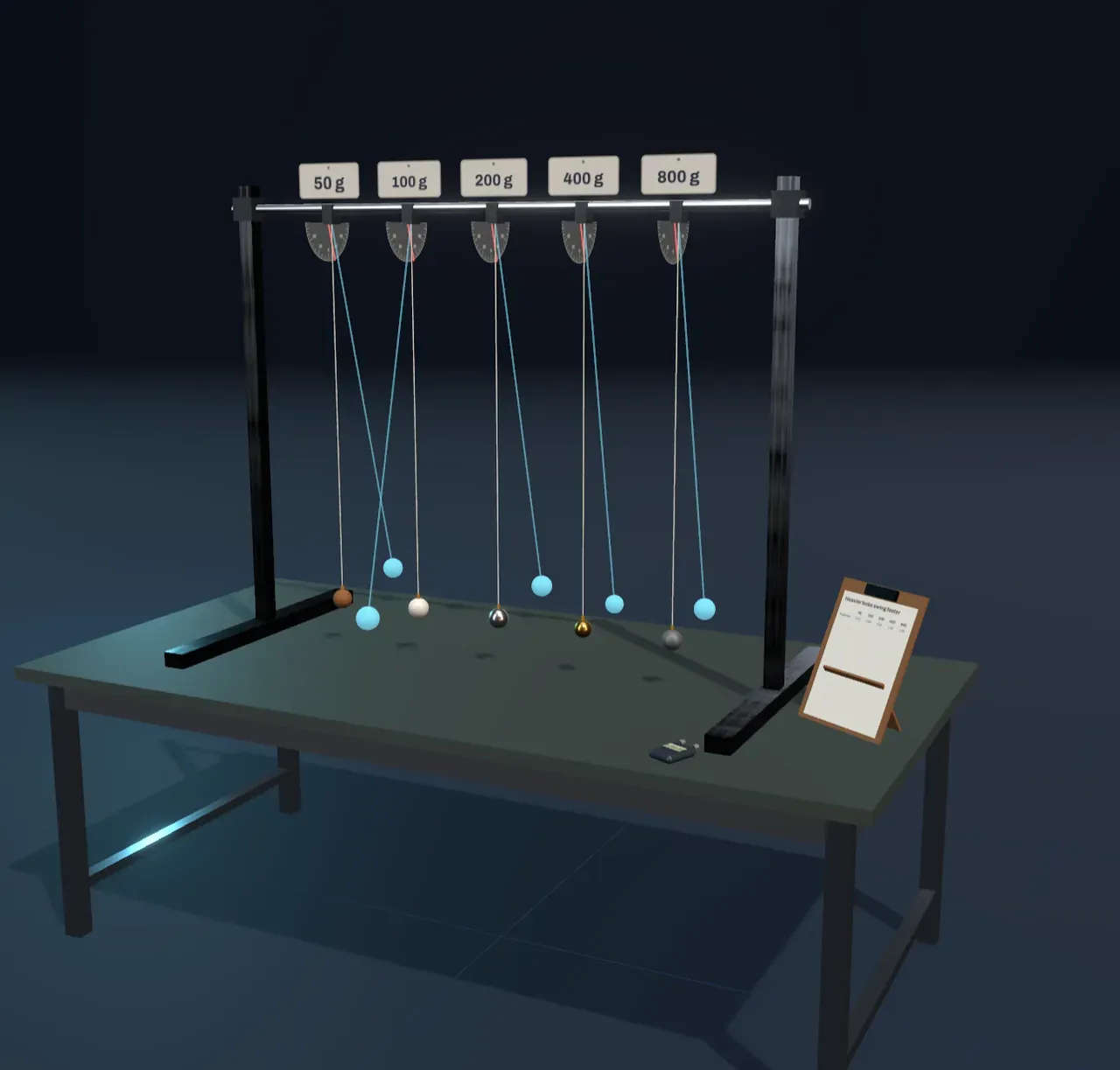
The bench in the scene puts one familiar object to the test: a weight on a string. Five pendulums hang from one bar, each a different version of the thing a hypothesis is about. The Hypothesis menu offers three ideas. Heavier swings faster says a heavy bob should beat time quickly and a light one slowly. T = 2π√(L/g) is the textbook formula: the time for one swing, the period, grows with the square root of the string’s length. Width does not matter says a pendulum keeps the same beat whether it swings wide or narrow. Why pendulums behave as they do is the subject of Pendulums; here the question is how anyone could find out.
The prediction comes first
A hypothesis earns its keep by saying, in advance, what the measurements will be. At Prediction, the real bobs hang still: nothing has been measured yet. What moves are the blue ghosts, one for each pendulum, swinging at the beat the hypothesis predicts. In the mass test the five balls are nearly the same size but made of different stuff, from beech wood to lead. For Heavier swings faster, written as “four times the mass, half the period”, the 800 g ghost swings every second and the 50 g ghost every four.
Writing the prediction down before the test matters more than it sounds. A prediction made after seeing the data can always be bent to fit it. One made before is a promise that the data can break, and an idea that cannot be broken by any possible result tells you nothing about the world.
The test: trials and error bars
Step to Test and every bob is pulled back to its release angle and let go together with its ghost. Now the swings are timed, by hand, with a stopwatch, the way a school lab would. Hand timing is not exact: your thumb starts and stops the watch a little early or a little late, so each timed swing is off by about a tenth of a second, sometimes more and sometimes less. Each timing is one trial.
One trial says little. Several, averaged, say more, because the random errors partly cancel. The scatter of a mean of n trials, its standard error, is the scatter of one trial divided by √n: four trials halve it, a hundred cut it tenfold. The chart beside the scene shows every trial as a small dot and each mean with an error bar two standard errors long either side. A true prediction falls inside such a bar about 95 times in 100. How a mean and its spread are found is worked through in Statistics and regression, and how uncertainty shrinks with more data is the subject of Models and uncertainty.
Try it: with T = 2π√(L/g) at Test, slide Trials per pendulum from 1 up to 20. The bars shrink from about ±0.24 s to ±0.05 s, and every mean stays on the blue curve.
One clear miss is enough
At Verdict, each pendulum’s tag lights up: mint where the mean agrees with the prediction within its bar, pink where it misses. Heavier swings faster fails badly. Every bob, from 50 g to 800 g, swings in about 2.01 s; the predictions run from 4.0 s down to 1.0 s. Four of the five means miss by many error bars. The hypothesis is falsified.
T = 2π√(L/g) fares differently. Every mean agrees, at every number of trials. But notice what the verdict says: the formula survives. It is not proven. Five agreeing pendulums cannot rule out a sixth that disagrees, at a length no one tried or a precision no one reached. The philosopher Karl Popper made this asymmetry the heart of his account of science in the 1930s: no number of agreements can prove a general claim, while one solid disagreement can refute it. Scientific ideas are kept because they have survived hard tests, and they stay open to the next one.
Small effects need sharper tests
Width does not matter is the subtle case, and a famous one: Galileo reported it around 1600, and for small swings it is very nearly right. Select it and look at Verdict with Trials per pendulum at 1: every mean agrees, and the hypothesis survives. Then raise Trials per pendulum. From 4 trials the 60° pendulum misses, and from 10 trials the 45° one does too. The wide swings really are slower, the 60° one by about 0.15 s, or 7%, and the 45° one by about 0.08 s, but one hand-timed swing cannot see a difference that size. The ghosts already hint at it: watch the 60° bob for a few swings and it drifts behind its ghost, because timing many swings in a row is itself a sharper test.
Try it: choose Width does not matter, step to Verdict, and slide Trials per pendulum from 1 up to 20. Watch the 60° tag turn pink first, then the 45° one, while the narrow swings stay mint.
So a hypothesis that survives a test has survived that test. A sharper one, with more trials, a better clock or a wider range of settings, may still catch it out. Physics later explained the effect: Galileo’s rule is the small-swing limit of the exact pendulum. Being falsified did not make it useless. It marked where it stops working.
When a result surprises
A miss is only as solid as the measurement behind it. Even a true hypothesis falls outside a two-standard-error bar about once in twenty measurements by chance, so with five pendulums roughly one test in five would show a chance miss somewhere. That is why a surprising result is repeated, ideally by other people with other equipment, before anyone throws out a well-tested idea. The bench’s timing errors are one fixed set of random draws, chosen so that the formula never suffers such a fluke; a real lab has no such luck.
The full cycle, then, runs: notice something, form a hypothesis, make it predict, test the prediction against measurements with honest error bars, and accept the verdict. A failed prediction sends you back to a new hypothesis. A passed one sends you to a harder test.
What this model leaves out
Real science is rarely this tidy. Hypotheses come with assumptions about the equipment, and a miss can mean the stopwatch is broken rather than the idea, so scientists must decide which part to blame. The bench times one swing per trial to show the effect of trials clearly; a careful experimenter would time ten swings at once and divide, which cuts the error from the thumb tenfold. The swings run without air drag or a stretching string, and the timing scatter is the same for every pendulum. The two-standard-error rule is a common convention, not a law: fields that test many ideas at once demand far stricter ones. Finally, a verdict here is yes or no, while working scientists weigh how strongly the evidence favours one idea over another.