From fertilised egg to blastocyst: cleavage divisions that do not grow the embryo, the inner cell mass, and totipotent, pluripotent and multipotent stem cells.
Step 1 of 5 · Dividing without growing
Step 1 of 5
Dividing without growing
Every cell in your body carries the same chromosomes, because they all came by mitosis from one fertilised egg. Yet a nerve cell, a muscle cell and a blood cell are very different. How does one cell turn into all these kinds? To answer, start at the start.
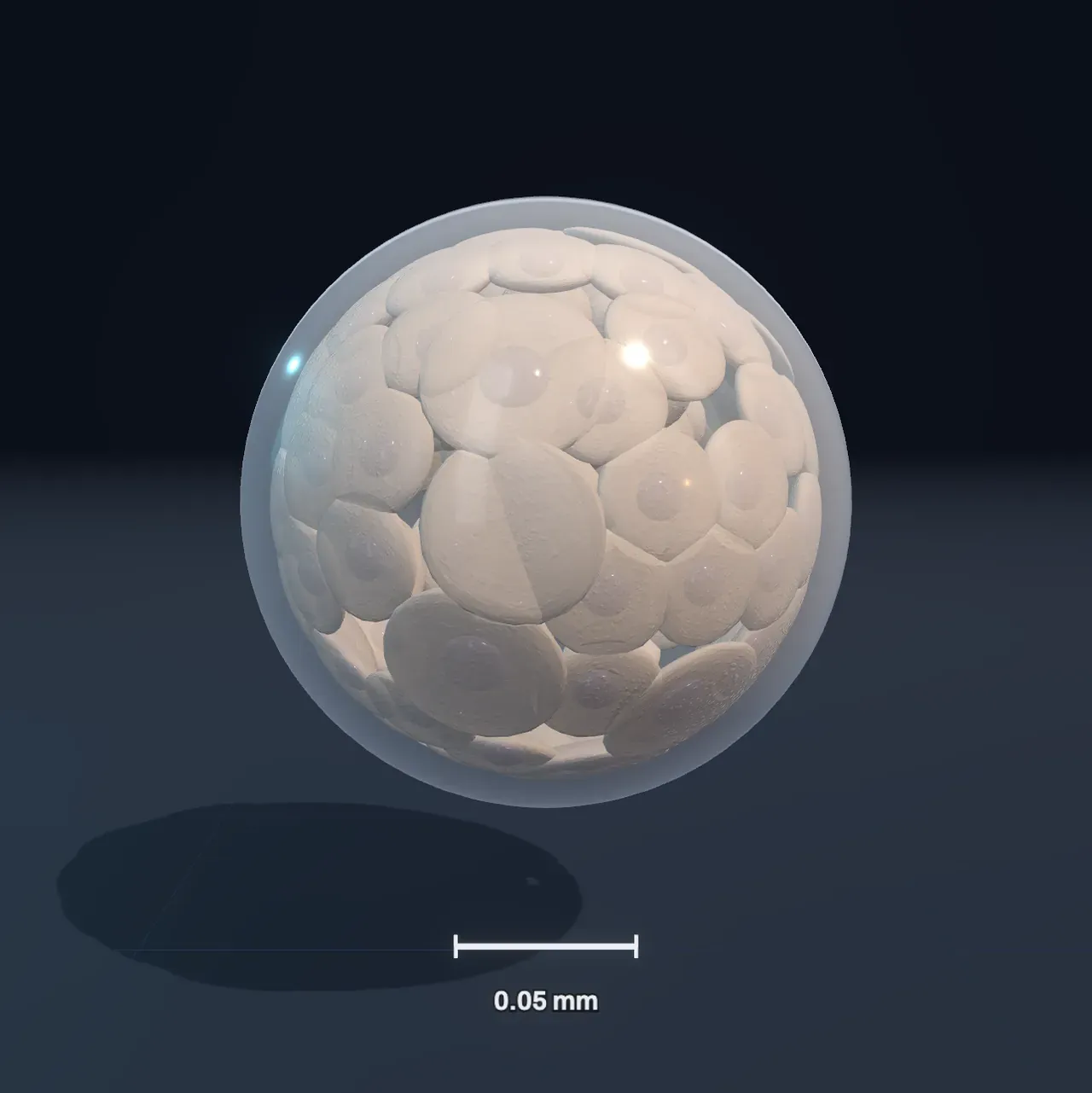
The Scene shows a fertilised egg, half a day after fertilisation, inside a clear shell. Over the next days it will divide again and again on its way down the oviduct to the womb. Time since fertilisation is fixed until you choose an answer.
Step 2 of 5
Counting cells
The first divisions are called cleavage: all the cells divide together, about once a day, without growing in between.
Step 3 of 5
A hollow ball
Around day four the cells pack into a tight ball, a morula. Then a fluid-filled cavity opens inside it, and the cells split into two groups: a thin outer layer, and a clump of cells at one side inside, the inner cell mass. This hollow ball is a blastocyst.
Step 4 of 5
What a cell can still become
A stem cell is a cell that can divide and stay a stem cell, and can also become a specialised kind of cell. Stem cells differ in what they can still become, and that range narrows as the embryo develops:
- Totipotent: anything, placenta included. The fertilised egg and the cells of the first days.
- Pluripotent: any kind of body cell, but not placenta.
- Multipotent: only a few related kinds.
Cut open will open the embryo and colour each cell by what it can still become.
Step 5 of 5
Stem cells in adults
Stem cells remain in an adult’s body too: in bone marrow, in the skin, in the gut lining and in muscle. They replace worn-out cells and repair damage, each in its own field.
In Shinya Yamanaka found that an adult skin cell can be turned back into a pluripotent one by switching on just four genes. He won a Nobel Prize for it in . These cells open a way to grow tissue from a patient’s own cells.
Move Time since fertilisation forwards and back, and follow the colours: from one white to two colours, to three layers, to organs.
Loading the interactive version…
Loading the interactive version…
Each step sets up the Scene for you, and a control marked “fixed” stays put for that step.
Practice · Predict, then look
A fertilised egg divides into cells over the first four days. What will happen to the size of the whole embryo?
Practice · Predict, then look
A fertilised egg divides into cells over the first four days. What will happen to the size of the whole embryo?
Practice · Calculate
Three days after fertilisation. How many cells does the embryo in the Scene have?
Practice · Calculate
Three days after fertilisation. How many cells does the embryo in the Scene have?
Practice · Reach the target
Move Time since fertilisation until the embryo becomes a blastocyst: a hollow ball of cells, with a clump of inner cells at one side inside it. Press Check.
Practice · Reach the target
Move Time since fertilisation until the embryo becomes a blastocyst: a hollow ball of cells, with a clump of inner cells at one side inside it. Press Check.
Practice · Predict, then look
The cells of the blastocyst’s inner cell mass can become any kind of cell in the body, but not placenta. What are stem cells like that called?
Practice · Predict, then look
The cells of the blastocyst’s inner cell mass can become any kind of cell in the body, but not placenta. What are stem cells like that called?
Practice · Choose
Adult bone marrow holds stem cells that make billions of new blood cells every day: red, white and platelets. But they do not make nerve or skin cells. What kind of stem cells are they?
Practice · Choose
Adult bone marrow holds stem cells that make billions of new blood cells every day: red, white and platelets. But they do not make nerve or skin cells. What kind of stem cells are they?
Lesson complete. Every practice question here is done.