Why cells divide, what a cell does before it divides, how to count chromosomes and chromatids, and why the two daughter cells match the mother cell.
Step 1 of 5 · Why cells divide
Step 1 of 5
Why cells divide
Each of you began as one cell, a fertilised egg. Today your body has about thirty trillion cells, and almost all of them came from that first cell, division after division. Even now, when your body has stopped growing, cells divide all the time: the gut lining renews itself within days, and a cut in the skin closes as the cells at its edges divide into it.
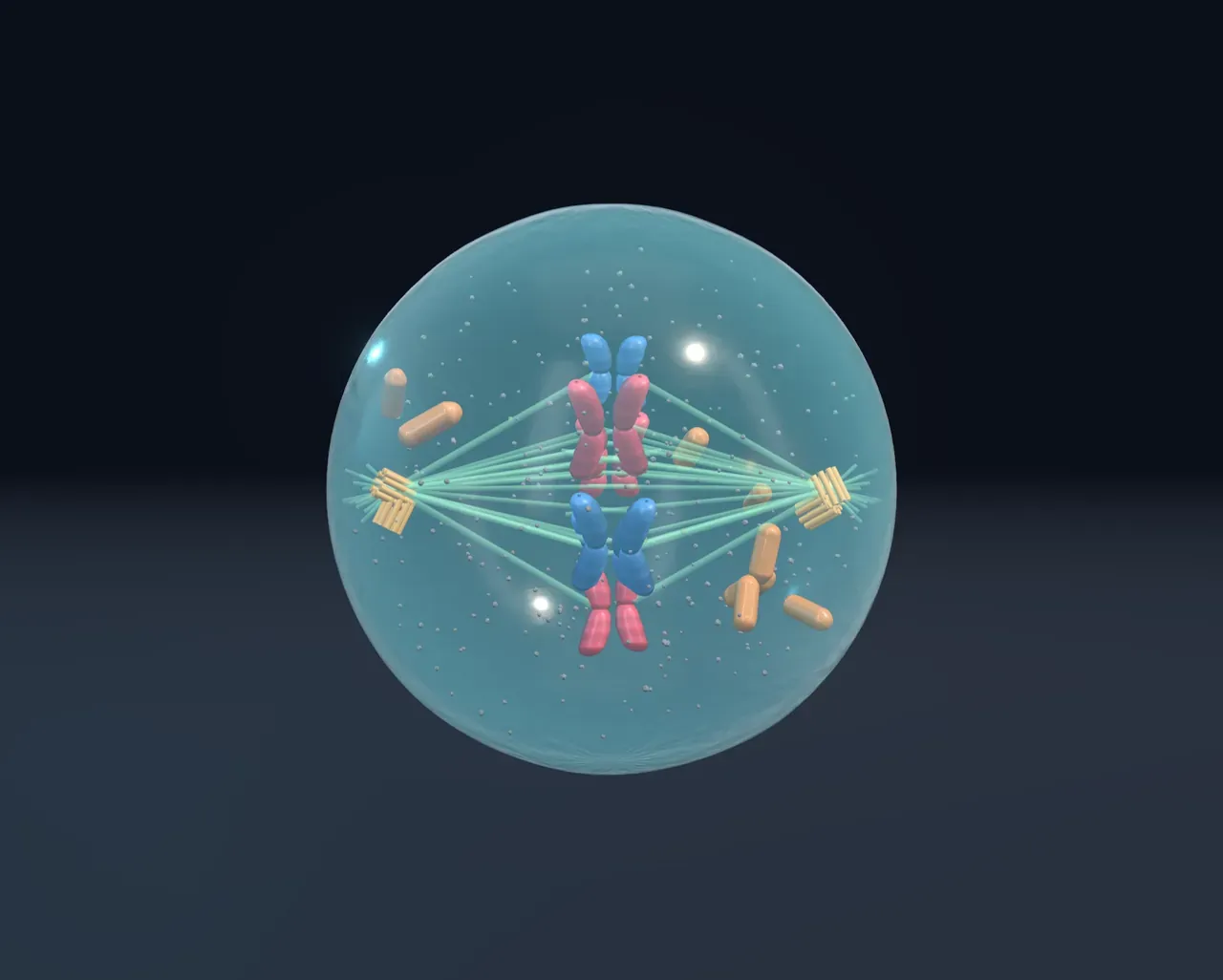
This division is called mitosis, and it makes two cells identical to the one it starts from. The Scene shows an animal cell, with a membrane, cytoplasm and a nucleus. Stage stands at the start.
Step 2 of 5
Counting chromosomes
The DNA in the nucleus is not in one piece. It is split into chromosomes, and each chromosome is one long DNA molecule, with the proteins wrapped round it. In most animals the chromosomes come in homologous pairs: one from the mother and one from the father, the same size and with the same genes. In the Scene the mother’s are pink, and the father’s blue.
The number of chromosomes in a body cell is called the diploid number, , where is the number of pairs. For a human, .
Step 3 of 5
Copied in advance
For most of its life a cell does not divide. This long stretch is called interphase, and in it the cell grows and does its work. Ahead of a division, in the part of interphase called the S phase, it copies all its DNA, as you saw in the last Unit.
After copying, each chromosome is made of two identical DNA molecules, sister chromatids, joined to each other at a centromere. In prophase, as they coil up, they look like an X.
Step 4 of 5
One becomes two
Move Stage forward and follow the cell. The chromosomes coil up, line up in the middle, split, and the whole cell pinches in two. After the division each daughter grows and enters an interphase of its own, and so on: the cell cycle.
Cells do not divide whenever they like. The cell checks that its DNA was copied without damage and that every chromosome is properly attached, and only then goes on. When those checks break down, cells divide without end: that is cancer.
Step 5 of 5
The daughters
Show the spindle is On now, and the division is over. Count the chromosomes in each of the two cells.
Loading the interactive version…
Loading the interactive version…
Each step sets up the Scene for you, and a control marked “fixed” stays put for that step.
Practice · Choose
Every day your body carries out billions of mitotic divisions. Which of these is mitosis not used for?
Practice · Choose
Every day your body carries out billions of mitotic divisions. Which of these is mitosis not used for?
Practice · Calculate
The cell in the Scene has pairs of chromosomes, like a fruit fly, and it is in prophase: the chromosomes have coiled into X shapes. How many chromosomes does the cell hold?
Practice · Calculate
The cell in the Scene has pairs of chromosomes, like a fruit fly, and it is in prophase: the chromosomes have coiled into X shapes. How many chromosomes does the cell hold?
Practice · Calculate
The cell copied its DNA in interphase, and now it is dividing. How many DNA molecules, that is chromatids, does it hold?
Practice · Calculate
The cell copied its DNA in interphase, and now it is dividing. How many DNA molecules, that is chromatids, does it hold?
Practice · Reach the target
Move Stage until the tightening ring closes the cell off completely, and the Scene holds two separate cells. Press Check.
Practice · Reach the target
Move Stage until the tightening ring closes the cell off completely, and the Scene holds two separate cells. Press Check.
Practice · Calculate
Now the cell has pairs, like a mosquito, and the division is over. How many chromosomes are in each of the two daughter cells?
Practice · Calculate
Now the cell has pairs, like a mosquito, and the division is over. How many chromosomes are in each of the two daughter cells?
Lesson complete. Every practice question here is done.