How the ear hears: tiny pushes of air, a wave that sorts pitch along the cochlea, a quiet sound heard only at some pitches, and high notes that go first with age and noise.
Step 1 of 6 · Tiny pushes
Step 1 of 6
Tiny pushes
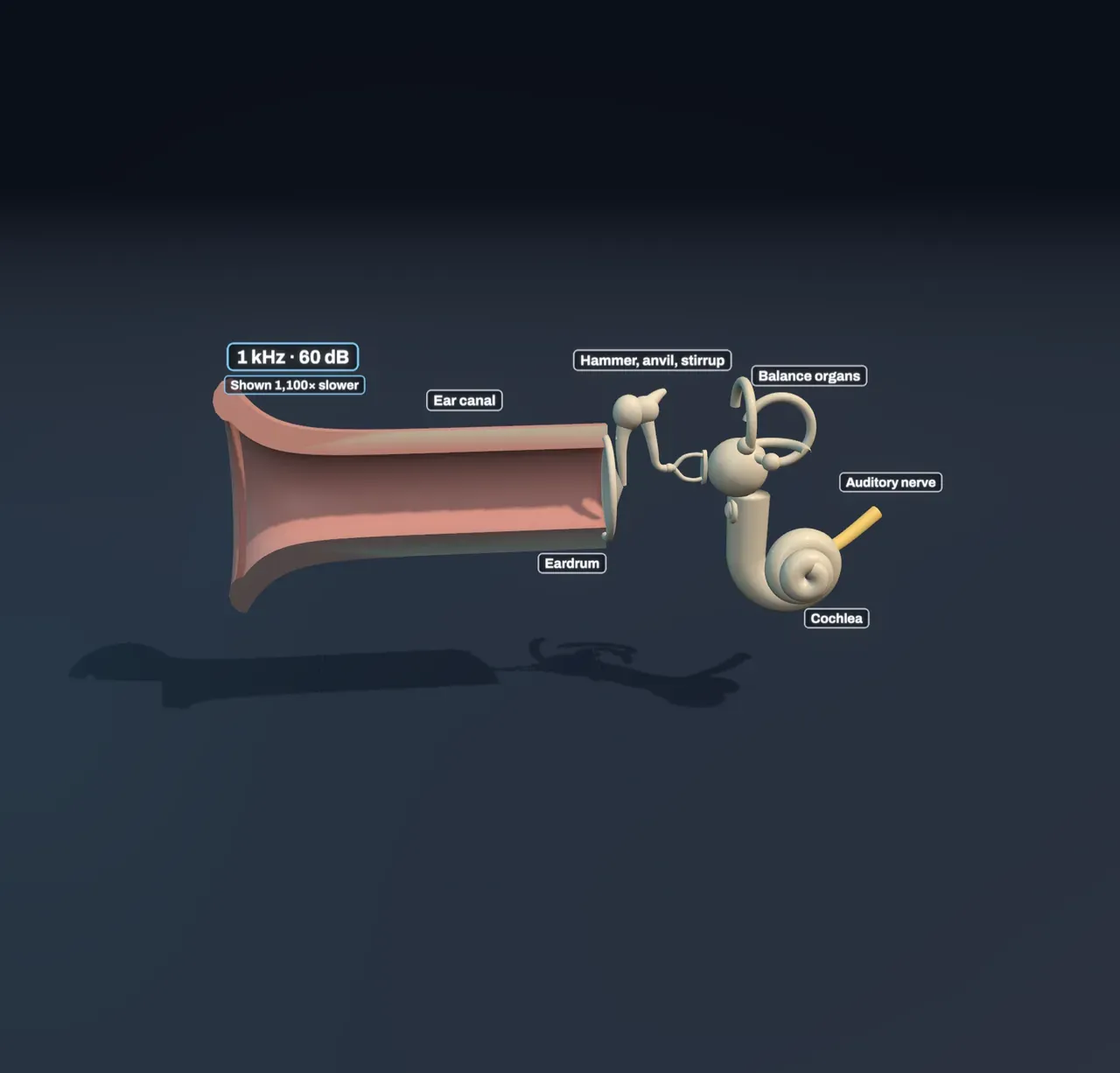
Sound is the air squeezing and stretching. It travels along the ear canal and pushes on the eardrum, and three tiny bones pass the movement on to the cochlea, a coiled tube full of fluid.
Loudness is measured in decibels, a scale of ratios: dB is the quietest sound a young ear hears, when the air’s pressure swings by only 20 µPa. Every 10 dB is times the sound energy, and every 20 dB is times the pressure:
Step 2 of 6
A wave that sorts
Uncoil the cochlea is at Cochlea uncoiled: the cochlea is straightened into a tube, with a scale of pitch along it. Along its length runs the basilar membrane: narrow and stiff at the base, by the oval window, and wide and floppy towards the tip, about 35 mm away. Every tone sends a wave from the base towards the tip, and the wave peaks at one place. The tone is 1 kHz for now.
Step 3 of 6
One place, one pitch
About inner hair cells sit along the membrane. Each sits at one place, so each nerve fibre that listens to it stands for one pitch. The brain knows which pitch it hears from which fibres are active. Pitch (powers of ten) uses powers of ten because the membrane is built roughly that way too: equal ratios of pitch take up roughly equal lengths.
Step 4 of 6
Quiet and loud
The quietest sound you can hear, the threshold of hearing, depends on its pitch. The ear is most sensitive between about 2 kHz and 5 kHz, partly because the ear canal resonates near 3 kHz. The tone now is Low hum 50 Hz at Conversation.
Step 5 of 6
High notes go first
Every tone, whatever its pitch, passes the base of the cochlea on its way. There, over a lifetime, the hair cells wear out more than anywhere else. A Mosquito tone 17 kHz is playing now, and Listener’s age is 20 years.
Step 6 of 6
Noise
Rock concert, 105 dB. Above about 85 dB, hours of noise a day kill hair cells.
Loading the interactive version…
Loading the interactive version…
Each step sets up the Scene for you, and a control marked “fixed” stays put for that step.
Practice · Calculate
Ordinary conversation is 60 dB. By how much does the air pressure at the eardrum swing? ( dB is 20 µPa, and every 20 dB is times the pressure.)
Practice · Calculate
Ordinary conversation is 60 dB. By how much does the air pressure at the eardrum swing? ( dB is 20 µPa, and every 20 dB is times the pressure.)
Practice · Predict, then look
A 1 kHz tone peaks about 21 mm from the base. Predict where a Low hum 50 Hz peaks.
Practice · Predict, then look
A 1 kHz tone peaks about 21 mm from the base. Predict where a Low hum 50 Hz peaks.
Practice · Reach the target
Change Pitch (powers of ten) until the wave peaks 10 mm from the base, and press Check.
Practice · Reach the target
Change Pitch (powers of ten) until the wave peaks 10 mm from the base, and press Check.
Practice · Predict, then look
A whisper, 30 dB, is easily heard at speech pitches. Predict whether a 20-year-old hears a Low hum 50 Hz when Loudness drops to Whisper.
Practice · Predict, then look
A whisper, 30 dB, is easily heard at speech pitches. Predict whether a 20-year-old hears a Low hum 50 Hz when Loudness drops to Whisper.
Practice · Predict, then look
A 20-year-old just hears a Mosquito tone 17 kHz at 60 dB. Predict what happens when Listener’s age goes up to 45 years.
Practice · Predict, then look
A 20-year-old just hears a Mosquito tone 17 kHz at 60 dB. Predict what happens when Listener’s age goes up to 45 years.
Practice · Choose
After a whole evening at a rock concert, 105 dB, your ears ring. What happens to the hair cells the noise killed?
Practice · Choose
After a whole evening at a rock concert, 105 dB, your ears ring. What happens to the hair cells the noise killed?
Lesson complete. Every practice question here is done.