An ecosystem inside the large intestine: microbes that ferment fibre we cannot digest and give back fatty acids, a fence of mucus that wears thin when they go hungry, antibiotics that make room for opportunists, and the kinds of symbiosis, from mutualism to parasitism.
Step 1 of 6 · Food you cannot digest
Step 1 of 6
Food you cannot digest
Tens of trillions of microbes live in the large intestine, the microbiome, and they are an ecosystem in their own right. What reaches them is mostly dietary fibre: the walls of plant cells from beans, grains, vegetables and fruit. These are long chains of sugars, like starch, but joined by bonds our enzymes cannot cut. Fibre in the diet is at Recommended, 30 g a day.
Step 2 of 6
What you get back
Fibre breakers cut the chains into sugars and ferment them. Fermentation is getting energy from sugar without oxygen, and its waste is short-chain fatty acids: acetate, propionate and butyrate. Butyrate makers live on what the breakers leave. In the model, about 70% of the fibre is fermented, plus about 6 g a day of mucus and starch that escaped digestion; each fermented gram gives about millimoles of fatty acids.
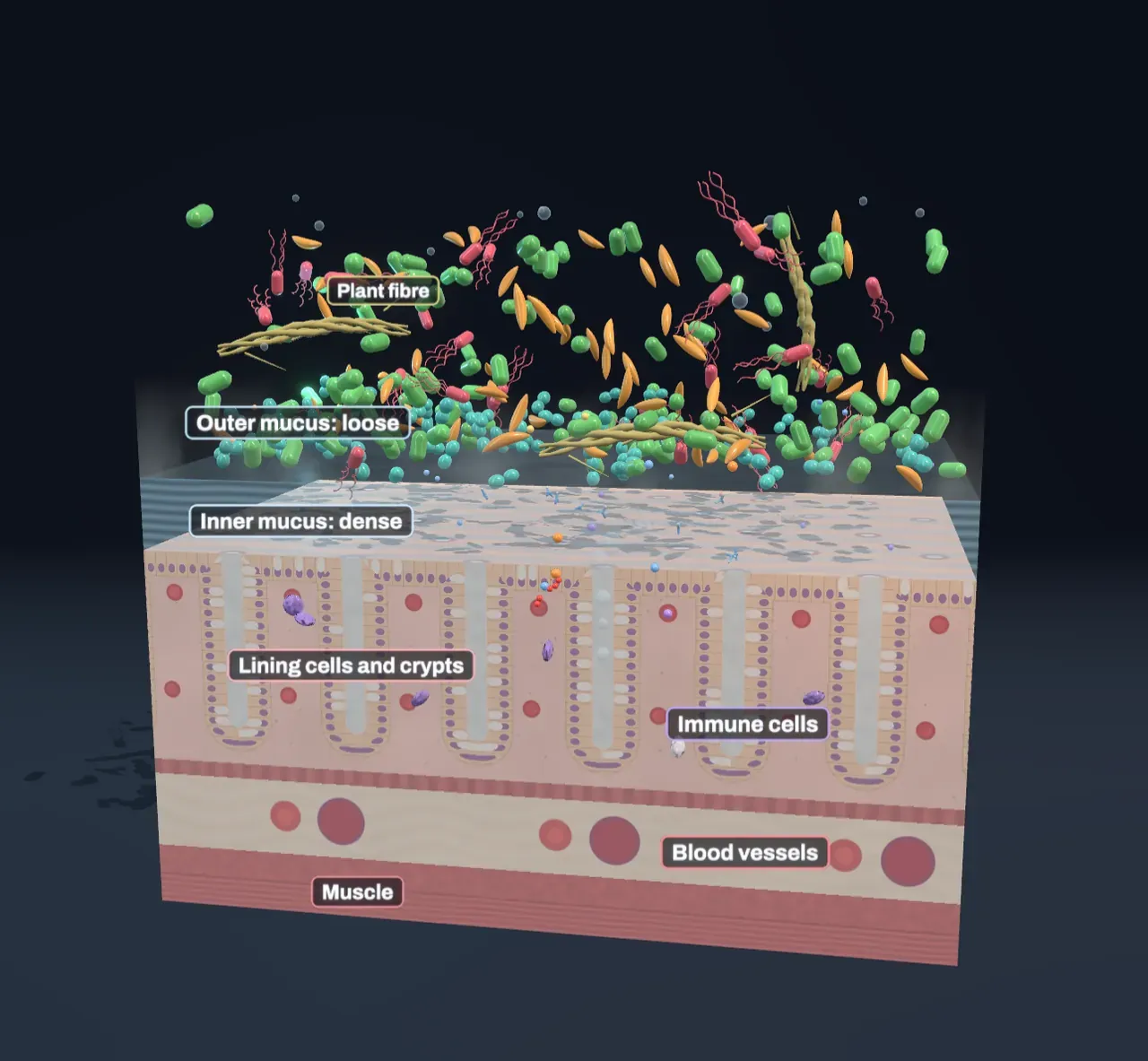
Zoom to the give and take is at Give and take: golden sugars leave the fibre strand, orange butyrate sinks into the lining cells and is burnt there with oxygen from the blood, and acetate and propionate go on into a capillary.
Step 3 of 6
A fence of mucus
Goblet cells in the lining pour out mucus all the time. The inner layer is dense and almost no microbe gets into it; in the outer layer many microbes live, and some, the mucus grazers, feed on the sugars mucus is made of. Fibre in the diet is at Typical Western.
Step 4 of 6
Burning butyrate
Butyrate is the favourite fuel of the large intestine’s lining cells. When little of it arrives, they switch to burning sugar without oxygen, and the oxygen they leave unused leaks into the gut: red pairs rising instead of being burnt. Fibre in the diet is at Very little.
Step 5 of 6
After antibiotics
Antibiotics are aimed at the bacteria causing an infection, but most kill a wide range of bacteria, and they reach the large intestine too. The chart shows each group’s share of the community.
Step 6 of 6
Kinds of symbiosis
When two kinds of living thing live together closely, they are in symbiosis, “living together”. Biologists sort the partnerships by who gains: in mutualism both partners gain; in commensalism one gains and the other is hardly affected; in parasitism one gains at the cost of the other, the host. After antibiotics, a bacterium such as Clostridioides difficile can take over the gut and cause severe diarrhoea.
Loading the interactive version…
Loading the interactive version…
Each step sets up the Scene for you, and a control marked “fixed” stays put for that step.
Practice · Choose
Why can the microbes in the large intestine break down dietary fibre, when we cannot?
Practice · Choose
Why can the microbes in the large intestine break down dietary fibre, when we cannot?
Practice · Calculate
At Recommended, 30 g of fibre a day. 70% of the fibre is fermented, plus 6 g of mucus and starch, and each fermented gram gives about millimoles of short-chain fatty acids. How many millimoles of them are made a day?
Practice · Calculate
At Recommended, 30 g of fibre a day. 70% of the fibre is fermented, plus 6 g of mucus and starch, and each fermented gram gives about millimoles of short-chain fatty acids. How many millimoles of them are made a day?
Practice · Predict, then look
Predict what happens to the inner mucus layer when Fibre in the diet drops from Typical Western to Very little.
Practice · Predict, then look
Predict what happens to the inner mucus layer when Fibre in the diet drops from Typical Western to Very little.
Practice · Reach the target
At Very little the lining cells get too little butyrate, and oxygen leaks into the gut. Find the smallest Fibre in the diet at which oxygen no longer leaks, and press Check.
Practice · Reach the target
At Very little the lining cells get too little butyrate, and oxygen leaks into the gut. Find the smallest Fibre in the diet at which oxygen no longer leaks, and press Check.
Practice · Predict, then look
Predict which group’s share of the community grows most when Just after antibiotics is switched on.
Practice · Predict, then look
Predict which group’s share of the community grows most when Just after antibiotics is switched on.
Practice · Choose
After antibiotics, C. difficile takes over the gut and causes severe diarrhoea. Is that symbiosis too?
Practice · Choose
After antibiotics, C. difficile takes over the gut and causes severe diarrhoea. Is that symbiosis too?
Lesson complete. Every practice question here is done.