A crowd inside you
Your large intestine, the colon, is the most crowded place on Earth that you carry around. Each gram of what is inside it holds around a hundred billion microbes, and the whole colon holds around forty trillion, about as many as there are cells in the rest of your body. Together they weigh about 200 grams. Most are bacteria, from a few hundred species in any one person, with some archaea, yeasts and a far greater number of viruses that infect the bacteria. This community, and the genes it carries, is your gut microbiome.
They are not visitors. A baby’s gut is colonised during and after birth, the community settles into an adult shape over the first few years, and from then on it stays recognisably yours for decades. Almost all its members are anaerobes: they live without oxygen, and many die in air. The colon suits them. It is warm, dark, airless and supplied with food several times a day, food that its owner could not use.
The digestion Article follows a meal down the small intestine, where you absorb almost everything your own enzymes can break down. This one starts where that leaves off, with what is left over.
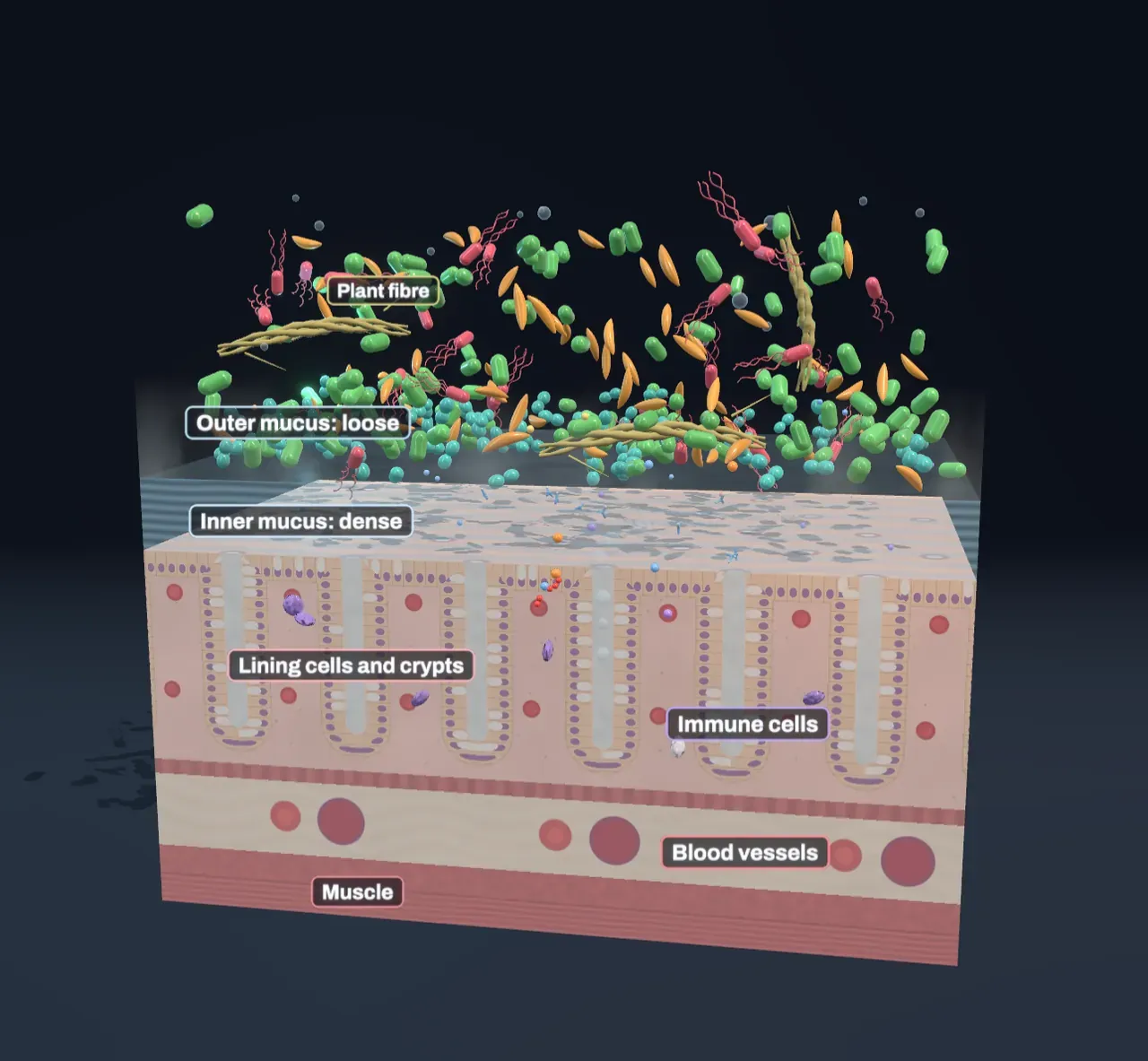
Try it: leave Fibre in the diet on Typical Western. The pink block is the colon’s wall; the gut’s contents, and the microbes, are above it. Note the blue band of mucus between the two.
Food you cannot digest
What reaches the colon is mostly dietary fibre: the walls of plant cells and other carbohydrates in beans, grains, vegetables and fruit. They are long chains of sugars, like starch, but joined by bonds that human enzymes cannot cut. Our own genes make fewer than twenty enzymes for digesting carbohydrates, enough for starch, table sugar and milk sugar. A single gut bacterium such as Bacteroides thetaiotaomicron carries genes for a couple of hundred, each fitting a different bond in a different plant sugar.
So the microbes do what we cannot. Fibre breakers cut the chains into sugars and ferment them. Fermentation is how a cell gets energy from sugar without oxygen, and its waste products are small molecules called short-chain fatty acids: mostly acetate (two carbon atoms), propionate (three) and butyrate (four), in a ratio of roughly three to one to one. Other microbes live on the breakers’ leftovers. Butyrate makers such as Faecalibacterium and Roseburia take up sugars the breakers let loose, and acetate that they release, and turn them into butyrate. The community is a food web, with each kind living off what the others drop. Fermentation also makes gases, hydrogen and carbon dioxide, and in some people archaea turn part of them into methane.
Try it: drag Fibre in the diet from Very little to Plant-rich. Watch the tan strands of fibre pile up, the green fibre breakers and amber butyrate makers multiply, and the gas bubbles grow more numerous. The chart shows the community’s make-up shifting as you go.
What you get back
About 95% of the fatty acids the microbes make are absorbed through the colon’s wall, and they are anything but waste to you.
- Butyrate is the favourite fuel of the cells lining the colon. They burn it, with oxygen from the blood, for most of the energy they use, which keeps the lining renewed and its barrier tight.
- Propionate goes in the blood to the liver, which turns some of it into glucose.
- Acetate, the most plentiful, travels on round the body as a fuel for muscles and other tissues.
Fermented fibre gives you about two kilocalories a gram, half what digested starch does. For someone eating the recommended 30 grams of fibre a day that is less than a twentieth of their energy, but it is energy you would otherwise flush away. The acids make the first part of the colon mildly acidic, which many harmful bacteria dislike. Gut bacteria also make vitamin K and some B vitamins, although how much of them you absorb is unclear.
They protect you in a quieter way too. A colon full of settled residents leaves an arriving germ little food and little room, an effect called colonisation resistance. And the immune system learns from them: butyrate and other signals from the community encourage regulatory T cells, which calm the immune system’s response, so that the trillions of friendly microbes next door do not set off constant inflammation.
Try it: choose Give and take under Zoom to the give and take. Gold sugars leave the fibre strand for the microbes beside it; orange butyrate drops through the mucus into the lining cells, which glow warm as they burn it, while blue acetate and violet propionate pass on into a capillary. Red pairs of oxygen rise from the blood and are used up in the cells.
A fence of mucus
Living next to forty trillion microbes is only safe if they stay at a distance. The colon’s lining makes sure they do. Among its tall absorbing cells are goblet cells, packed with mucus, which they pour out constantly. In the colon the mucus forms two layers. The inner one is dense and stuck firmly to the lining, and almost no bacteria get into it; it holds antibodies, IgA, that the wall secretes. The goblet cells keep adding to it from below, so it is renewed within an hour or two, as measured in mice, and as it moves outwards it loosens into the outer layer. That outer layer is where many microbes live, and some of them, the mucus grazers, feed on the sugar chains that make up mucus.
When there is plenty of fibre, that grazing is light. When there is little, more of the community turns to the only carbohydrate it has left: the mucus. Experiments in mice have shown what follows. On a fibre-free diet the mucus-eating species grow, the inner layer thins and lets microbes closer to the cells, and a gut pathogen takes hold more easily. Microbes near the wall put the immune system on alert. In mice kept on low-fibre food over several generations, some species were lost for good, and did not come back when fibre returned.
Try it: press Very little, then set Fibre in the diet to 0. The blue inner layer thins, teal grazers move down into it and opportunists move in, and the purple immune cells in the wall multiply. Now press Plant-rich: the mucus thickens and the microbes stand back.
When the community is knocked down
An antibiotic is aimed at the bacteria causing an infection, but most are broad in the bacteria they kill, and they reach the colon as well. A course of them can cut the community there to a fraction of its size and wipe out whole groups, the strict anaerobes that make butyrate among the worst hit. With little butyrate arriving, the lining cells switch to burning sugar without oxygen. The oxygen they no longer use leaks out into the gut, and the bacteria that thrive on it, opportunists like E. coli and its relatives Salmonella and Klebsiella, can bloom. With the residents gone, a germ such as Clostridioides difficile can take over and cause severe diarrhoea; when it keeps coming back, the most effective treatment is to transplant a healthy person’s gut community.
Most people’s microbiome largely recovers within weeks to months, but some species can take much longer or not return. This is one reason doctors avoid antibiotics that are not needed, along with antibiotic resistance, which the gut’s crowded community helps to spread from one kind of bacterium to another.
Try it: turn on Just after antibiotics, first with Zoom to the give and take on Gut wall and then on Give and take. Far fewer microbes, unfermented fibre piling up, pale lining cells, and the red oxygen leaking up into the gut instead of being burnt.
Give and take: kinds of symbiosis
Two kinds of living thing that live closely together are said to be in symbiosis, from the Greek for “living together”. It is a broad word. Biologists sort the relationships by who gains and who loses:
- In mutualism both partners gain. You give the butyrate makers food and a home; they give you fuel for your colon and a calmer immune system.
- In commensalism one partner gains and the other is hardly affected. Many gut microbes may be commensals, living on scraps without doing much for or against you, although that is hard to prove.
- In parasitism one partner gains at the other’s cost, as a tapeworm does, or C. difficile after antibiotics.
The boundaries move. E. coli is a harmless resident of most guts, yet some strains cause food poisoning, and an ordinary strain that gets into the bladder causes an infection. A mucus grazer that lives harmlessly on the outer layer in a well-fed gut can wear the barrier thin in a starving one. Whether a microbe is a partner or a pest depends on where it is and on what else is going on, which is why the Fibre in the diet slider moves the same community from one end of the scale towards the other.
Symbiosis is everywhere in biology. Cows and termites rely on gut microbes to digest grass and wood; the fungi of a mycorrhiza trade minerals for a tree’s sugars; and the mitochondria in your own cells are descended from bacteria that moved into another cell well over a billion years ago and never left. The gut community is an ecosystem too, with competition for food, food webs and recoveries after a disturbance, like those in Ecosystems and population dynamics.
What this model leaves out
The Scene shows the colon after some weeks on a steady diet. Real communities are far more varied: hundreds of species instead of four groups, sorted here by what they eat, though many species do more than one job. Every number in the model is a typical, illustrative value. The shares of the four groups follow a simple curve with the fibre eaten; fermentation makes about 9 millimoles of fatty acids from each gram of carbohydrate fermented, from 70% of the fibre plus a few grams of starch and mucus; butyrate is about a fifth of them. The thickness of the mucus, how close the microbes get and how alarmed the immune system is follow the fibre in the same simple way. People differ widely in all of these, and the kinds of fibre matter as much as the amount, which the model leaves out.
The antibiotic course is a generic broad-spectrum one, and the Scene shows the gut just after it, not the weeks of recovery. Fungi, archaea and viruses are not drawn, and neither is the small amount of protein that also reaches the colon, whose fermentation makes less welcome products. The wall is drawn with crypts about 50 micrometres wide, the microbes about five times larger than at that scale, and only a few hundred of them where a real patch of this size would hold millions.