How much energy reaches each level, when every link multiplies by the same share again. Why a small change in efficiency changes the top a great deal, why food chains are short, and which pyramid always stands upright.
Step 1 of 6 · Four links up
Step 1 of 6
Four links up
Each level gets a share of the energy of the level below it, not of the algae. So at level , after links,
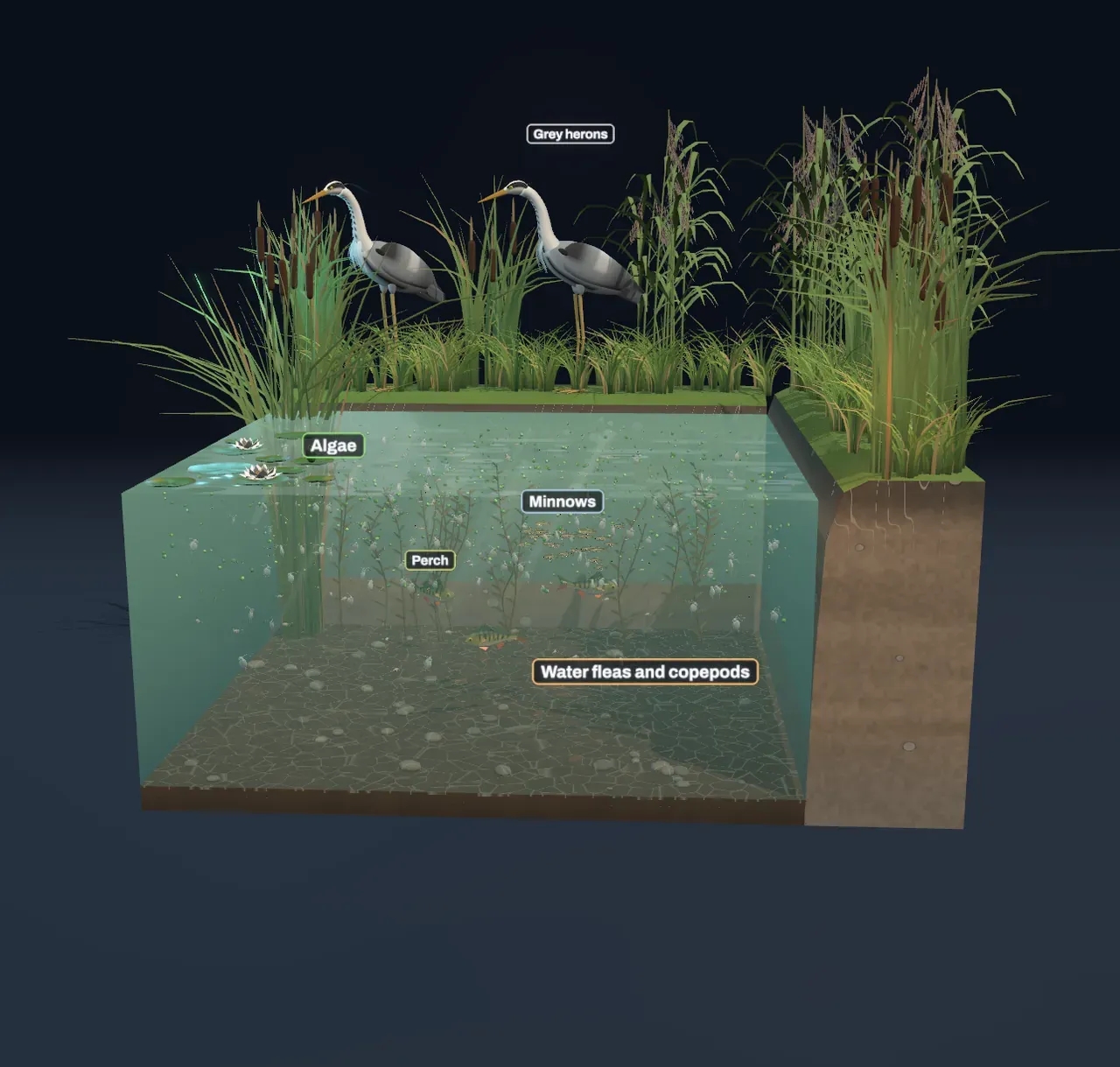
It is exponential decay, as in the Unit on exponents and logarithms: at each link you multiply by the same number again. Work out how much reaches the herons, then press Energy pyramid under Build the energy pyramid to check on the chart.
Step 2 of 6
One heron
A heron needs a whole dot a year, so the lake feeds as many herons as the whole dots that reach the top. Here Sunlight is fixed, and Energy passed on is free. The chart says how many herons the lake feeds.
Step 4 of 6
A sixth level
Why are there almost no chains of six links? There is no reason there could not be a predator that eats herons. The question is whether it would have enough energy to live.
Step 5 of 6
How long a chain
Even at a high efficiency the chain comes to an end. Here each link passes on 25%, a quarter. To find how many levels the energy is enough for, ask how many times you can divide by before falling below one dot, and that is a question for a logarithm.
Step 6 of 6
Three pyramids
In the Scene the pyramid is built of energy: each tier stands on the part of the tier below that was passed up. You can build pyramids out of other things too, and not all of them look like this.
Loading the interactive version…
Loading the interactive version…
Each step sets up the Scene for you, and a control marked “fixed” stays put for that step.
Practice · Calculate
The algae capture dots a year, and each link passes on 10%. From the algae to the herons there are four links: algae to zooplankton, to small fish, to perch, to herons. How many dots reach the herons?
Practice · Calculate
The algae capture dots a year, and each link passes on 10%. From the algae to the herons there are four links: algae to zooplankton, to small fish, to perch, to herons. How many dots reach the herons?
Practice · Reach the target
Sunlight is fixed at 125 W/m². Change Energy passed on until the lake feeds exactly one heron, then press Check.
Practice · Reach the target
Sunlight is fixed at 125 W/m². Change Energy passed on until the lake feeds exactly one heron, then press Check.
Practice · Calculate
Suppose the lake had a predator that ate only herons, a sixth level. At 10% a link, how many dots of energy would reach it in a year?
Practice · Calculate
Suppose the lake had a predator that ate only herons, a sixth level. At 10% a link, how many dots of energy would reach it in a year?
Practice · Calculate
At 25% a link the algae still capture dots. If the chain went on, with an animal needing one dot a year at the top of each level, how many levels in all, counting the algae, could get at least one dot?
Practice · Calculate
At 25% a link the algae still capture dots. If the chain went on, with an animal needing one dot a year at the top of each level, how many levels in all, counting the algae, could get at least one dot?
Practice · Choose
You can build a pyramid of trophic levels three ways: by the energy flowing through each level in a year, by the number of individuals, or by the weight of what is alive at one moment (biomass). Which one always stands with each tier smaller than the one below?
Practice · Choose
You can build a pyramid of trophic levels three ways: by the energy flowing through each level in a year, by the number of individuals, or by the weight of what is alive at one moment (biomass). Which one always stands with each tier smaller than the one below?
Lesson complete. Every practice question here is done.